
Dates: 28 December , 2015 to 31 Dececember, 2015
A short trip to Barcelona between Christmas and the New Year, which included a day trip to Tarragona and the opportunity to visit not only Roman but also medieval and modern sites; a homage to Gaudí by way of Park Güell and the Sagrada Familia; a return to MNAC; and of course time for tapas and sherry!
Early rising
Monday, 28 December, 2015 – London, UK
To the airport
We have an early start, with a 04:30 pick up by Canon Cars to take us to London Gatwick for our flight to Barcelona. The journey to Gatwick took just under 40 minutes and apart from a short queue on the airport turnoff the traffic flowed freely.
Once at the airport we dropped our bags using the automated bag drop which was really easy, even for me, and then we sailed – or perhaps that should be flew given that we’re at the airport – through security. We just had time to sit down for a quick coffee from Costa and eat some fruit from Boots (travelling on a budget) before heading to the gate for boarding.
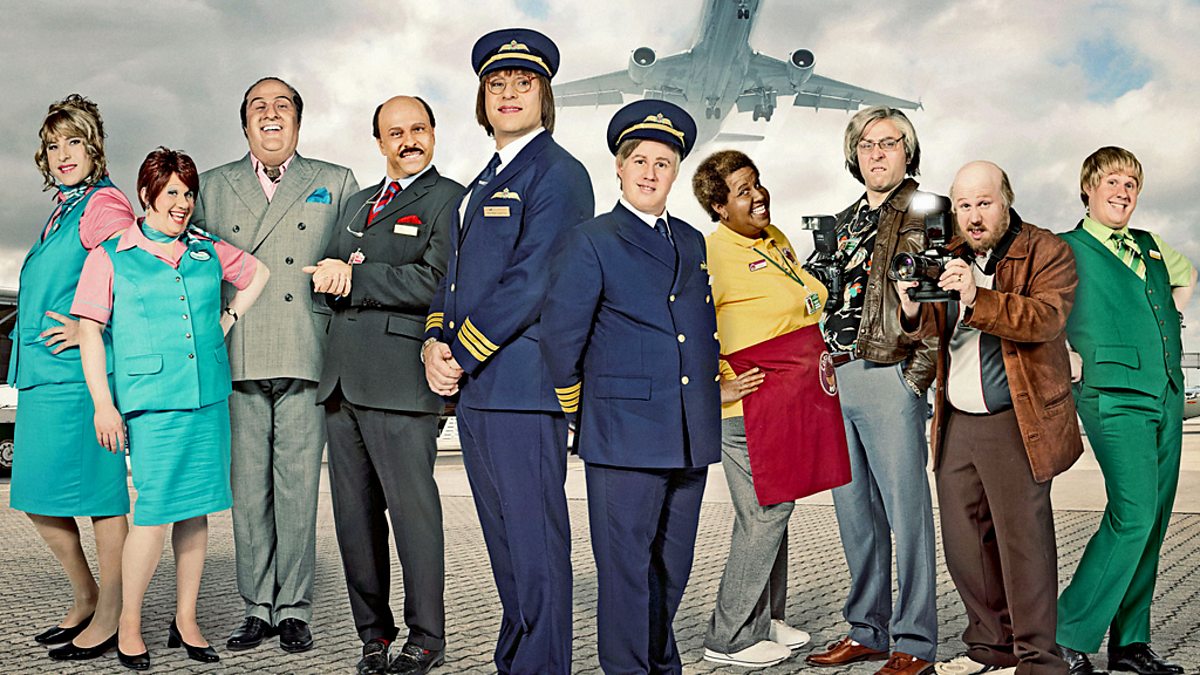
Even without speedy boarding we were seated on the aircraft in next to no time. Unfortunately the plane had to remain on the stand whilst the bags of passengers who had not boarded in time were offloaded. Consequently we lost our slot and were delayed by about 20 minutes.
¡Hola Barcelona!
Monday, 28 December, 2015 – Barcelona, Spain
¡Hola Barcelona!
Despite the delayed take-off we made good time to Barcelona and because our bags were offloaded quicker than expected we were on board the Aerobús by 10:15 and 35 minutes later arrived at Plaça Catalunya. The Barcelona Aerobús provides a cheap and easy airport transfer. Tickets can be purchased in advance online, the coach stop is directly outside the arrivals hall, the coaches are frequent and consequently not overcrowded. And to top it all they even offer free wi-fi. So there is just enough time to settle down, send a message home, enjoy a brief view of the city before disembarking at Plaça Catalunya.
Izara Boutique
Our hotel is located on Ronda San Pere, opposite El Cort Inglés, less than a five minute walk from Plaça Catalunya. The Izara is a discrete boutique hotel, so discrete that we walked past it the first time. The hotel occupies the entire second floor with beauty clinics on the floor below and the Portuguese consulate above. We received a warm welcome from Bruno, who gave us a brief orientation, pointing out local sites and suggesting some restaurants we might like to try and others we may wish to avoid. We were checked in, oriented, unpacked and back out on the street within 15 minutes.
Lunch time aperitif
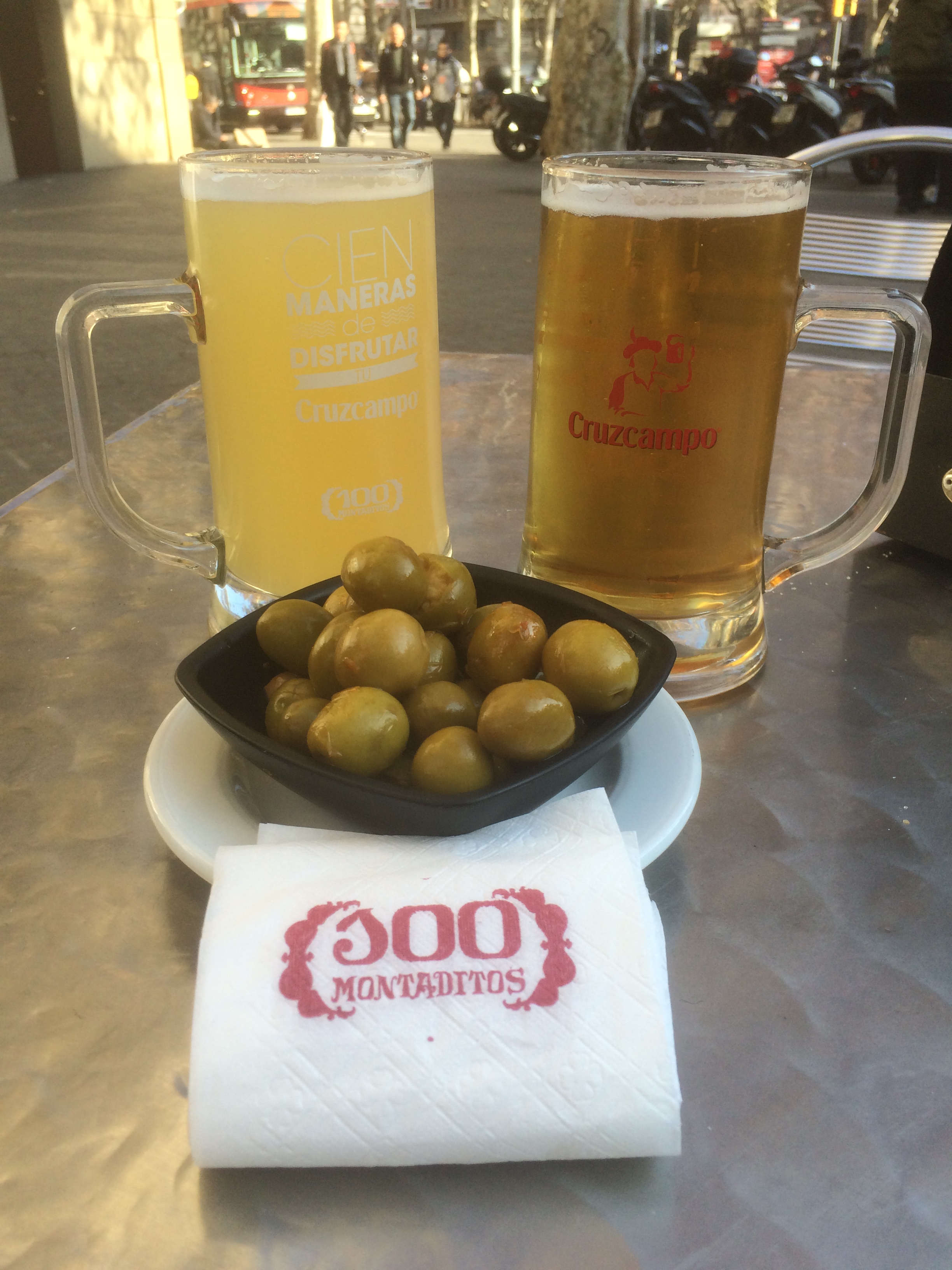
Given that we’d made such good time transferring from the airport and checking into the hotel we decided to have a quick lunchtime aperitif at 100 Montaditos just along Ronda Sant Pere by Plaça d’Urquinaona.
This chain of bars – there are over 350 in Spain – takes its name from the Mondtadito, a small tapa-sized roll of bread. True to its name there are 100 montaditos, including a handful of montaditos dulces, on the menu plus aperitivos and ensaladas.The etymology of the word montadito comes from the verb montar, which means ‘to mount’ in Spanish. The montaditos are baked on site and prepared to order. When the bar is busy there is a constant aroma of freshly baked bread and the kitchen staff perform a carefully choreographed routine from order through to service!
But in the early afternoon the bar is not busy, there is no aroma of freshly baked bread and no choreography in the kitchen. Unfortunately they didn’t have any sherry either so I had to make do with a beer. It felt good being back in Barcelona, sitting outside in the sun, relaxing with a drink and a bowl of stuffed olives. ¡Salud!
Croissants at La Colmena
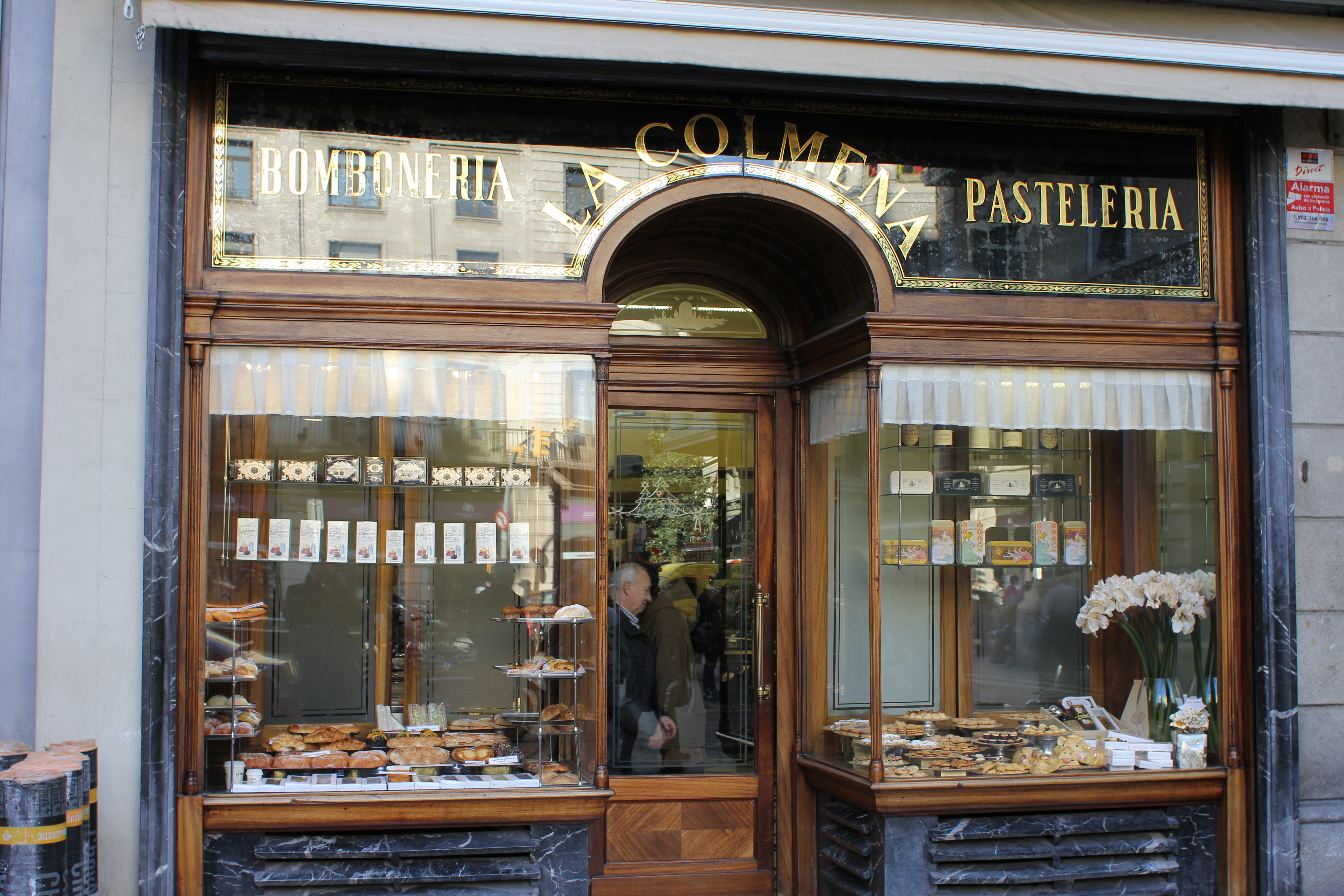
Whilst it is not as old as the nearby Cathedral, La Colmena or Dolceria de la Colmena is one of the oldest cake shops in Barcelona. Although the exact date it was founded is unknown it has been serving pastries and cakes for over a century.
We shared a roll and a croissant sitting outside in the sunshine. We watched people passing by, one lady in a short skirt and boots was walking up and down quite a lot. Having broken bread and a croissant we headed for spiritual refreshment in the Catedral de Barcelona. Although not empty Plaça de la Seu is quiet with most of the tourists wandering around the stalls selling antique jewellery, books, prints, illustrations and cameras.
One cathedral – many names
Unsurprisingly Barcelona’s Gothic cathedral Catedral de la Santa Creu i Santa Eulalia, Cathedral of the Holy Cross and Saint Eulalia, also known as La Seu, is located in the heart of the Gothic Quarter, Barri Gòtic. We climb the steps to the cathedral and join the short queue to enter.
Construction
The present cathedral is built on the site of an early Christian basilica which dates back to 343 AD. This church was destroyed in 985 AD during the invasion of the Moors led by Al-Mansur. In 1046 a Romanesque cathedral was built by Bishop Guislabert. A Roman chapel, the Capella de Santa Llucia, was added between 1257 and 1268 which was later incorporated in the cloister of the cathedral. In 1298, during the reign of King Jaume II ‘the Just’, work began on the present structure. With the exception of the Santa Llúcia chapel all the Romanesque buildings were demolished. However, construction progressed slowly due to civil wars and plagues and the main building was not completed until 1460. The Gothic facade was finished much later, in 1889, and it was not until 1913 that the central spire was completed. The cathedral is over 90m in length and 40m wide, its octagonal clock towers reach a height of more than 50m and the spire of the central tower reaches a height of 70m.
Exterior
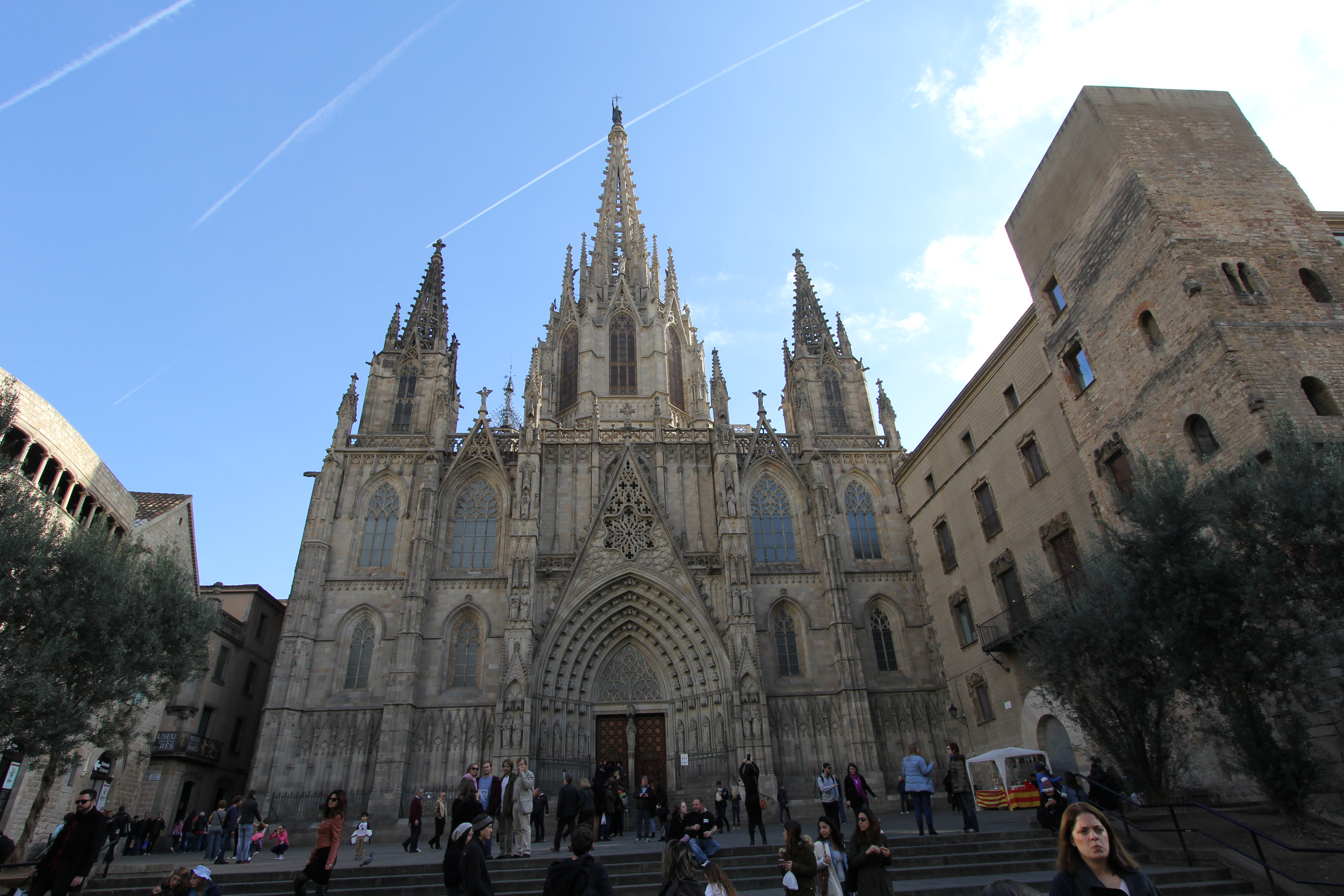
The neo-Gothic facade of the Cathedral was created by the architect José Oriol Mestres between 1887 and 1890 under the patronage of the banker Manuel Girona. Situated in the centre of the façade the main door is made up of a large Gothic arch with archivolts. There is a sculpture of Christ over the mullion and images of the twelve apostles are arranged along the sides of the door together with numerous figures representing kings, prophets, angels and saints. Of the eight stained-glass windows on the façade, some are modernist and others, like the famous Noli me tangere by Bartolomé Bermejo, are from the Renaissance. Two side towers with tall pinnacles were added between 1896 and 1898; the cimborio, which crowned by the image of Saint Helena, was constructed between 1906 and 1913.
Interior
The interior is airy, like most of the larger Spanish churches and cathedrals we have visited In Madrid, Segovia and Toledo and in common with other cathedrals has chapels around the perimeter. The interior consists of a single wide nave, illuminated by large, fifteenth-century stained-glass windows; with some 28 side chapels.
Crypt of Saint Eulalia
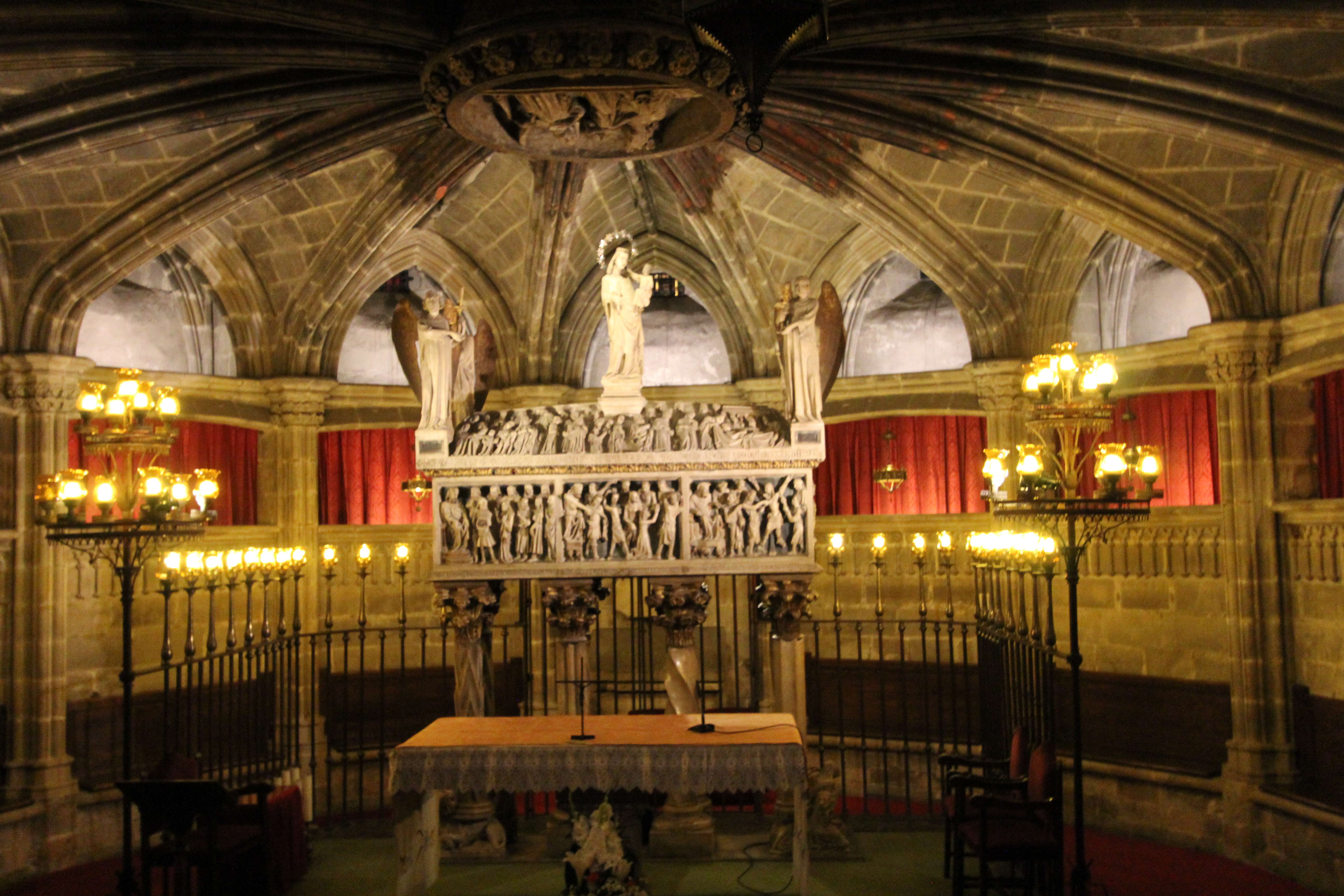
The crypt, which is below the high altar, contains the sarcophagus of Santa Eulalia, the13-year-old who was martyred by the Romans in Barcelona during the reign of Emperor Diocletian.
When we visited last year there was a service in the crypt and we were unable to see the magnificent Gothic tomb and alabaster sarcophagus containing the remains of Saint Eulalia. The gates to the crypt were locked but at least we were able to go down the stairs and peer through the heavy iron gates at the tomb.
For refusing to renounce her Christianity, the Romans subjected her to thirteen tortures which included: putting her into a barrel with knives stuck into it and then rolling her down a street, cutting off her breasts, crucifixion on an X-shaped cross and finally decapitation
From Innocent Saints to the roof top
From the Crypt we join the queue in front of the Chapel of Innocent Saints to access the small elevator which ascends to the rooftop walkway. From here we have a close up view of the cathedral’s two bell towers, the two lateral pinnacles, and cimborio plus a panoramic view of Barcelona and the Gothic quarter. To an untrained eye a close up view of current repair and restoration work looked somewhat slapdash rather than carefully finished. Since last year it appears that little progress has been made! After descending back to earth we took a turn around the cloister to see the holy geese.
Cloister
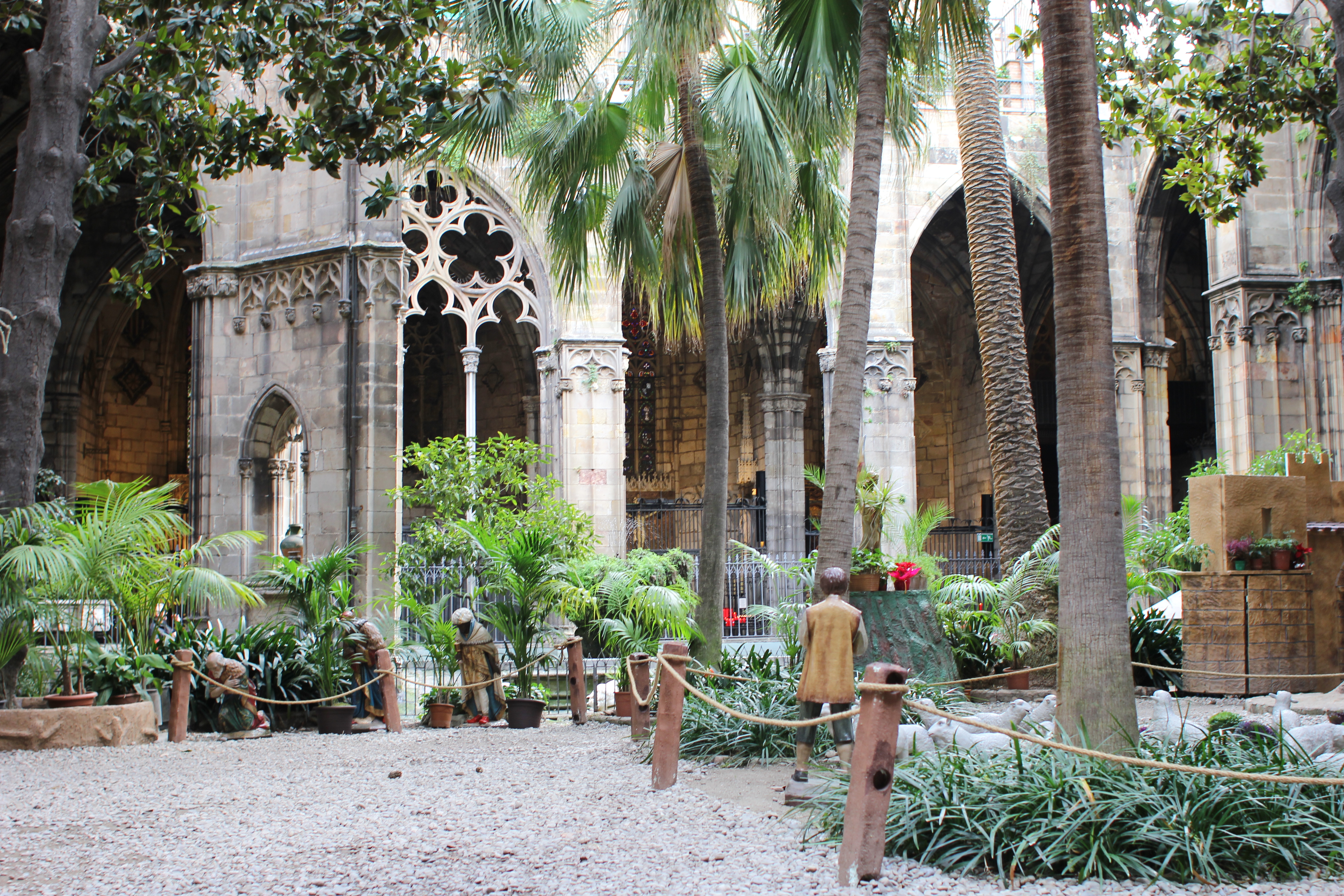
The cloister is still a welcoming lush green oasis with palm trees, magnolias, an orange tree and a fountain dating from the mid-15th century, where the traditional ou com balla (the dancing egg) takes place each year for the celebration of Corpus Christi.
Rectangular in shape it is made up of four galleries with ogive arches separated by pillars. The reliefs sculpted into the pillars of the Cloister’s arches show scenes from the Old Testament and from a legend about the Holy Cross, and the keystones of the vault depict scenes from the New Testament. The chapels arranged along its three galleries were each initially dedicated to the patron saint of an institution or guild, or were placed under the protection of a specific family.
The simple nativity scene is displayed once again in the garden and the gaggle of 13 white geese wander around the pond. Each goose represents one year in the life of the martyr Santa Eulalia, the young virgin tortured to death in 303 AD by the Romans for her Christianity.
Choir
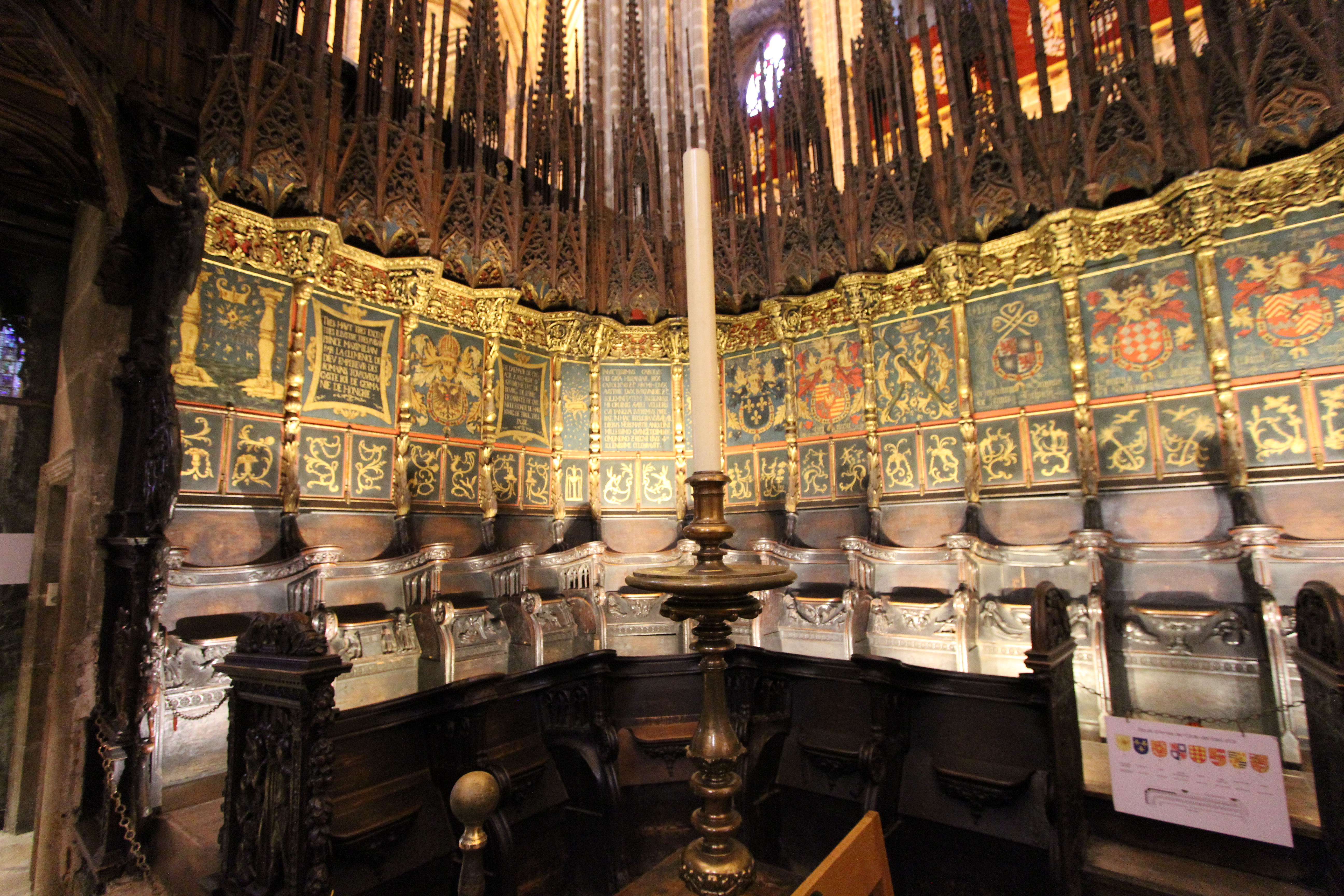
We complete our visit to the cathedral with another look at the beautiful choir at the centre of the nave with magnificently carved choir stalls which have rich patina developed through hundreds of years of use. The enclosure around the choir is decorated with reliefs that narrate the life of Santa Eulalia.
Las Ramblas
From the cathedral we walk across Plaça de la Seu towards Las Ramblas, where there is a very visible police presence. Because of its popularity with locals and tourists alike the street has also become a magnet for carteristas or pickpockets – the bane of every crowded metropolitan city centre. We walk down the tree line street looking at the flower kiosks with elegant and tasteful displays.
What appears to be a continuous street or avenue is actually made up of five ‘ramblas’ (Rambla de Canaletes, Rambla dels Estudis, Rambla de Sant Josep, Rambla dels Caputxins, Rambla de Santa Mònica) or six if you include Rambla de Mar which leads to the Maremàgnum. We take a diversion at Rambla de Sant Josep to explore the Boqueria.
Mercat de la Boqueria
The market is heaving and we are carried along on the human tide. As we shuffle along the aisles between the counters on either side, some stacked high with fresh fruit and vegetables, others with candied fruits, sweets and nuts. Even at this late hour in the day the fish counters are piled high with a wide range of fish and a mouth-watering selection of crustaceans. Then there are the stalls selling poultry, game and eggs; meat; charcuterie; offal. There are stalls specializing in salted fish; or olives and preserves, with oils and vinegars. And finally the offal stalls selling: liver, heart, feet, sweetbread, brains, kidneys, tail, sheep heads y muchas más cosas!
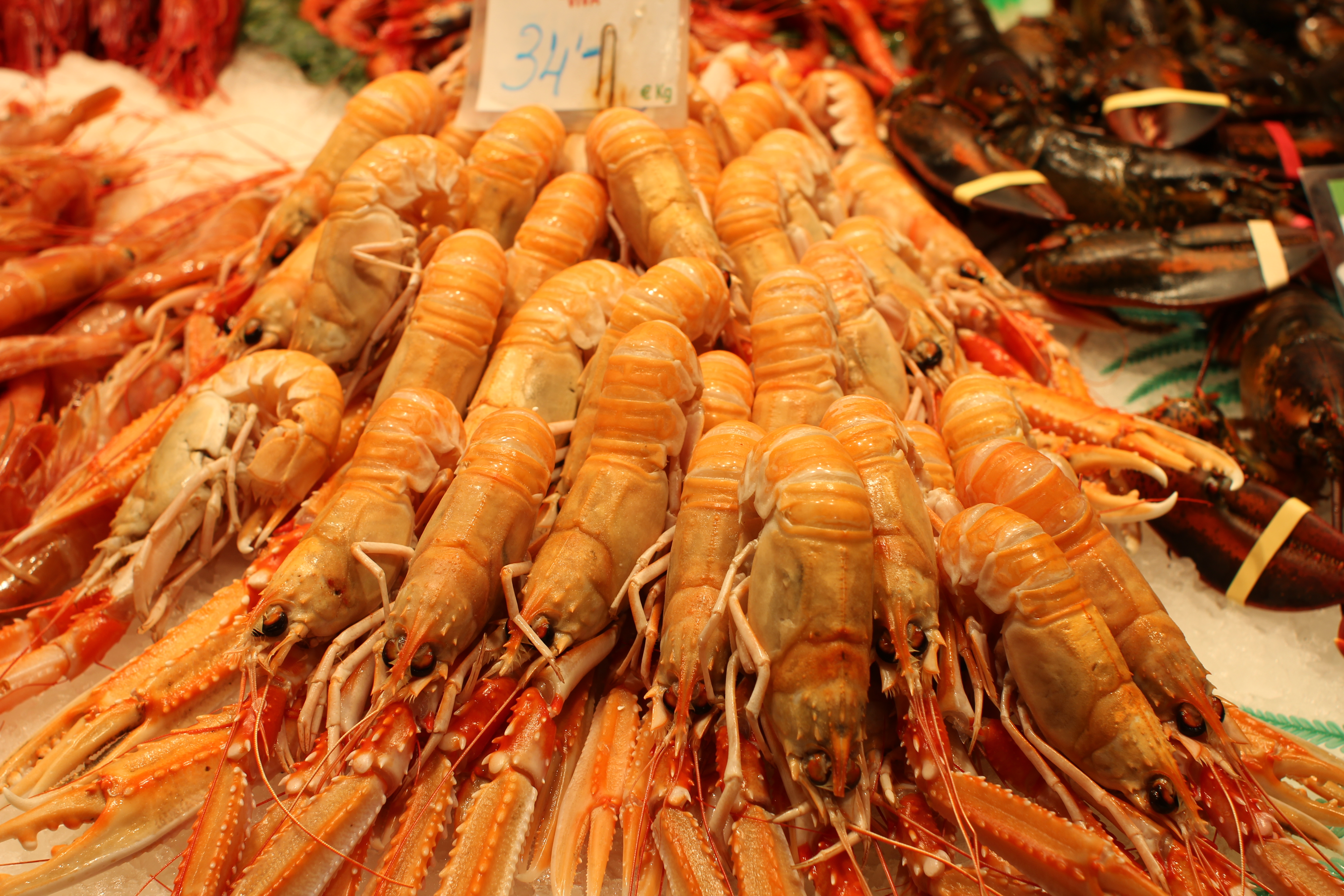
Prawns – Boqueria Market 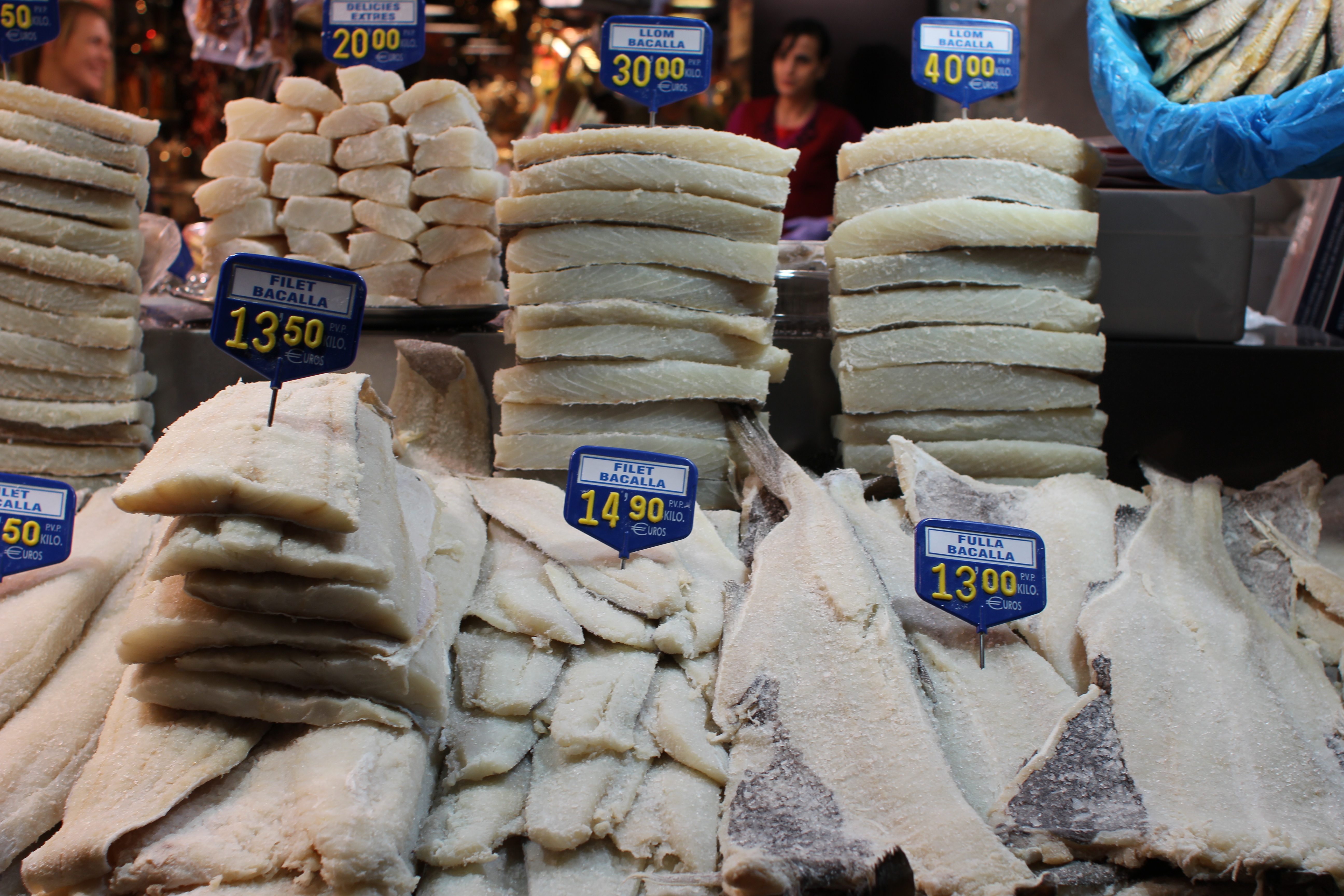
Bacalao – Boqueria Market
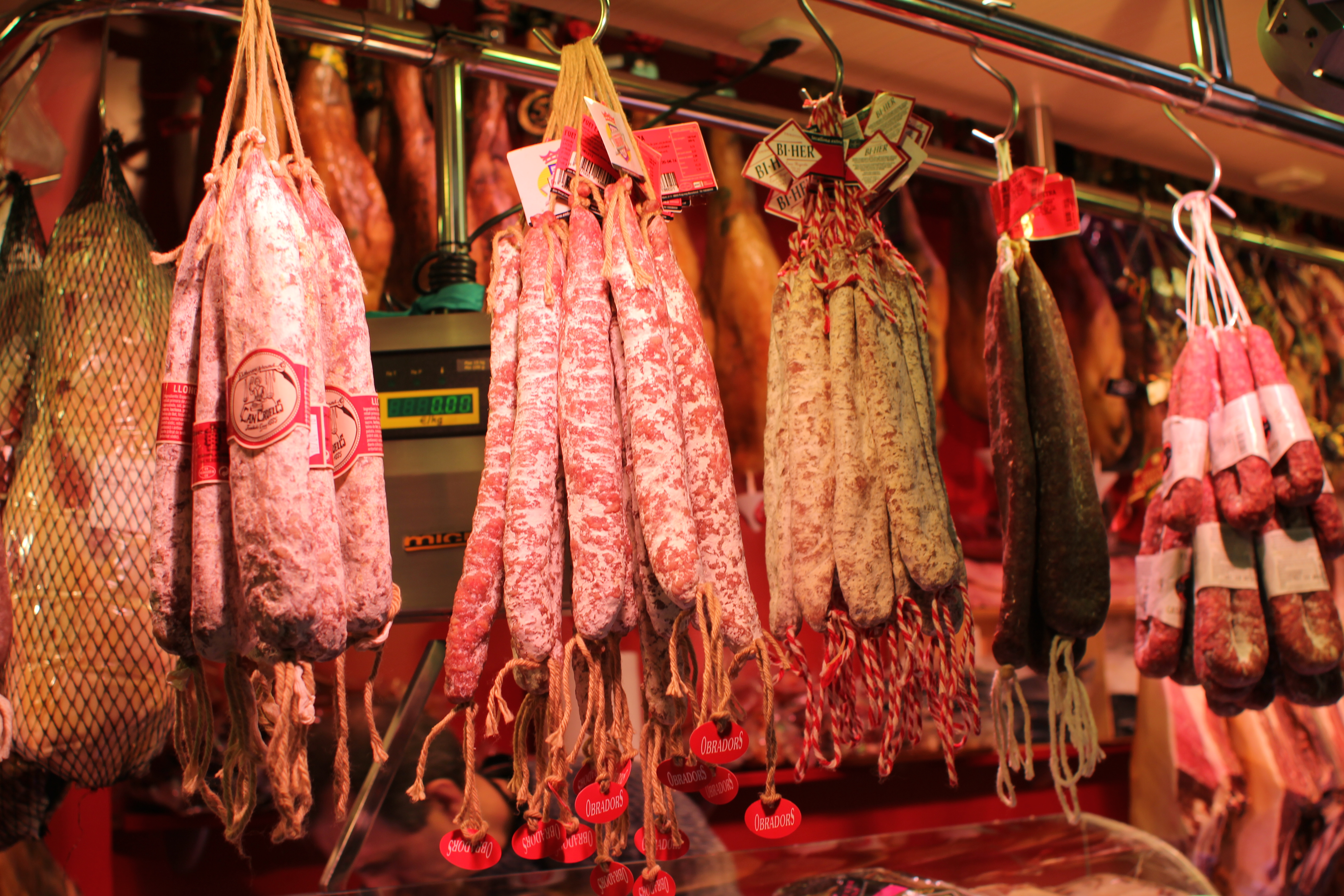
Chorizo & Salami – Boqueria Market 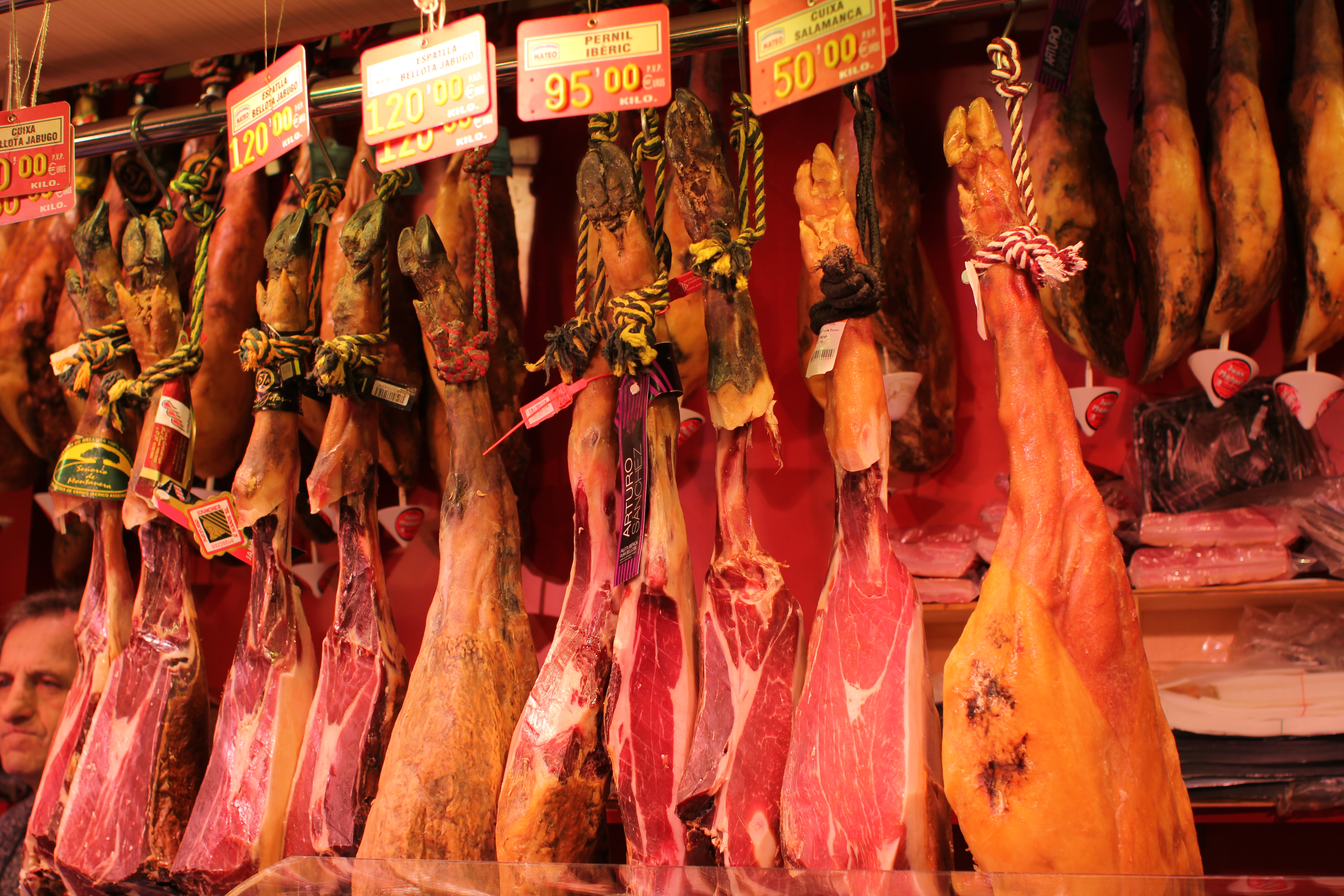
Iberico Ham – Boqueria Market
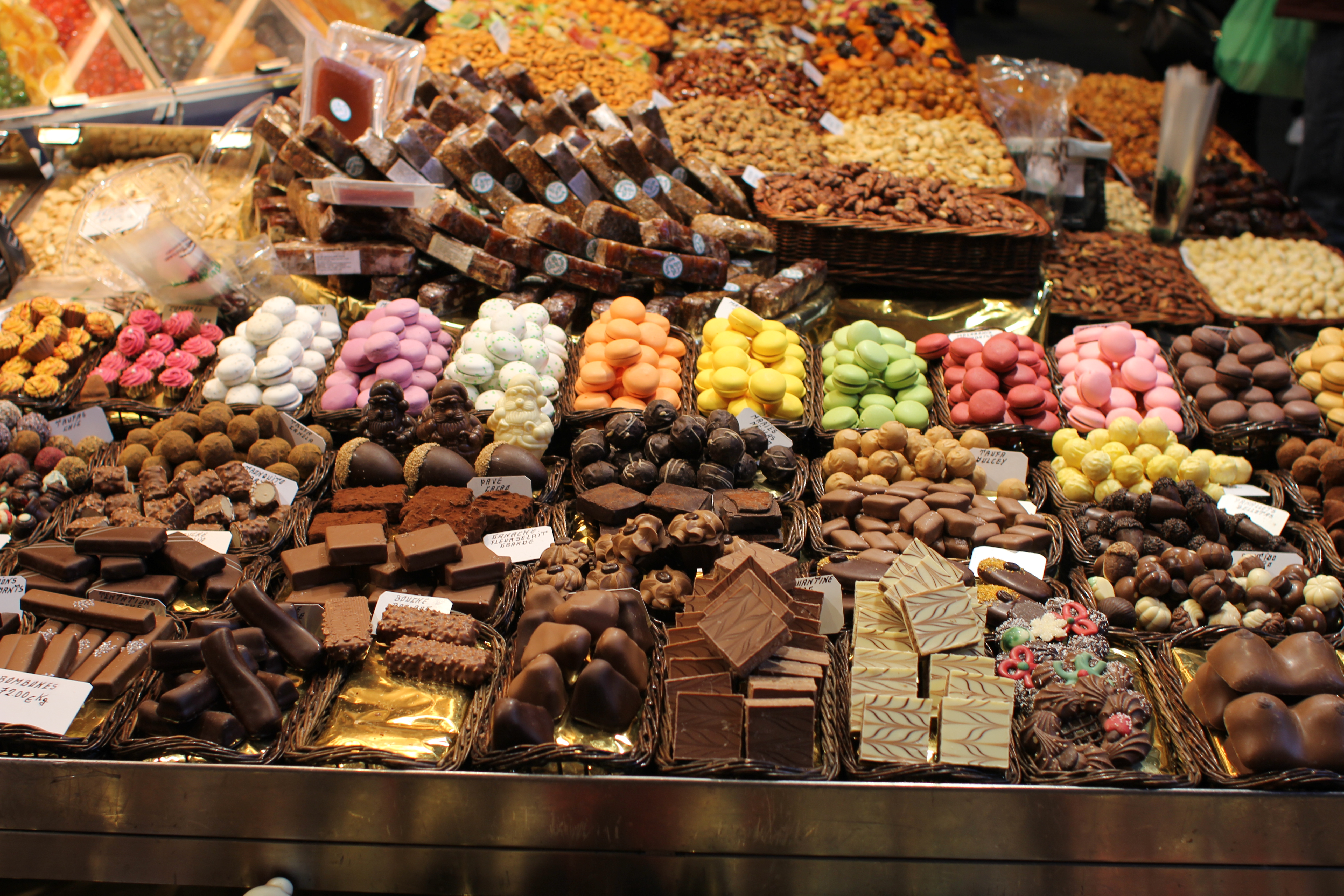
Sweets – Boqueria Market 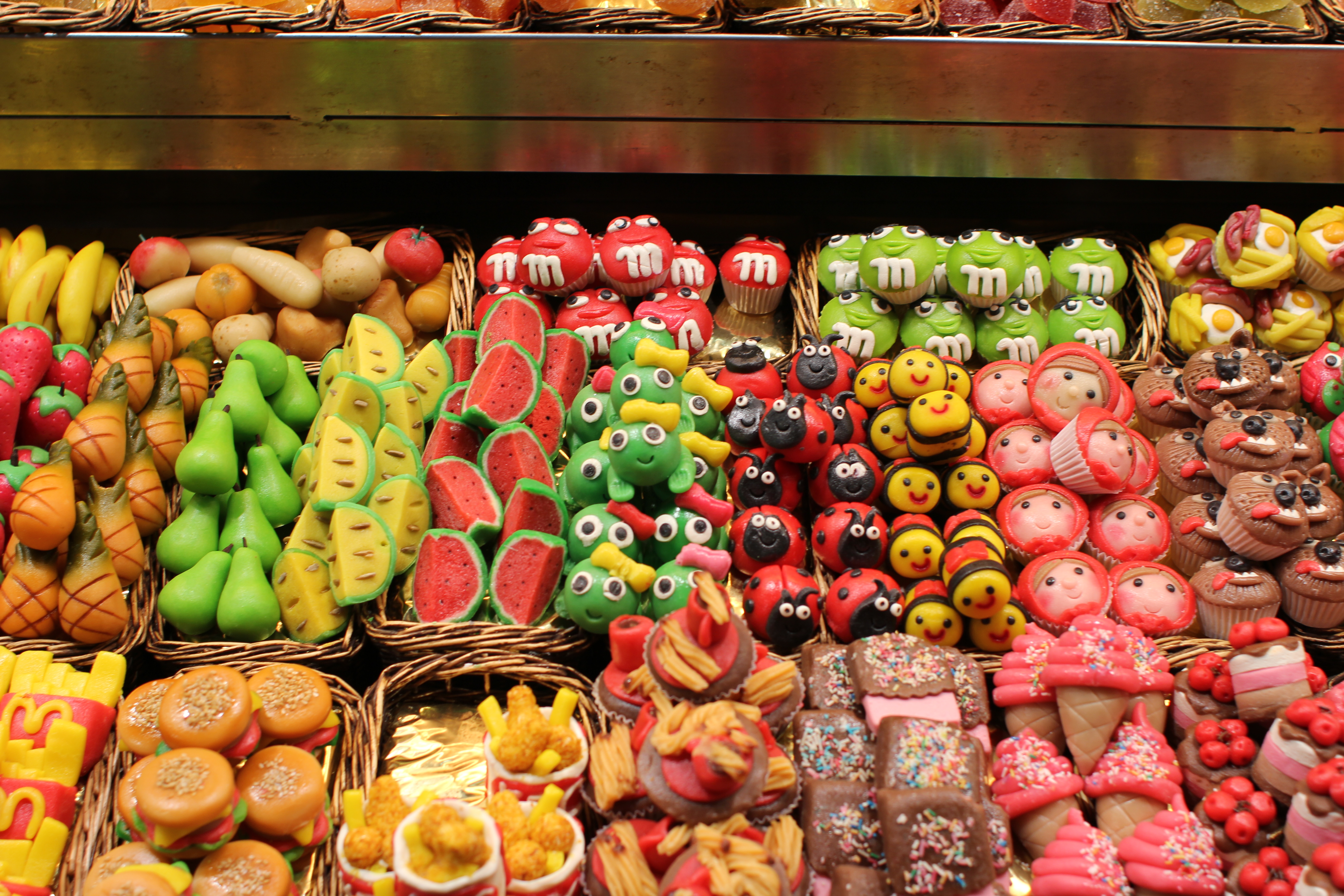
Sweets – Boqueria Market
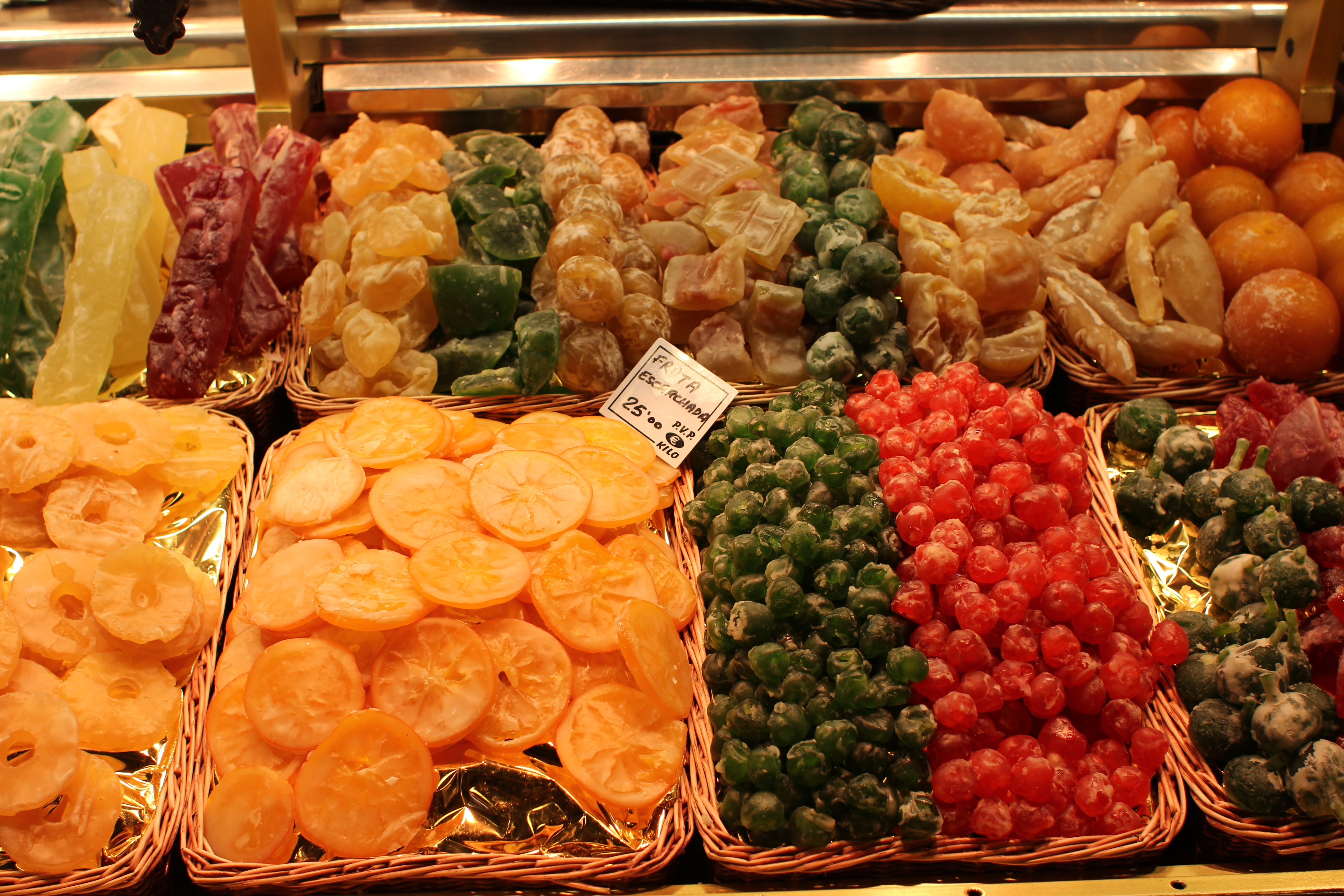
Candied Fruit – Boqueria Market 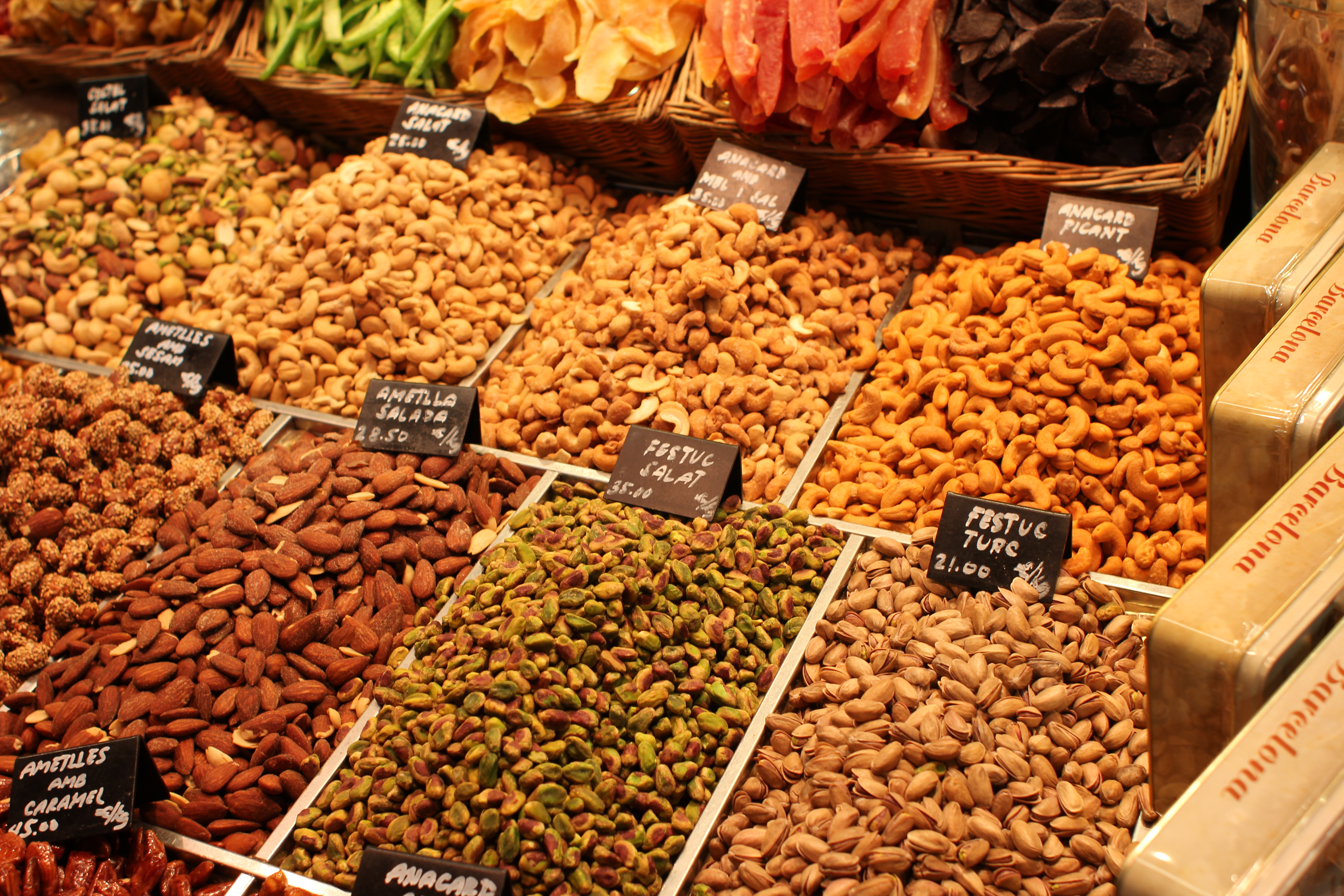
Nuts – Boqueria Market
The bars are busy with tourists tucking into tapas, folks perched on stools in animated conversations whilst drinking a beer, or sitting silently sipping coffee whilst the market rumbles on.
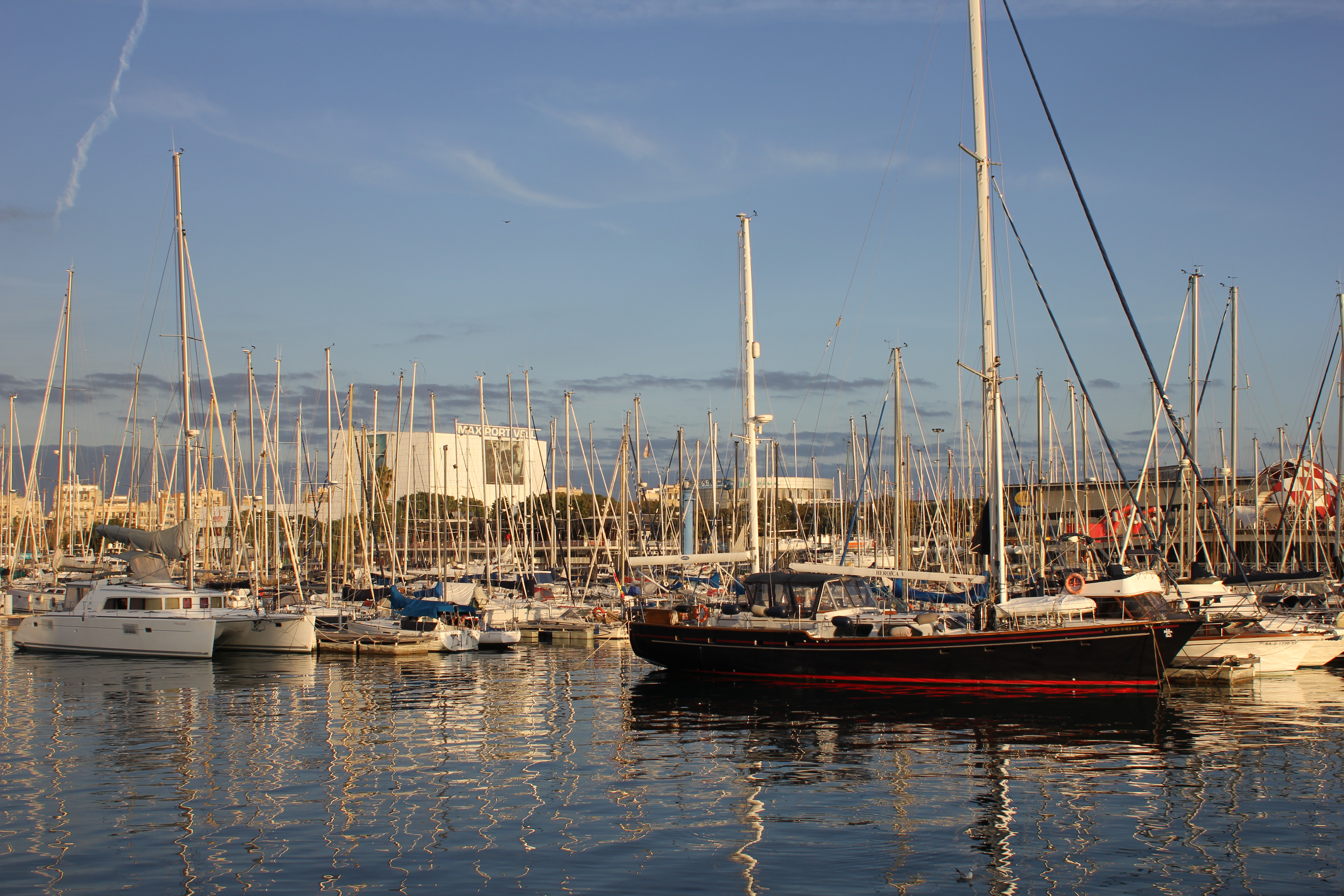
We continue our ramble down Las Ramblas until we reach the Columbus Monument (Mirador de Colon) and Port Vell. We stop along the quayside to check out the yachts before walking onwards to Barceloneta.
Carajillo in Barceloneta
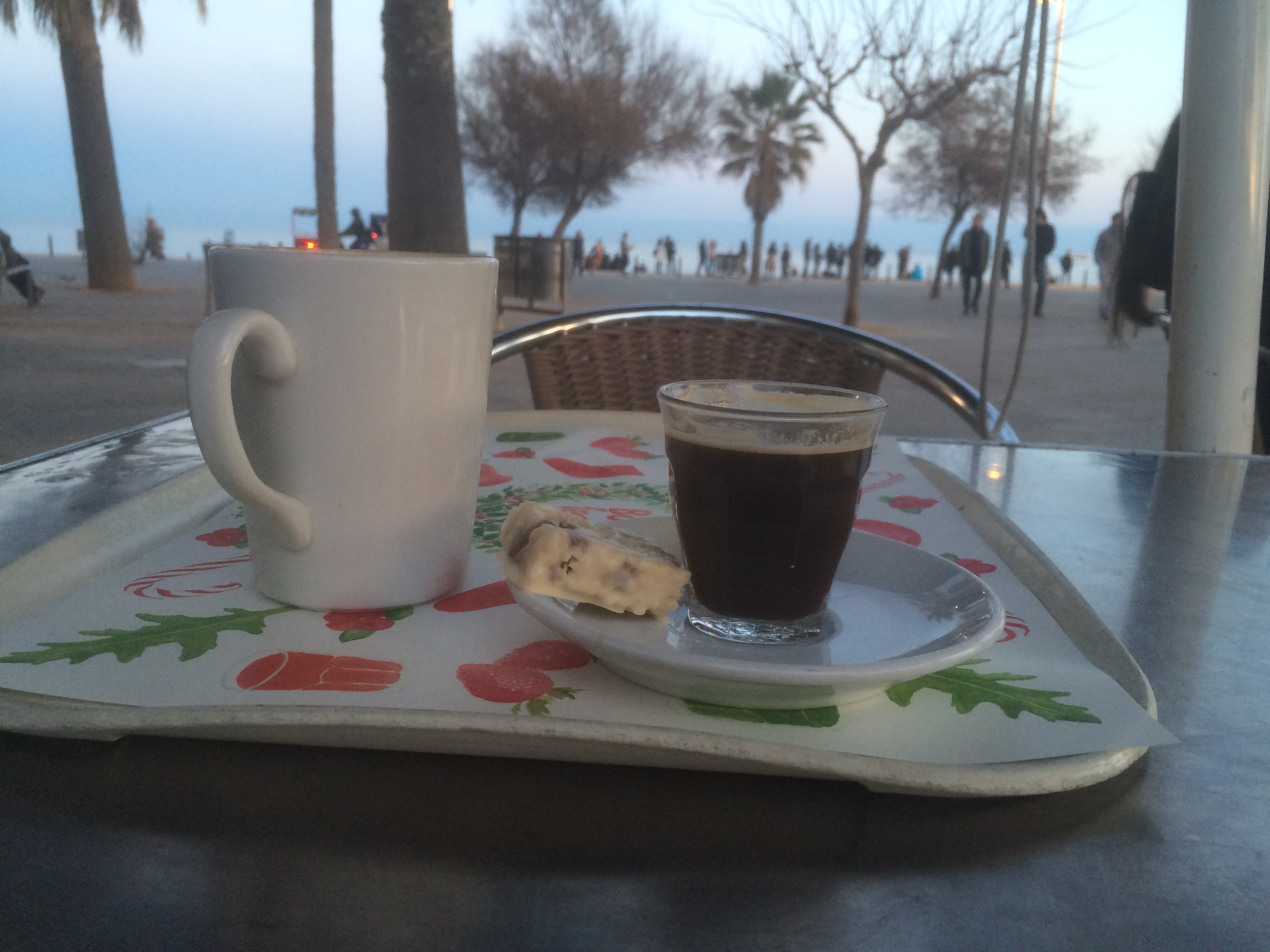
We stopped for a coffee at Buenas Migas on Plaça del Mar. It’s a small cafe, but there’s plenty of seating outside. As the sun is setting there is a gentle breeze coming off of the sea and there are a few people walking, jogging and cycling along the boardwalk.
We’ve done enough walking for today so it’s good to sit down with a warming carajillo talking about what we have seen, what we plan to do tomorrow and then just sit in silence to think and contemplate the remains of the day. In fact It’s so relaxing that we decide to stay for a second coffee. Revived and refreshed after our coffees we take a leisurely stroll to 7 Portes for dinner.
Dinner – 7 Portes
Set on the corner of Pla de Palau and Passeig d’Isabel II, 7 Portes opened in 1836 as Café de las 7 Portes – it had seven doors through which customers could enter.
We shared our starters of buñuelos de bacalao and espinacas a la catalana, con pasas y piñones. The large cod balls were fluffy and very tasty and whilst the spinach was a good match with the cod balls, it was not particularly flavoursome.
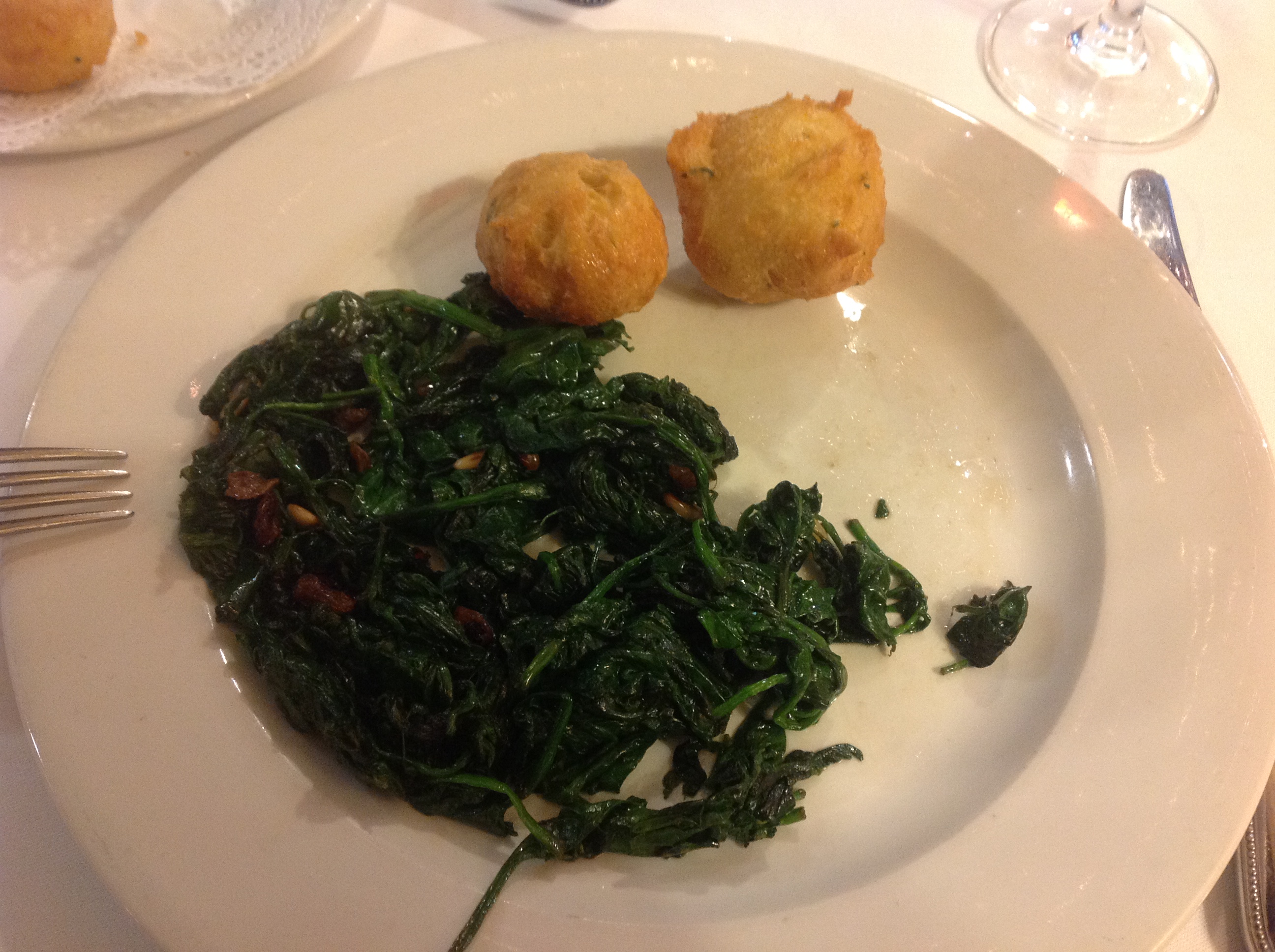
Buñuelos de bacalao y espinacas a la catalana 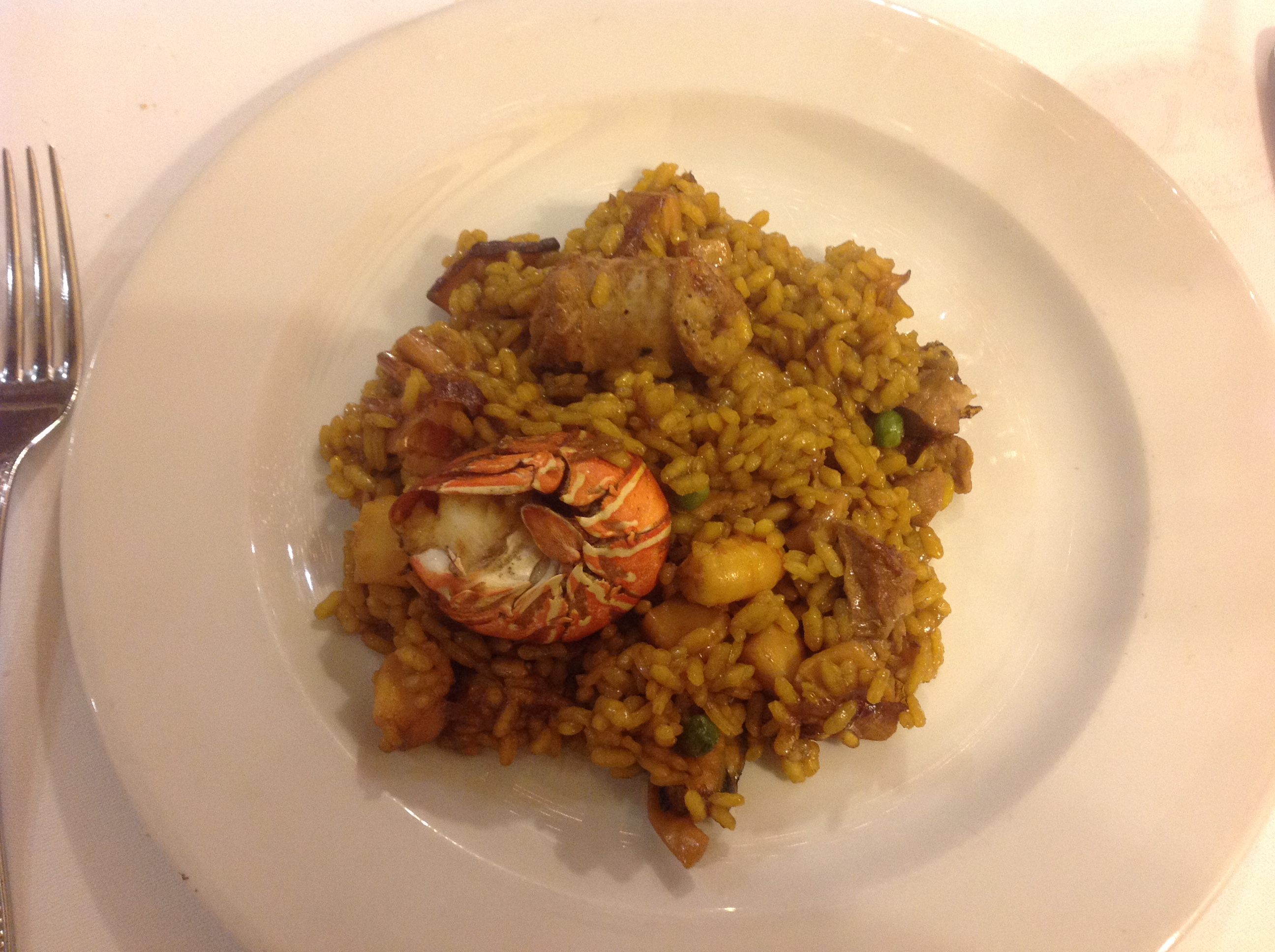
Paella Parellada
Paella Parellada 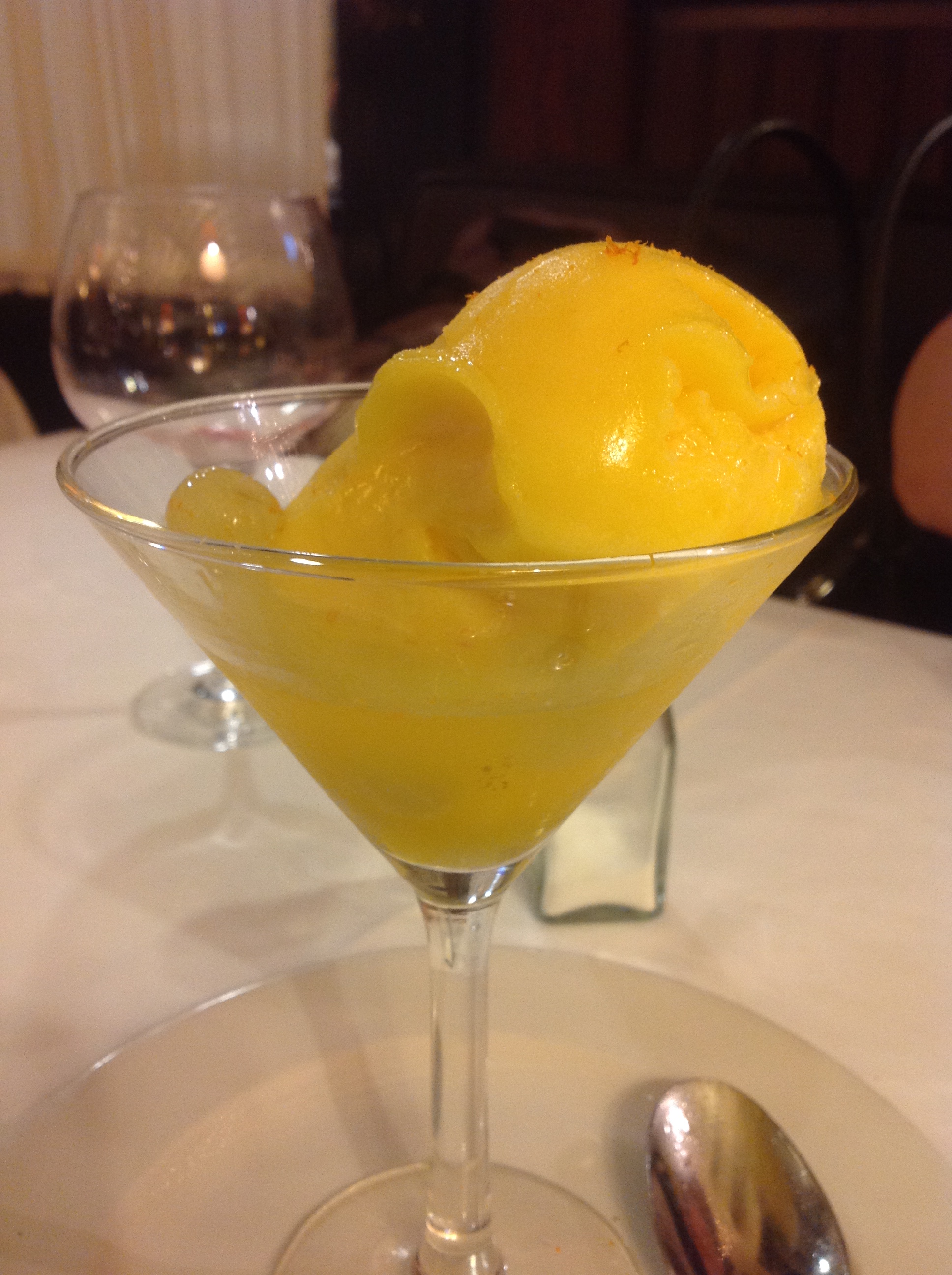
Sorbet
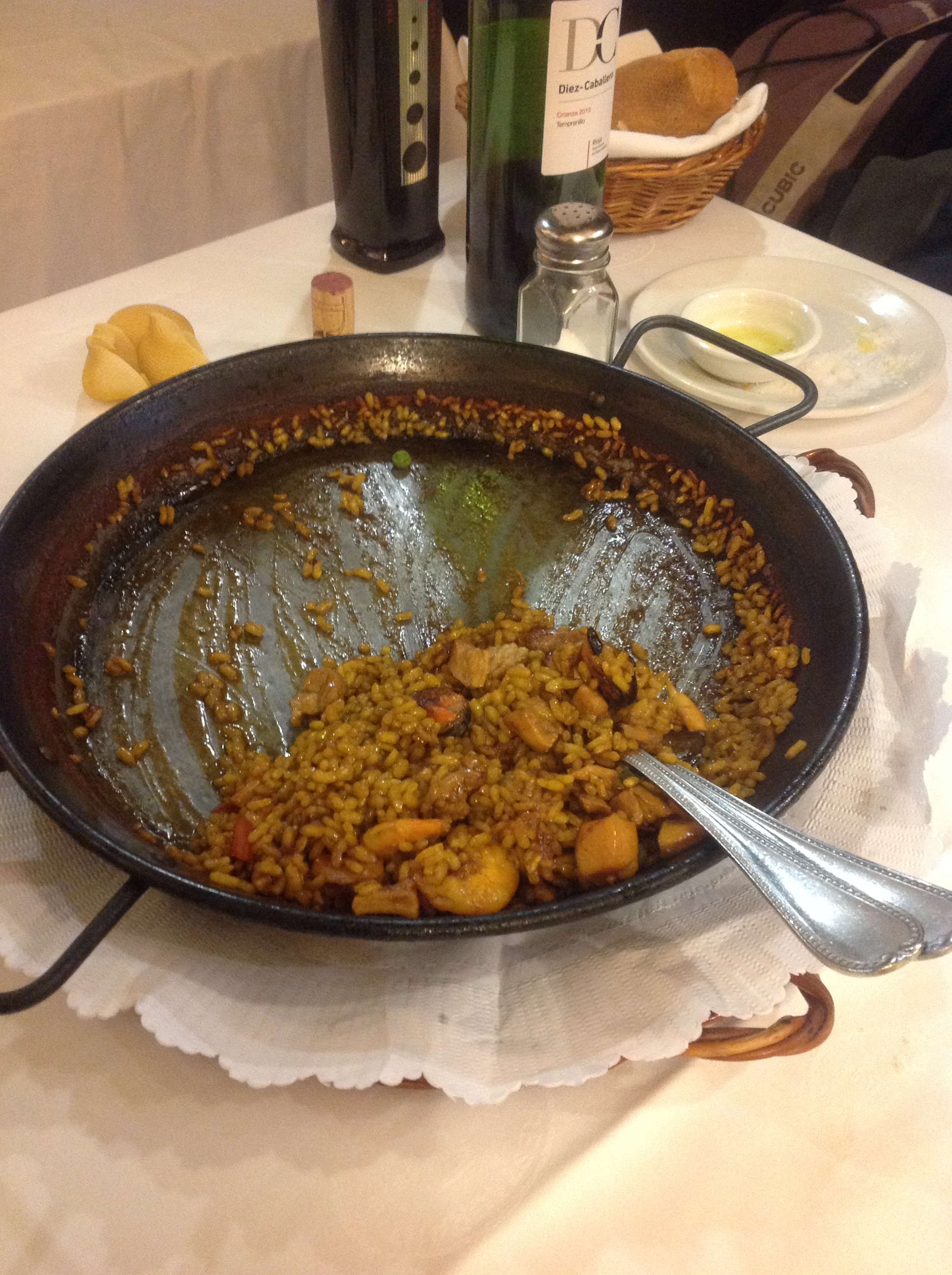
Our main course was paella Parellada (named after Paco Parellada who took over the restaurant in 1942 and whose family continue to run it today) with both meat and fish. Since we’re not in Valencia I figured we could mix the two! Overall the dish was OK, but lacked socarrat – the caramelized crust – which is the sign of a good paella, or good paella chef. We finished dinner with a very refreshing mandarin and champagne sorbet which was smooth and bursting with fruit flavour.
After that we were fit for bursting so the walk back to the hotel – just 25 minutes – along Via Laietana was much needed.
Gaudi: Horticulture, Architecture and Spirtuality
Tuesday, 29 December, 2015 – Barcelona, Spain
Desayuno
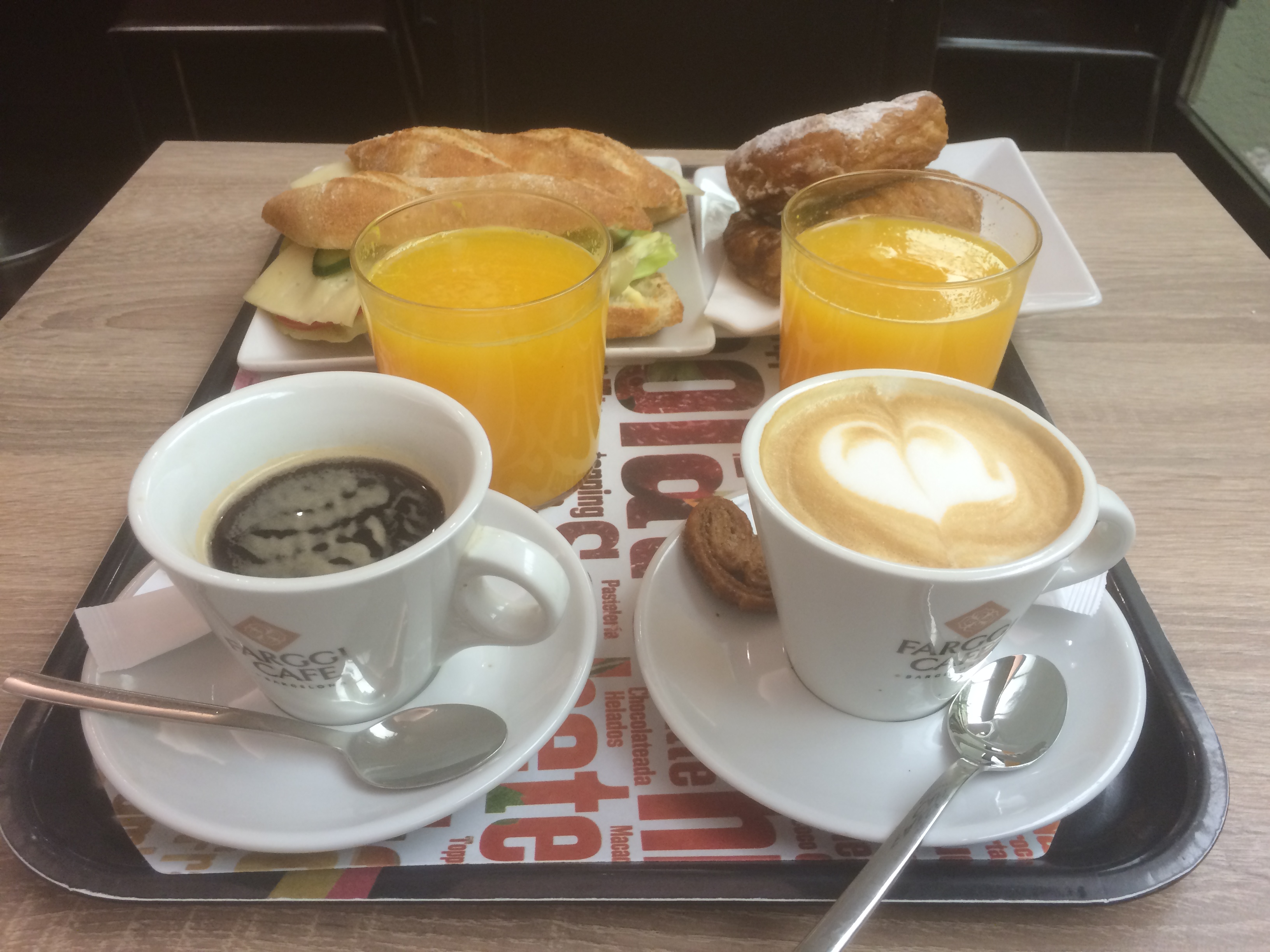
Being boutique and bijou our hotel does not serve breakfast, instead we have a voucher for breakfast at the Farggi Café on Passeig de Gràcia.
It’s a much better arrangement, more choice, and good to get some fresh air strolling along Ronda Sant Pere, even if it is only for a couple of minutes before breakfast
A jewel of Catalan Modernisme
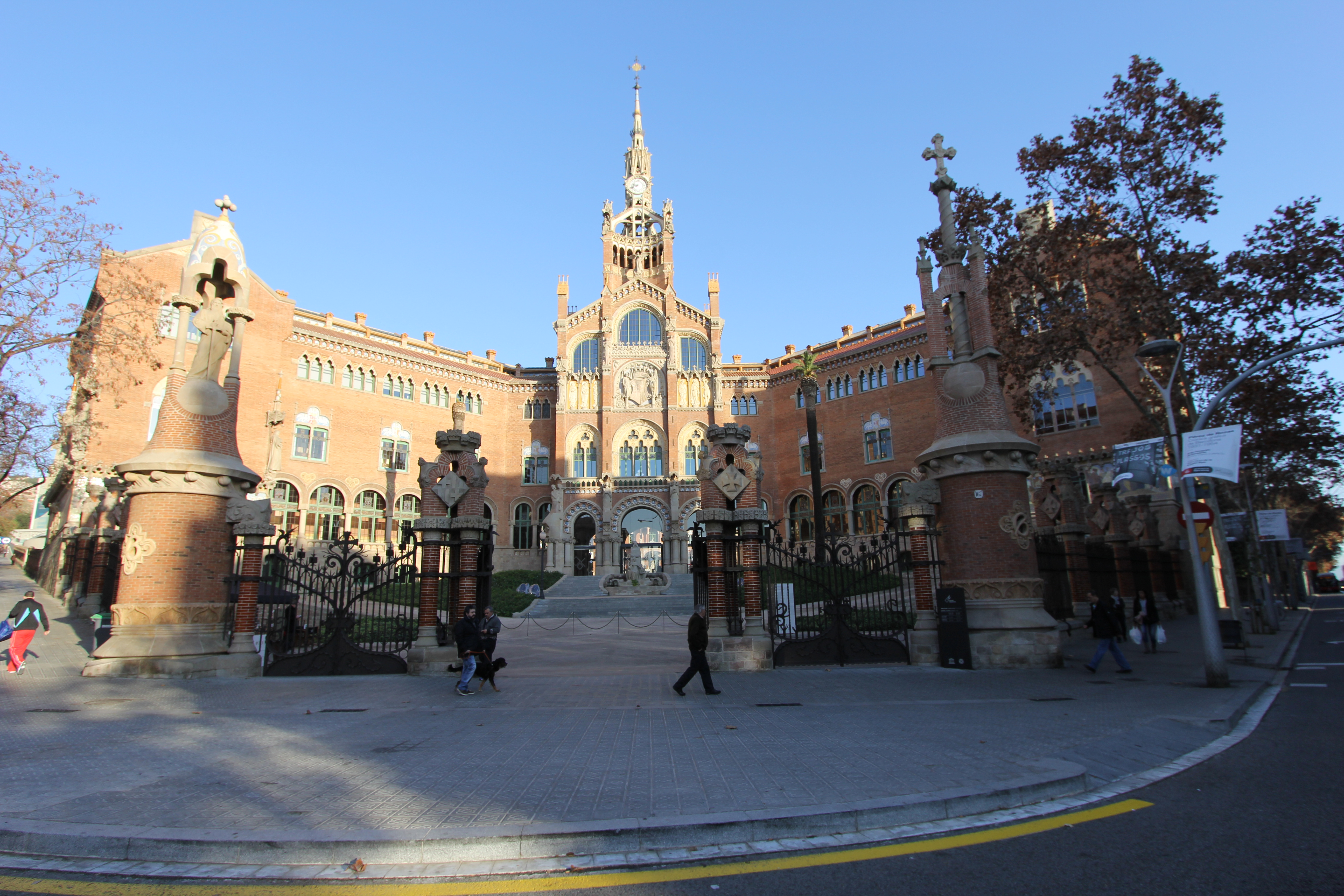
Our first stop of the day is the Hospital de la Santa Creu i Sant Pau. We take the Metro from Gracia, Line 4 (Direction Trinitat Nova) to Guinardó / Hospital de Sant Pau. After checking directions we walk down the hill from the new hospital to the Modernista Sant Pau Complex. Designed by Lluís Domènech i Montaner as a garden city for nursing the sick it was built between 1905 and 1930.
Today the site is now a knowledge campus and the headquarters of international organizations including: the Global University Network for Innovation, and the United Nations University Institute on Globalization, Culture and Mobility.
Our itinerary only allowed for a brief glimpse of the exterior of this art-nouveau complex which was awarded World Heritage status by UNESCO in 1997. Hopefully the next time we visit Barcelona we’ll take time to explore the pavilions, gardens and underground passages, as well as see the sculptures, stained glass and mosaics.
Sadly after an all too brief consultation we have to leave the hospital and begin our walk to Parc Güell. The walk to the park, which is mainly up hill, takes about 30 minutes and gives us the opportunity to see another district of Barcelona. We arrive at the park in good time which enables us to have a quick walk round the public section before joining our guided tour.
Parc Güell
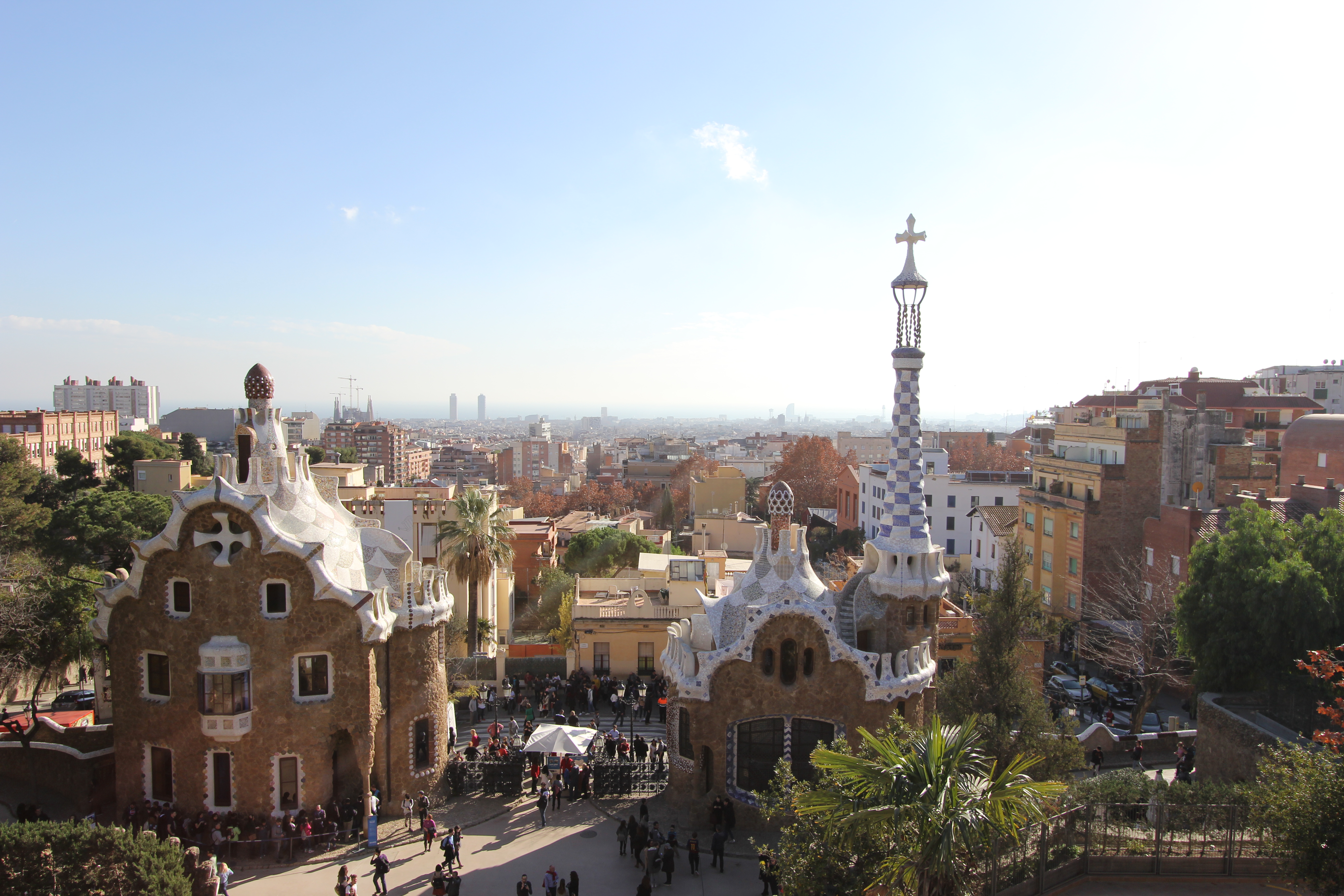
As our guide Viggo explained, whilst entry to the park is free, access to the monumental zone – so called because it contains the most important structures and buildings -isrestricted to ticket holders only. As a free attraction, the park became so popular, that the number of visitors was impacting on the site. Therefore in order to preserve and maintain the site the the number of visitors is strictly limited.
Viggo provides us with brief biography of the wealthy industrialist Eusebi Güel. Having acquired land in the area known at Muntanya Pelada (bare mountain), Güell’s vision and ambition was to create a gated community for bourgeois families, recreating the parks he had seen in England. Güell had commissioned Gaudi to undertake and number of projects and he commissioned him to work on this development of this residential estate. Gaudi’s brief was to draw up plans for the estate to accommodate 60 triangular shaped building plots. He designed a complex network of paths and steps accommodate the sloping terrain, as well as viaducts and aqueducts.
As we tour around the monumental zone Viggo stops to point out features of Gaudi’s design and provide some background to specific structures such as the viaducts or buildings.
Planting
When designing the property Gaudí retained existing vegetation, such as the carob and olive trees, as well as introducing Mediterranean plants that did not require much water. He also designed system for collecting, storing and irrigating the property.
Paths Roadways, and Viaducts
There are numerous paths and steps that link the various areas of the park together whilst coping with the sloping terrain. In addition to the roads Gaudi also designed three viaducts: Pont de Baix, the Pont del Mig and the Pont de Dalt (lower, middle and high bridges), which are suspended sloping columns and vaults made from unhewn stones taken from the site itself.
Dragon Stairway
From the main entrance esplanade a twin flight of stairs leads up to the hypostyle room. Near the top of the stairs there is a mosaic dragon or salamander which is now synonymous with the park.
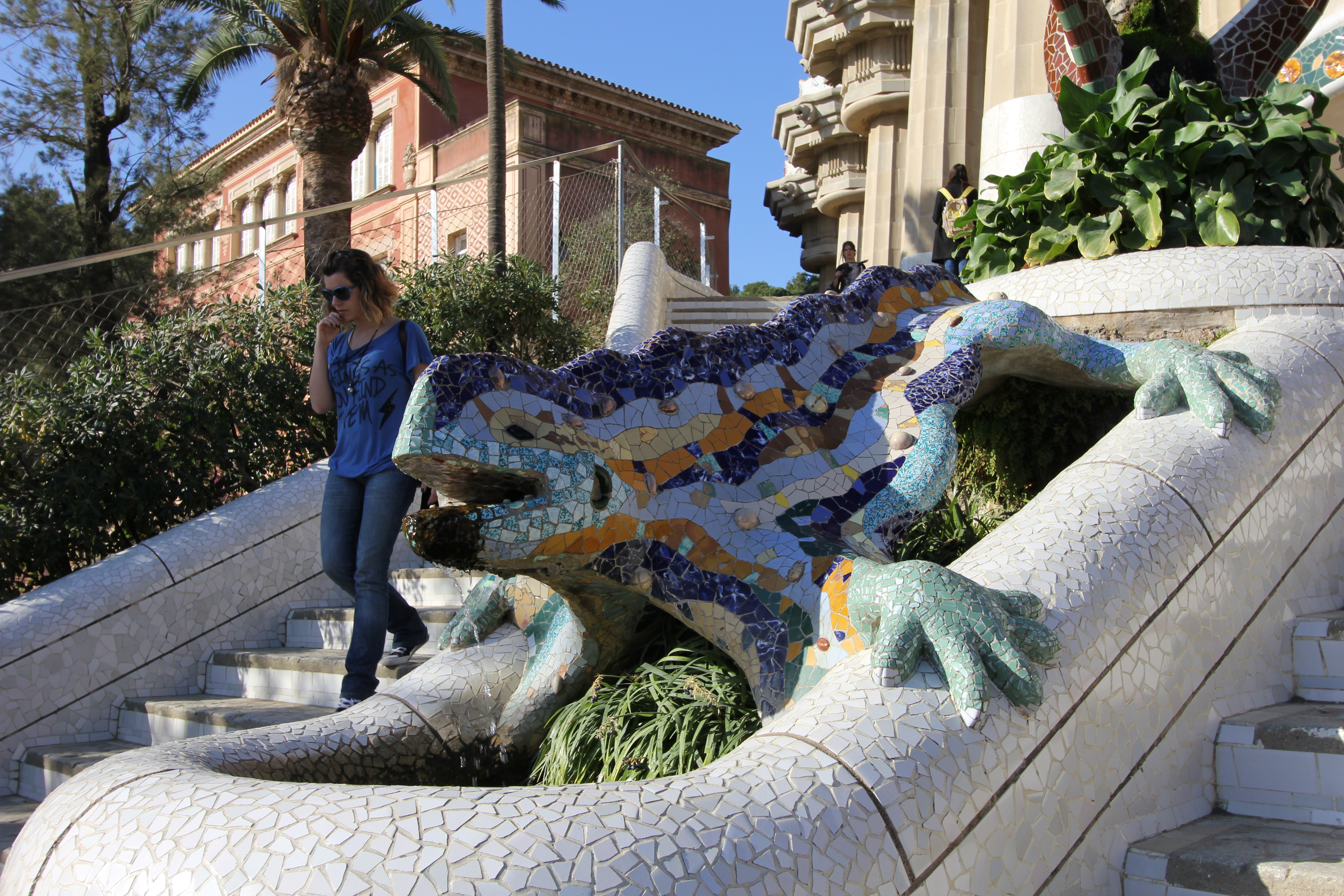
Salamander – Park Güell 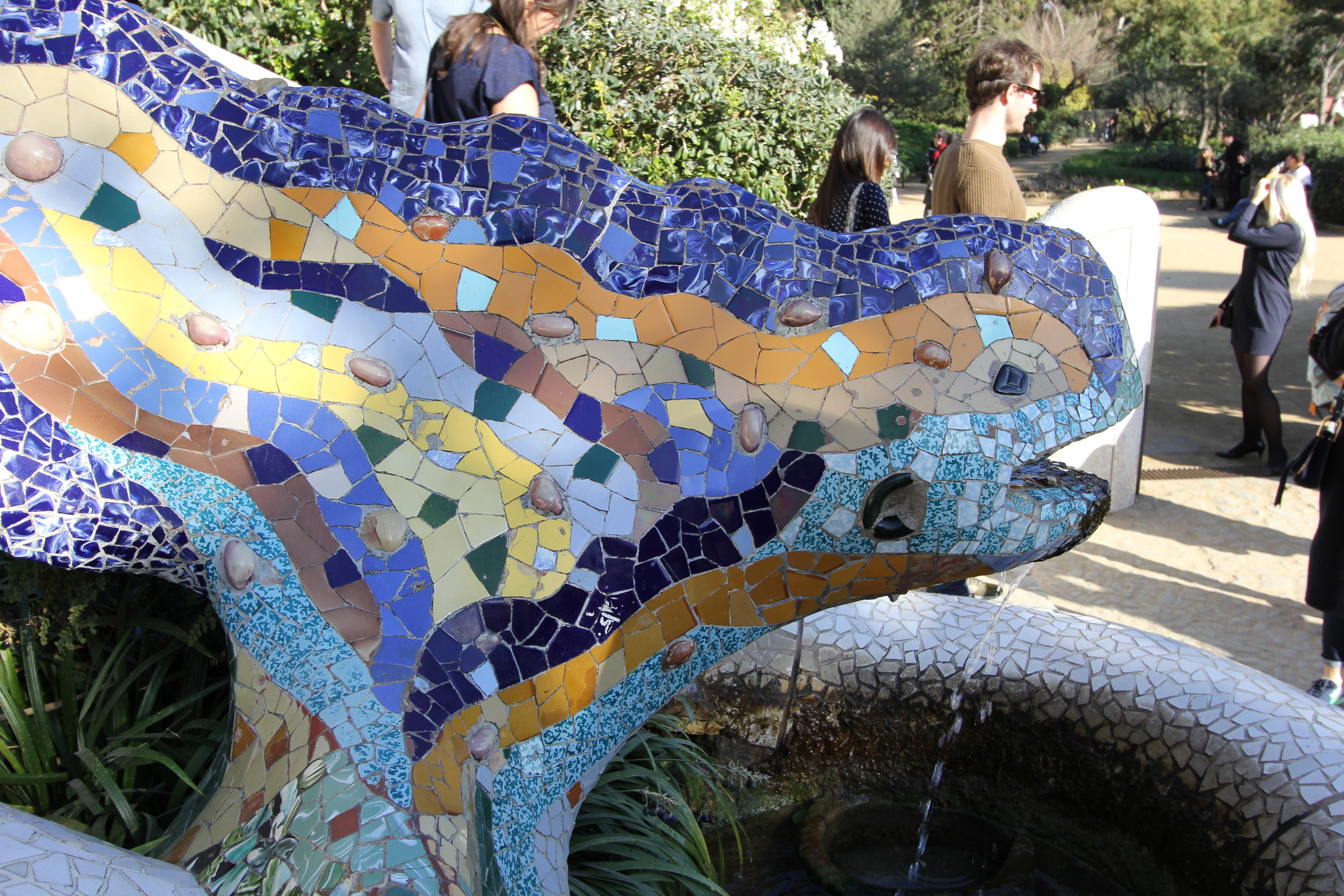
Salamander – Park Güell
Hypostyle Room
Designed to serve as the market place for the estate, it is made up of 86 Doric-style columns, the base of which are clad in mosaic tiles, enabling them to be wiped clean by the market stall holders. Some sections of the room, look like church naves. The ceiling is formed of small domes constructed from clay bricks and decorated with original tile-shard mosaics which were brought in by the artisans working on the project and supervised by Josep Jujol, one of Gaudí’s assistants.
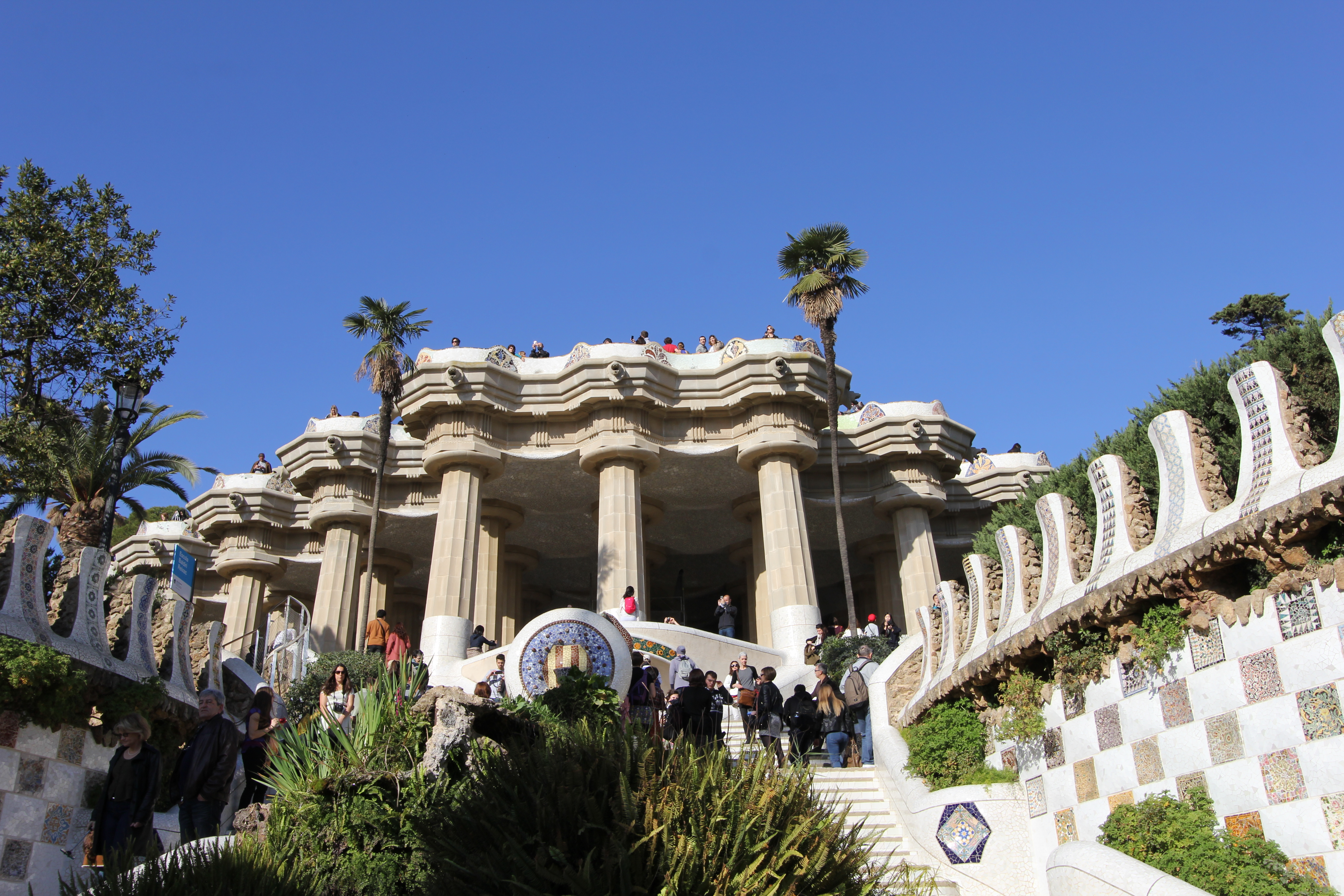
Stairway & Hypostyle Room – Park Güell 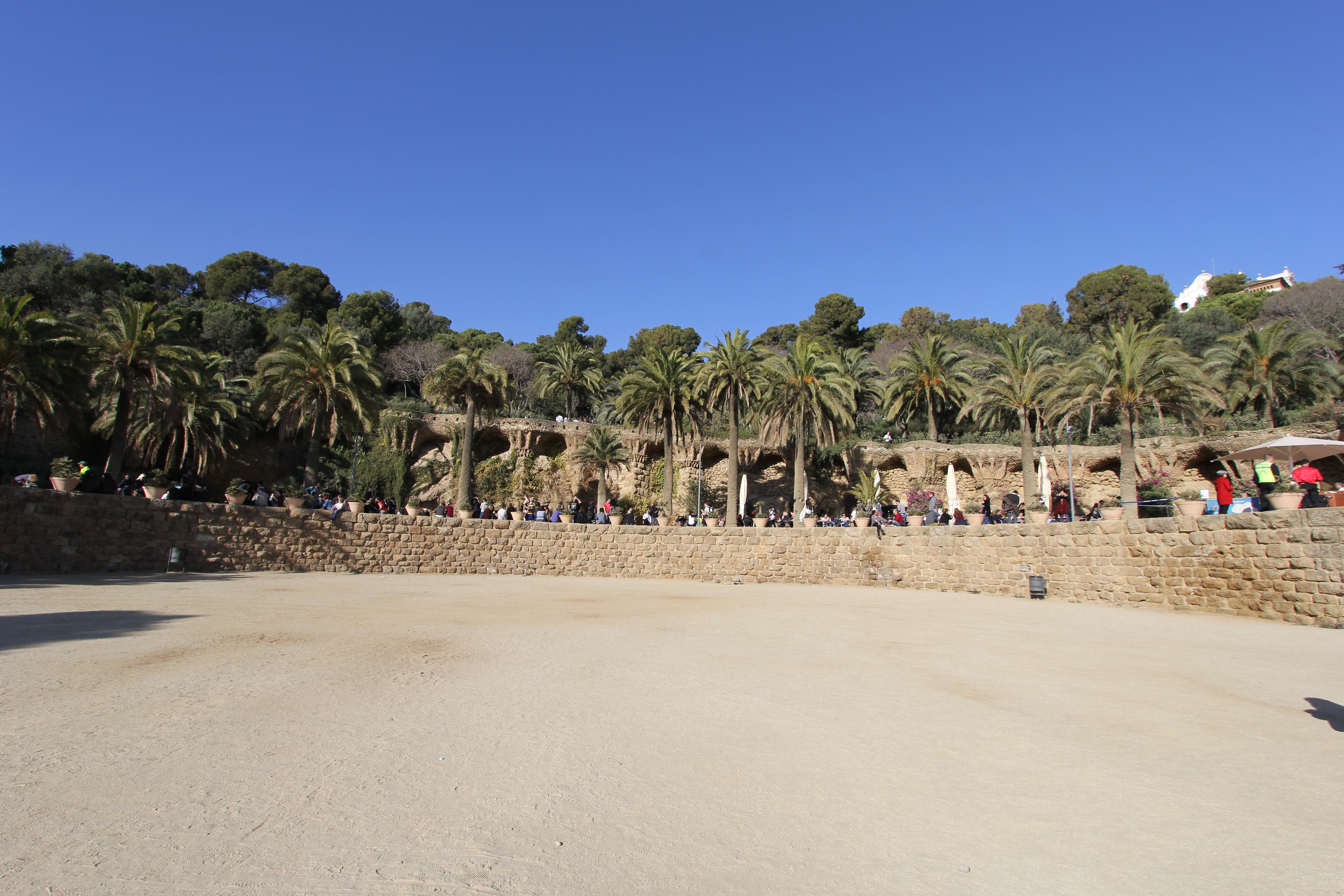
Greek Theatre – Park Güell
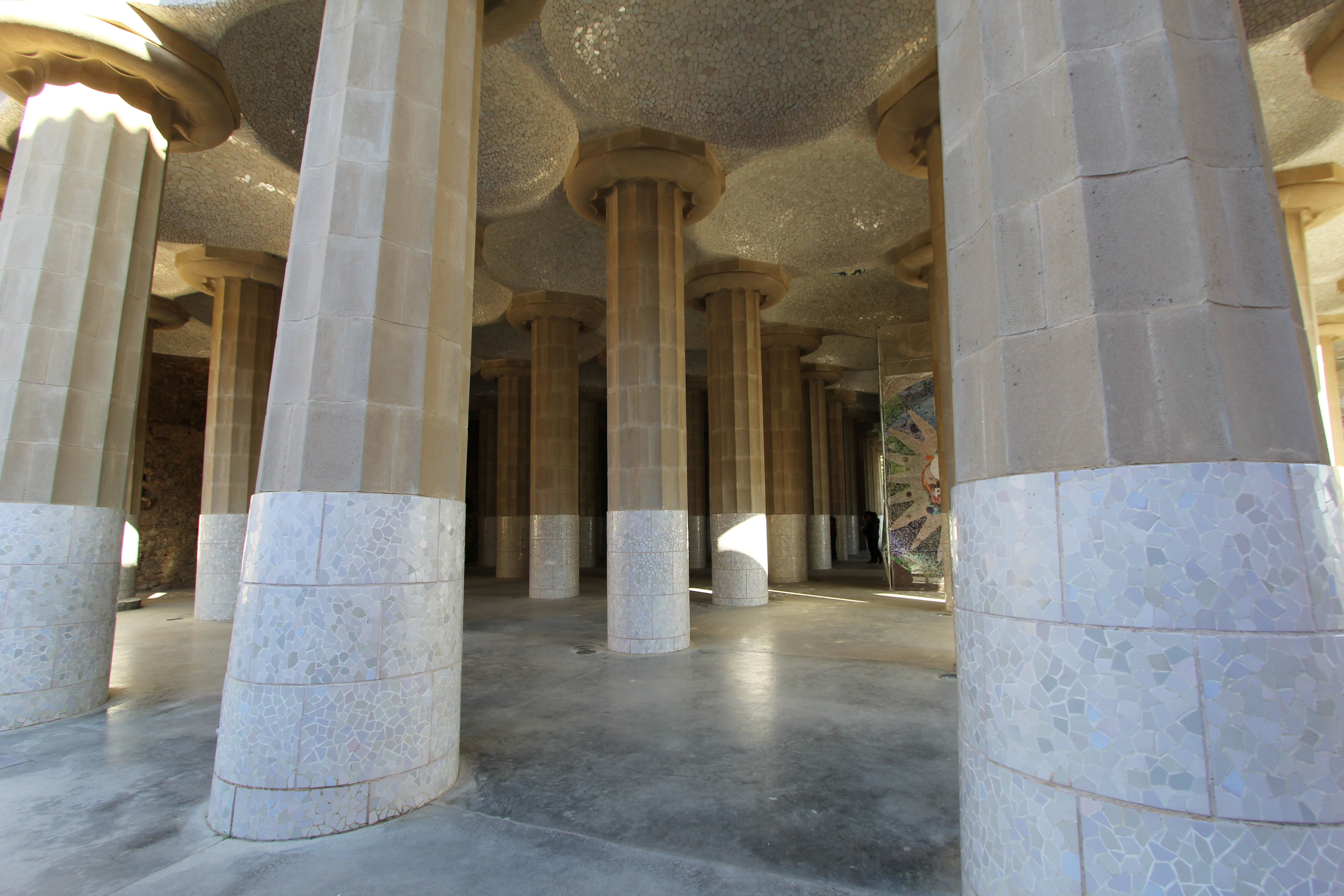
Doric Columns – Hypostyle Room 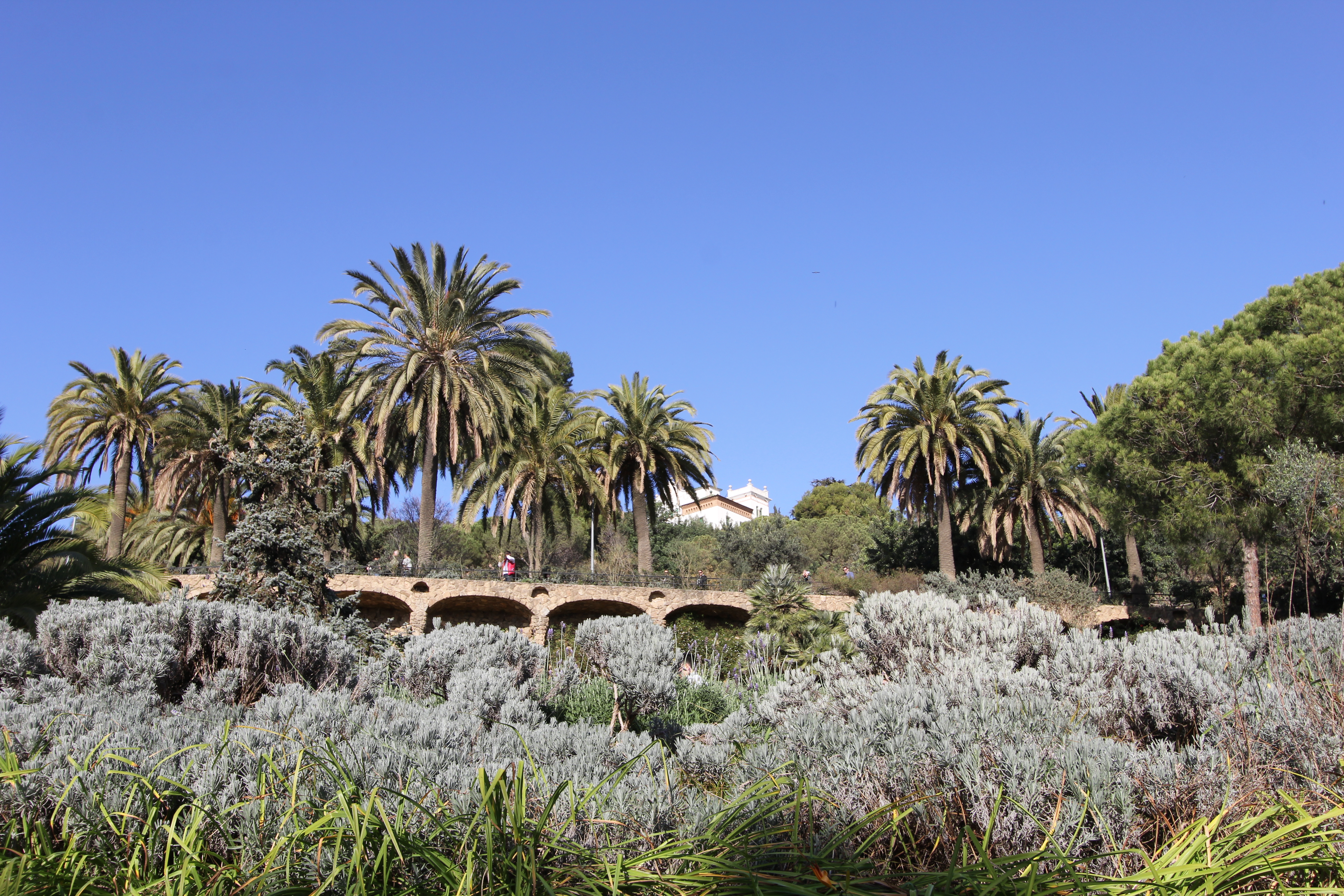
Viaduct – Park Güell
The Greek Theatre or Nature Square
The Greek Theatre, part of which is above the hypostyle room, was more recently renamed Plaça de la Natura (Nature Square). It was designed to stage large open-air shows that could be watched from the surrounding terraces. Even during Güell’s lifetime, the park was considered to be one of Barcelona’s great tourist attractions, and the square was often used for staging Catalanist events, traditional Catalan sardana dancing and other civic and social events.
Entrance and porter’s lodge pavilions
The main entrance to Park Güell on Carrer d’Olot, provides a spectacular view of the Dragon or Salamander Stairway leading to the Hypostyle Room above. The park’s stone wall is capped with ceramic tiles and medallions bearing the name of Park Güell. Either side of the entrance are two lodges:one with a waiting room and telephone booth; the other used as the porter’s residence: Casa del Guarda. Both of the lodges have beautiful roofs, constructed from traditional Catalan clay tiles covered with “trencadís”, a mosaic made of tile shards, although one also has upturned coffee cups – Gaudi had given up coffee at the time!!
Laundry Room Portico
On the eastern side of the Greek Theatre square there is an original iron door which leads to where there used to be the gardens of Casa Larrard, the former mansion that Güell adopted as his own house, but which has since 1931 been a school. The route, which runs at a level higher than that of the house, passes through a pine grove with the portico backing onto a retaining wall made from un-worked stone. The portico adopts the shape of a great wave atop slanting columns, with a double colonnade that acts as a buttress. It is one of the finest examples of the organic architecture upheld by Gaudí. The same meaning, at once structural and aesthetic, can be appreciated in the spiral ramp which takes visitors down to the house, at the end of the path.
So after a walk in the park we prepare for our walk to the Sagrada Familia. It’s 25 – 30 minutes on foot and the best bit is that it’s all downhill!
Sagrada Familia
From the serenity of Park Güell we are becalmed in the spirituality and bathed in ethereal light from the abstract stained glass windows of the Sagrada Familia.
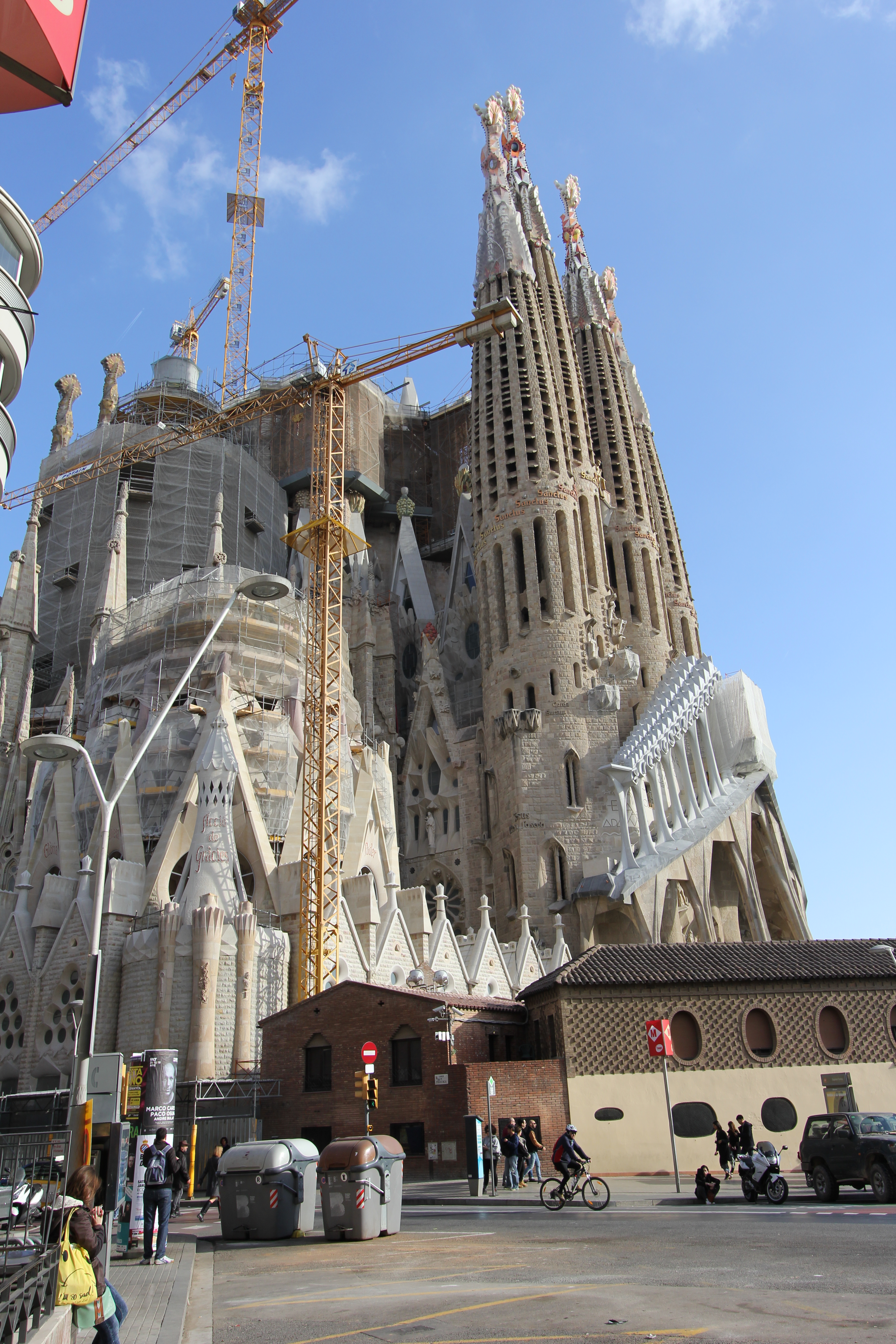
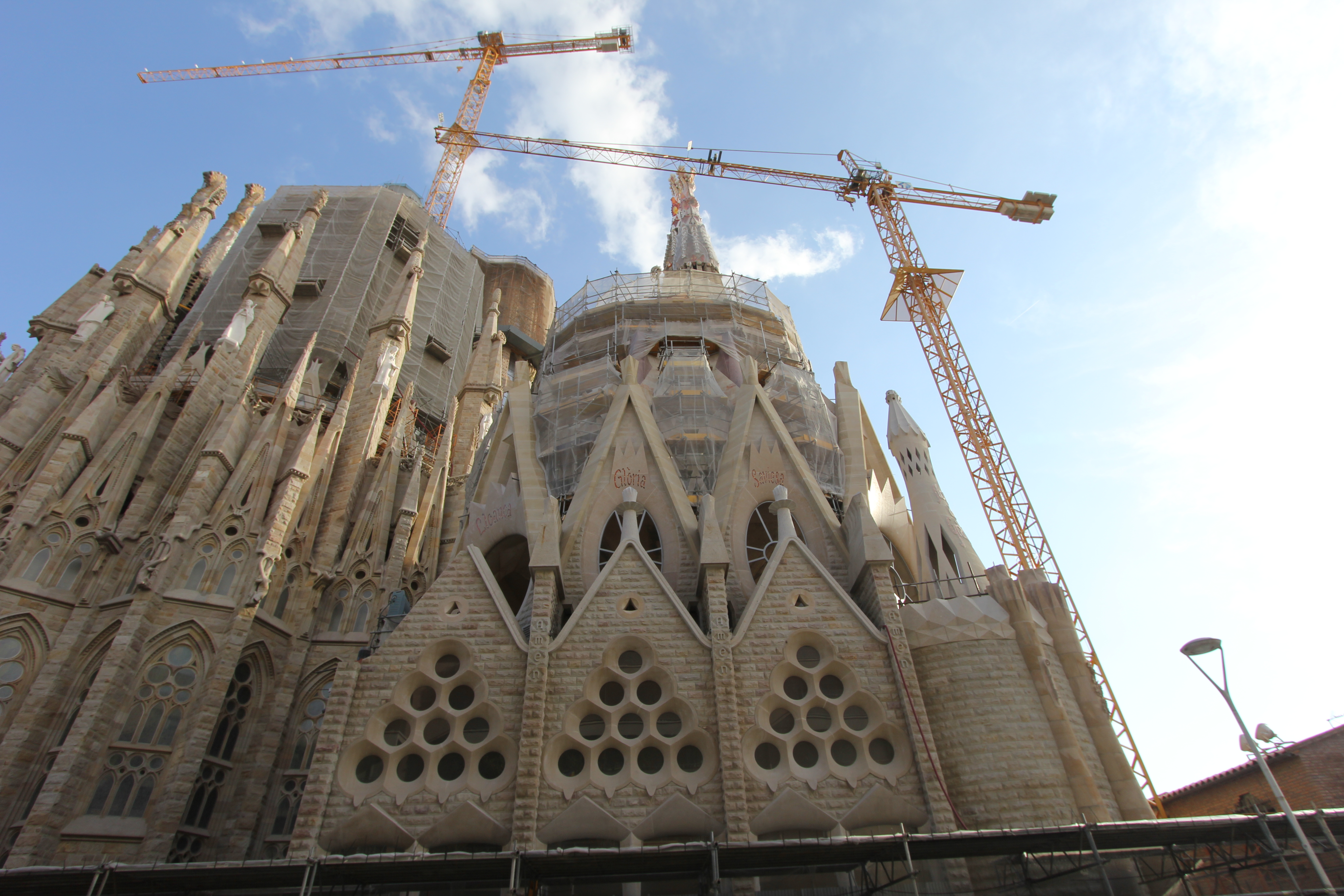
But first we scan the outside, the soaring towers and the detailed sculptures on the three facades. Very little of Gaudi’s design, in fact a redesign of the original plans, was completed during his lifetime. When he died in 1926 only one facade, the Nativity Facade,, one tower, the apse and the crypt were finished. Gaudi’s improvisation and constant changes to the design during construction meant that he left few models or drawings. Most of those he did produce were destroyed during the Spanish Civil War.
18 Towers and 3 Facades
Four towers on each of the three facades represent the twelve apostles. The towers reach a height of 90 to 120 meters (394ft). Another four towers represent the four evangelists. They will surround the largest, 170m/558ft tall tower, dedicated to Jesus Christ. The last tower, dedicated to Virgin Mary, will be built over the apse. When it is completed the church will have a total of 18 towers of which four have been completed. It is expected that construction will be completed in 2026, which is the centenary of Gaudi’s death.
The first facade, facing east, is the Nativity Facade, ornamented in a Baroque fashion with motifs of animals and plants.It was completed during Gaudi’s lifetime. Opposite the Nativity Facade is the Passion Facade. Construction began 1954, but sculptures depicting the crucified Jesus Christ were not installed until 1987. The abstract figures have caused a great deal of controversy and received criticism since they are very different from Gaudi’s style. The third and main facade is the Glory Facade, which will feature life and death. Construction of this facade – the most monumental of the three – commenced in 2002 and is ongoing.
Sagrada Familia 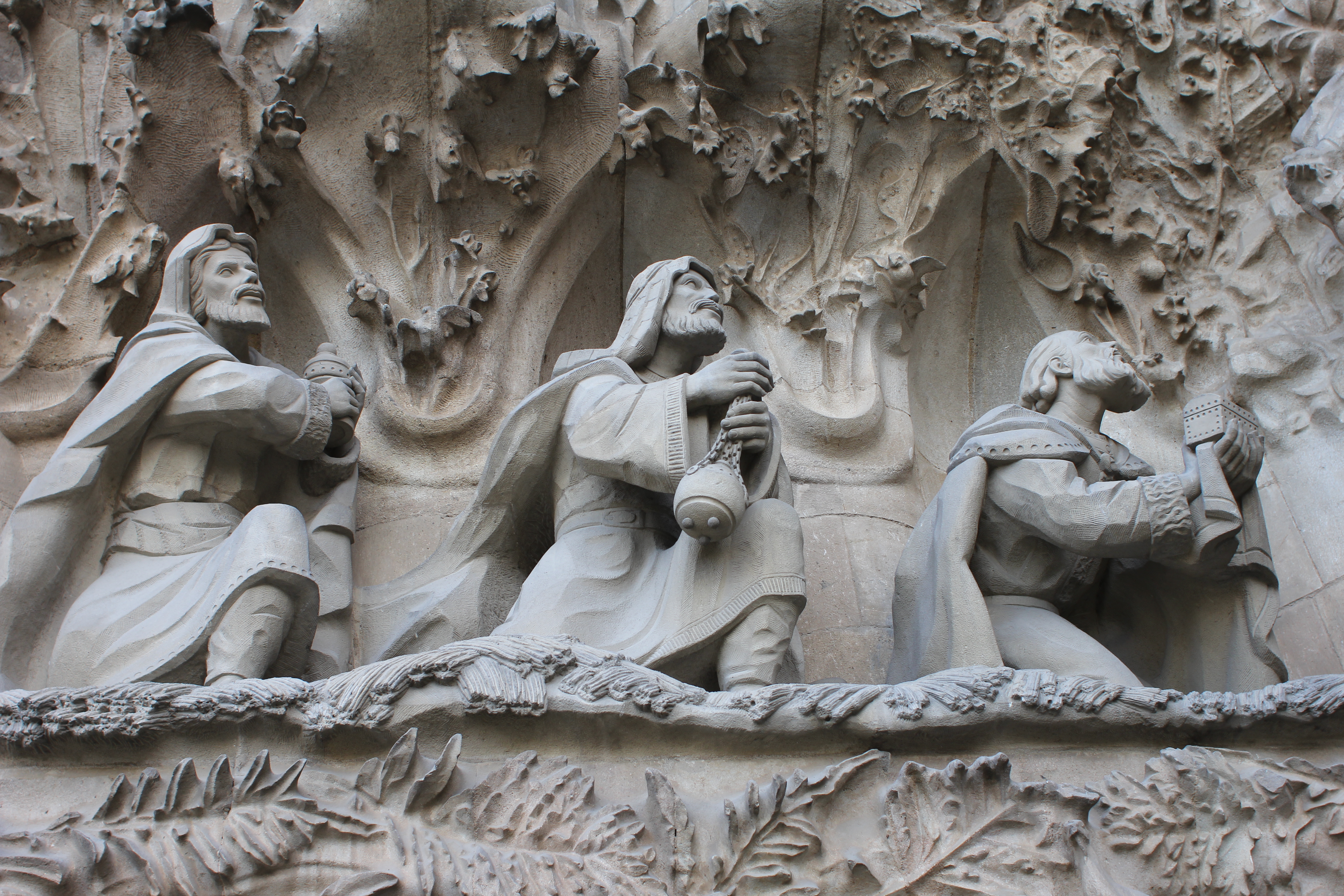
Entrance – Sagrada Familia
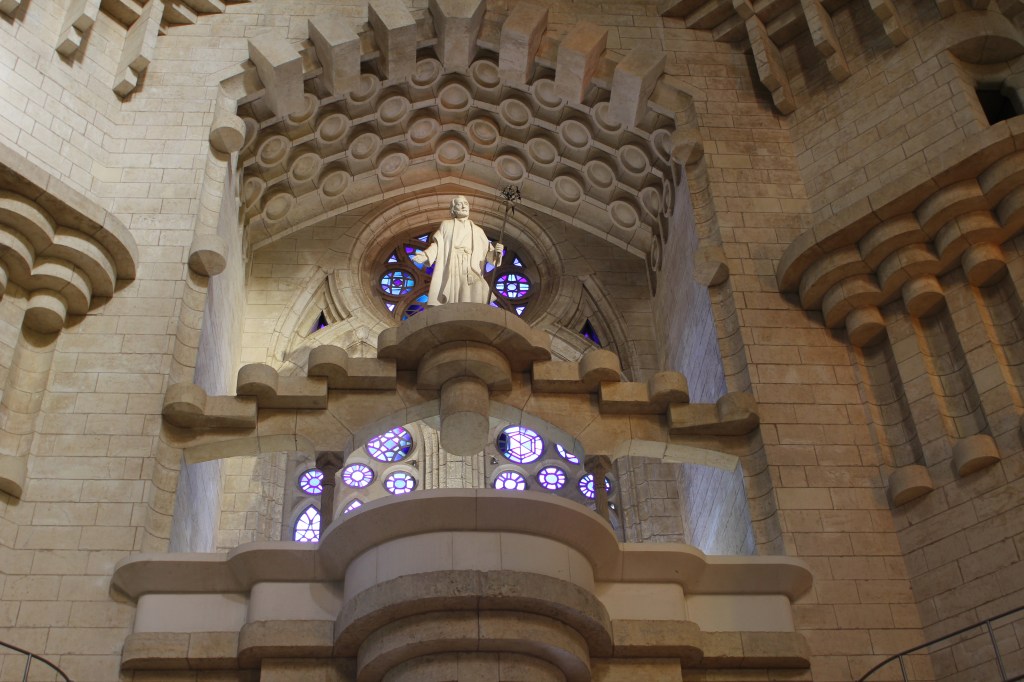
Interior – Sagrada Familia 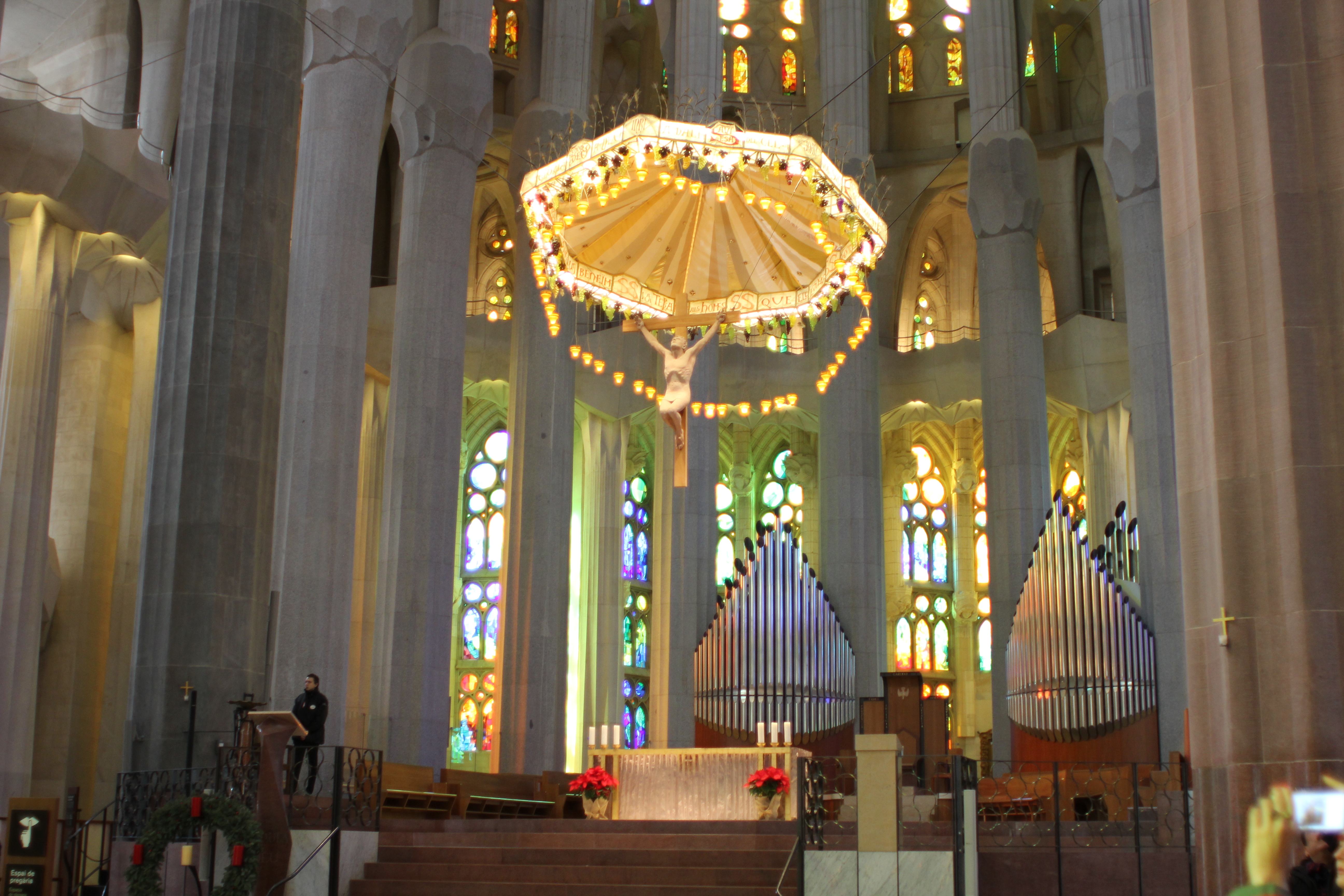
Altar – Sagrada Familia
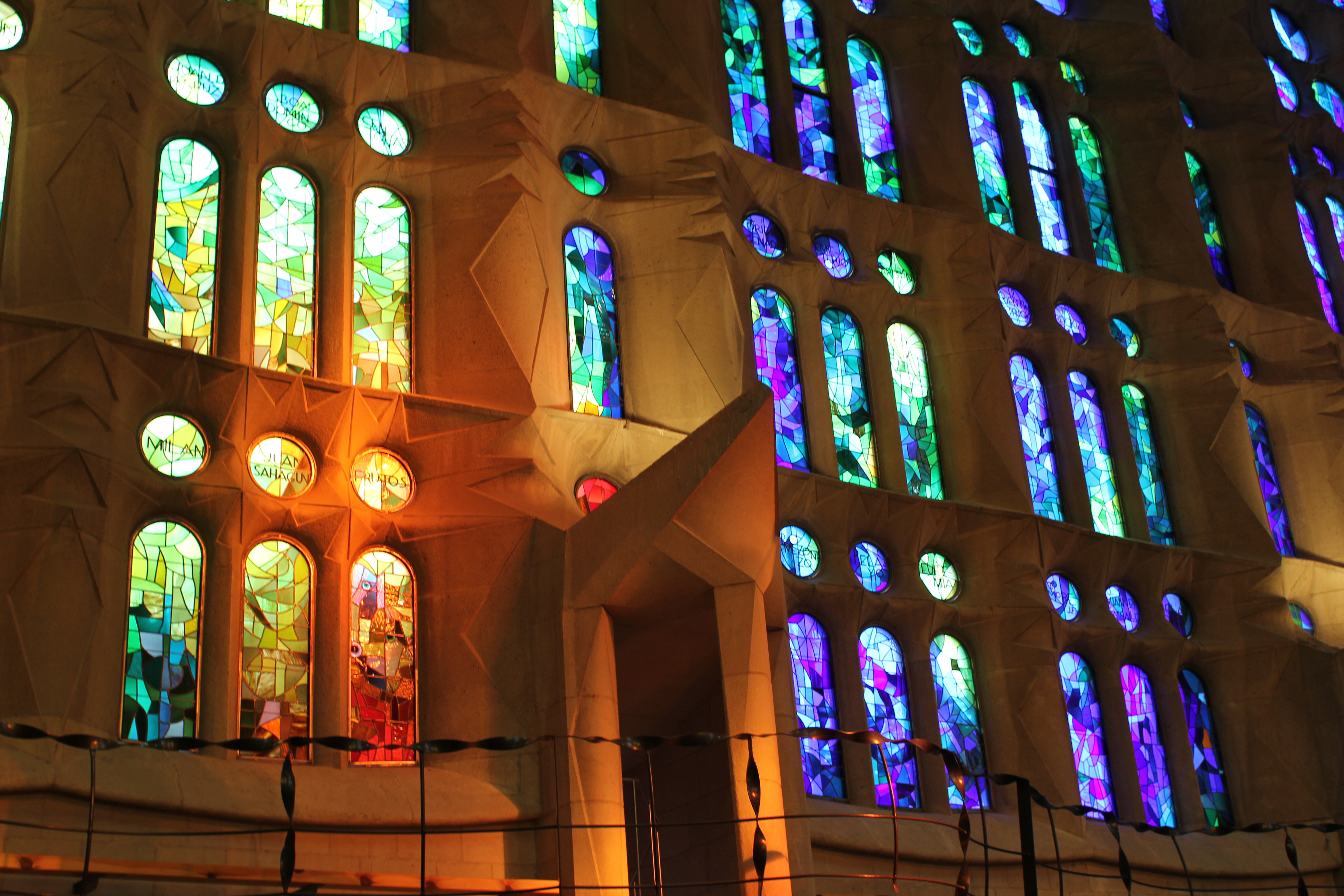
Stained Glass – Sagrada Familia 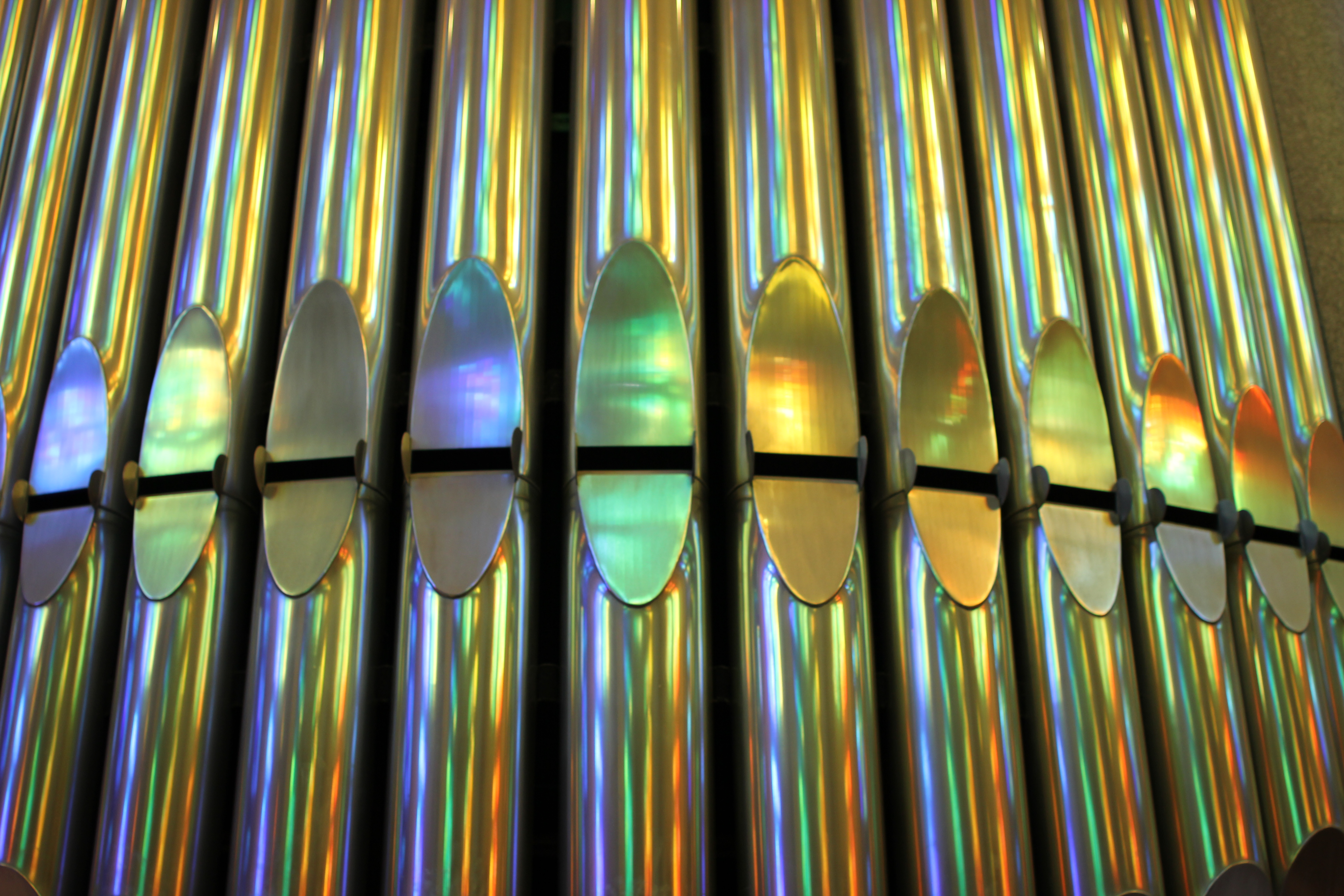
Organ – Sagrada Familia
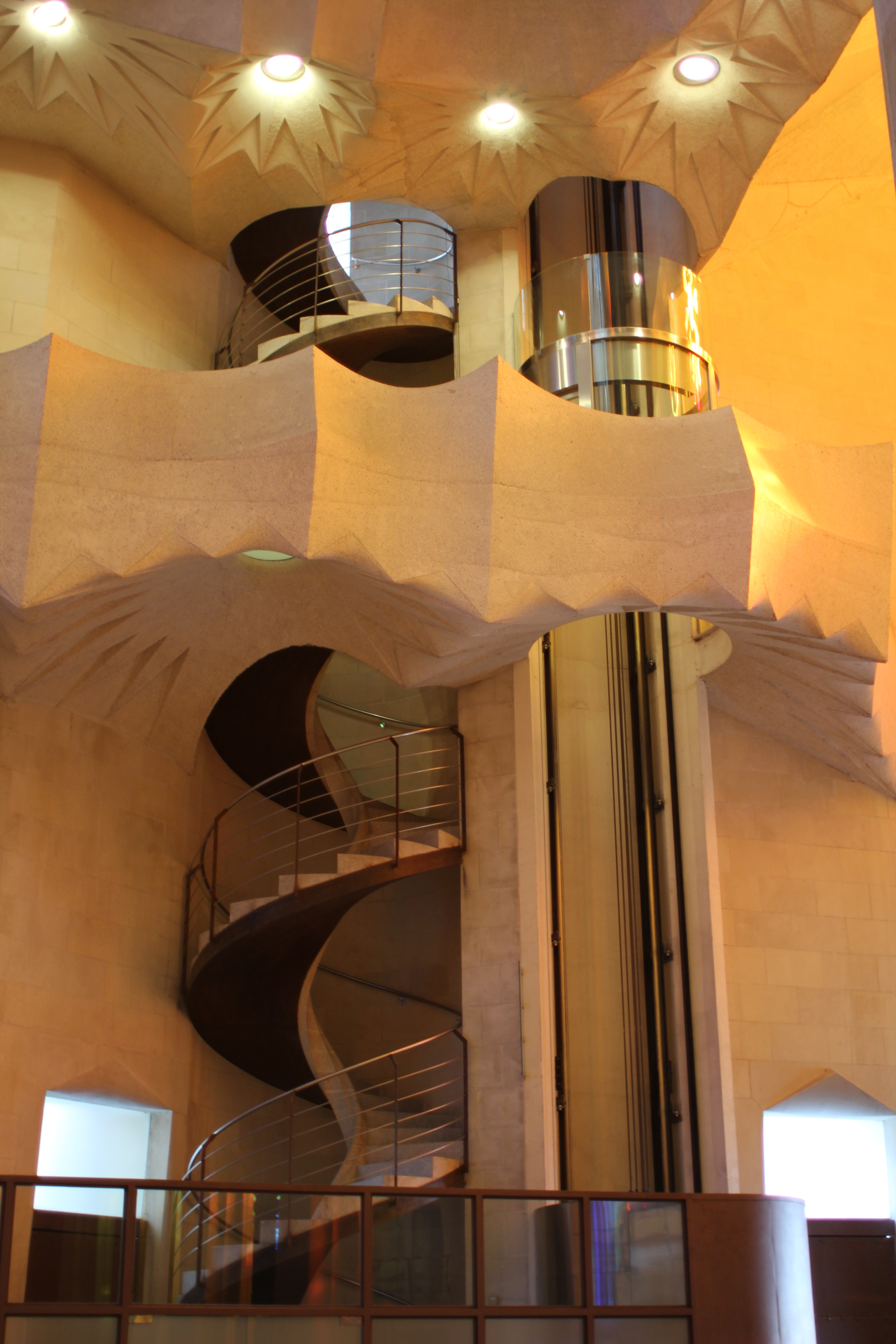
Light and geometry
Gaudi wanted to construct a building that would make an impact on the skyline, but also show his respect for the work of God.
Inside, the Basilica in showing respect for the work of God has an impact on the soul. Entering the temple, bathed in coloured light, surrounded by divine geometry you become at one with the building – mind, body and soul.
For me the ethereal light was captivating, but then I realized it was also the geometric shapes such as: Hyperboloids, found in the openings of the windows and the vaults; paraboloids, used to create linking surfaces; helicoids, which can be seen in the spiral staircases; and the ellipsoids generated to create the rounded capitals of the main columns.
What struck me on entering, apart from the light was the size of the interior and the array of columns which climb, like trees, to the roof top. Light pours into the chamber, not just from the windows on the facades but also from above. The lights above give the impression of the sun’s rays filtering through a canopy of trees. Yet this is not a green and verdant forest, the crisp whiter than white walls are broken up and illuminated by the light which comes through the intense colours of the stained glass. In contrast the windows above the altar let in a pure white light to illuminate the activity below. There is no need for embellishment and ornamentation when light is used so sensitively and creatively
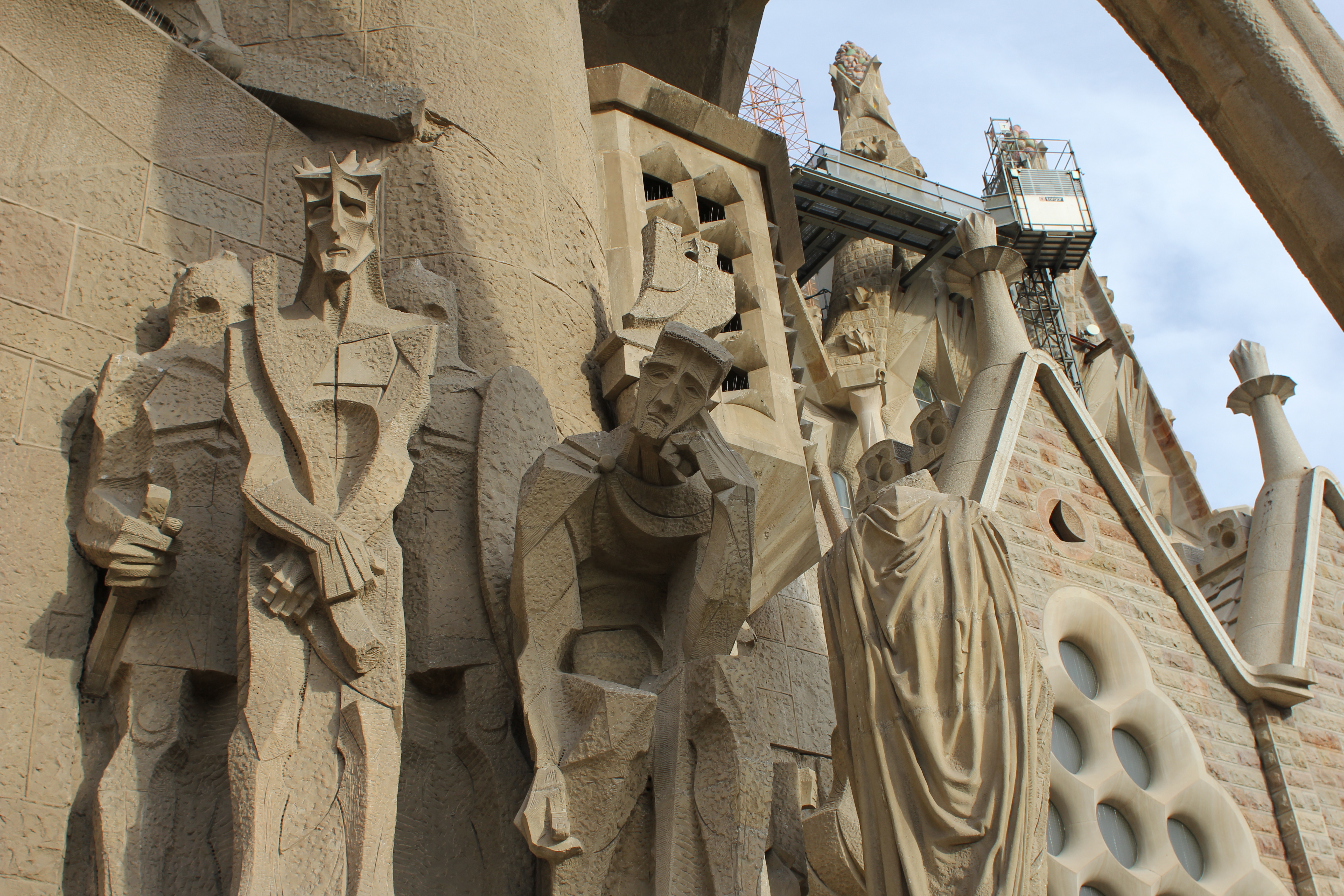
Sagrada Familia 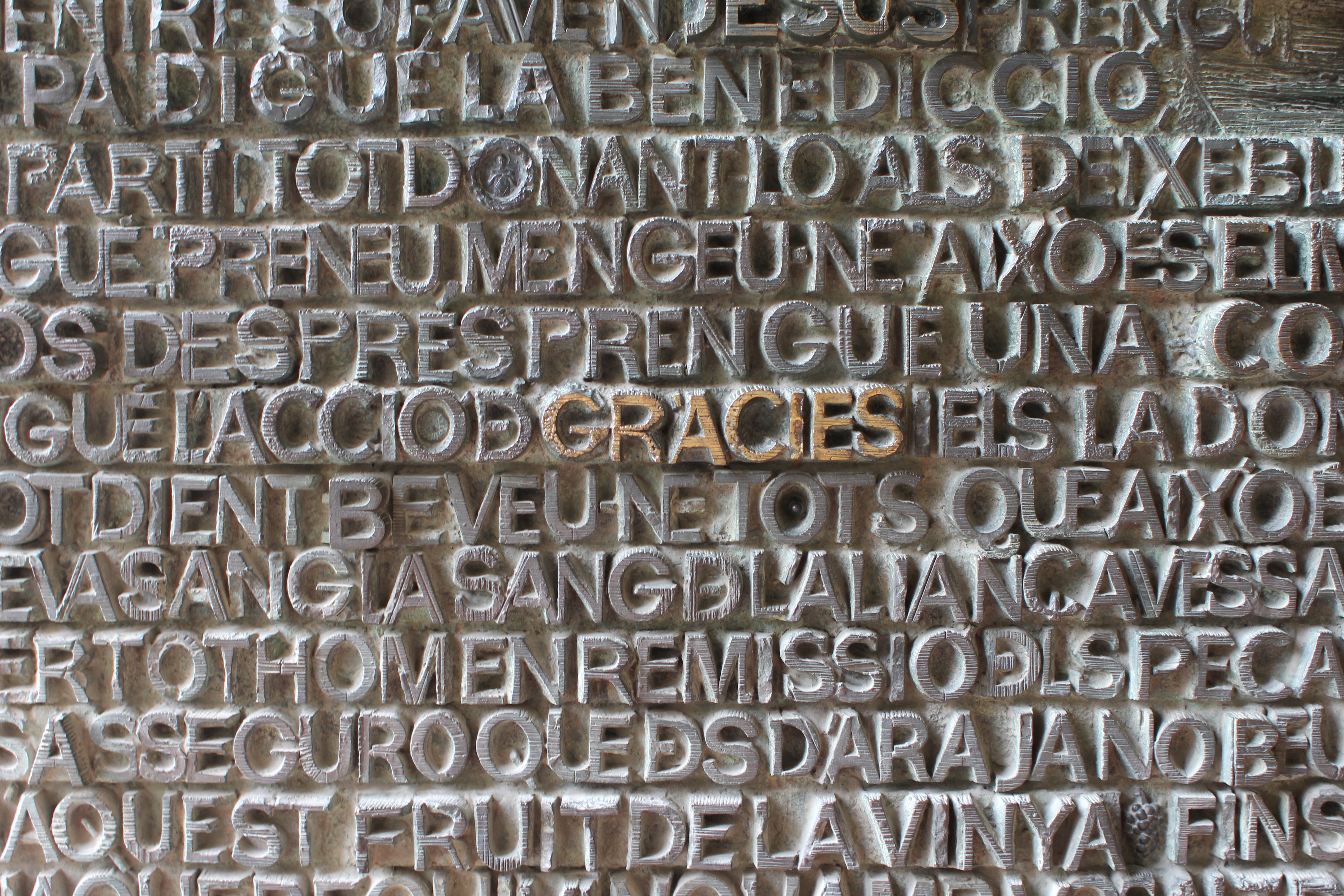
Sagrada Familia
Reluctantly we say: Adios Sagrada Familia and hopefully we leave in a state of Grace
Pilgrimage to MNAC – the art of Catalunya
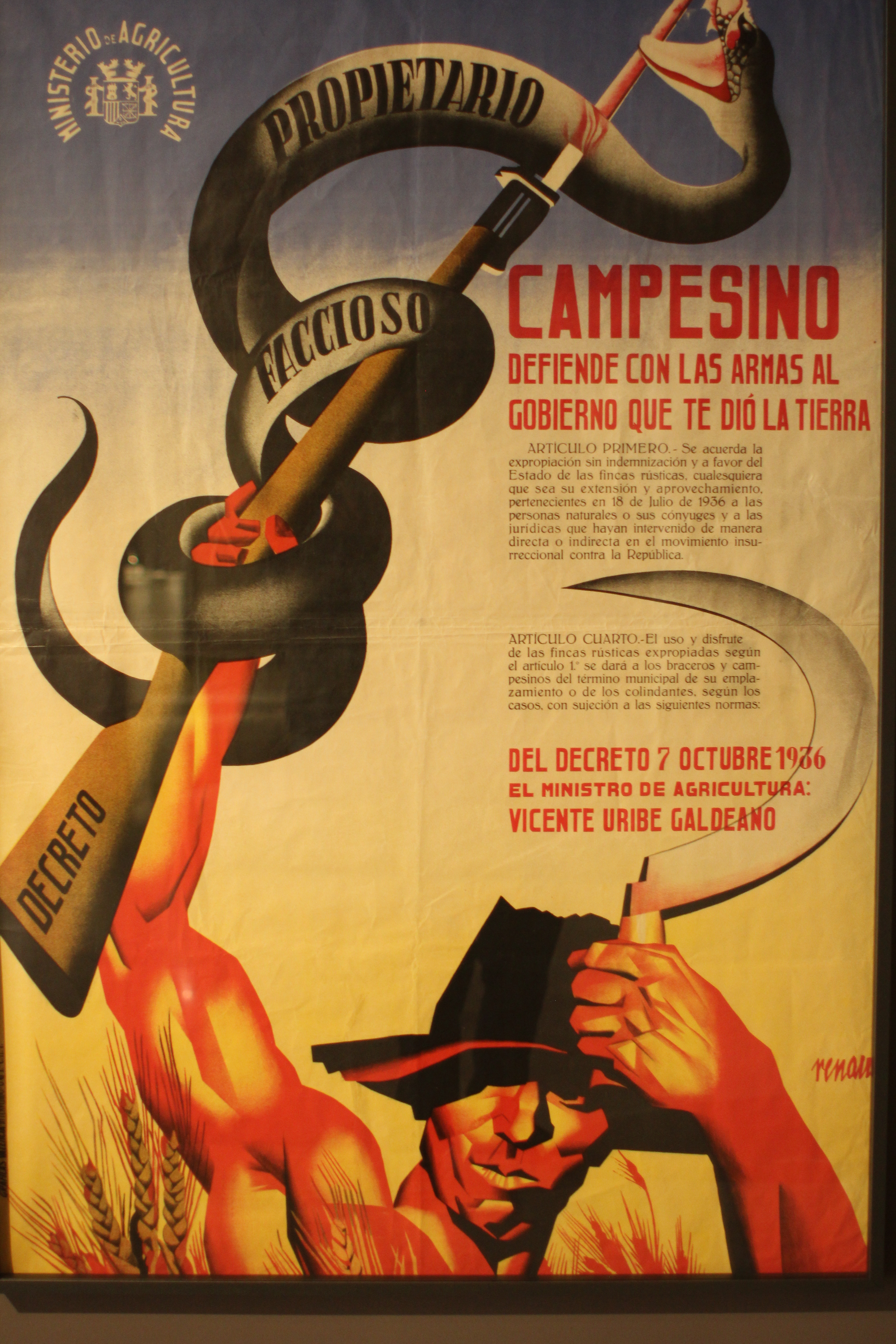
We made our annual pilgrimage to the Museu Nacional d’Art de Catalunya (MNAC), and like the previous year because we were limited for time decided to revisit the Modern & Contemporary Art Galleries.
The Palau Nacional is a splendid Spanish Renaissance-inspired building which houses several magnificent art collections, mostly Catalan art, but also Spanish and European art. The collections include: Romanesque Art, Gothic Art, Renaissance and Baroque Art and a superb Modern Art Collection. On our next visit we will have to allow more time to enjoy the other collections.
The two modern art galleries, which we revisited, include works in a range of mediums: sculpture and painting, photography, poster art, cinema, architecture and the decorative arts. Two movements in particular: Modernisme and Noucentisme are richly represented in the collection. The exhibits are enhanced through the excellent gallery text which explains, the social, historical and artistic context of the artworks and the international connections of Catalan artists and movements. Because the galleries are so well curated it makes the works so much more accessible and enjoyable.
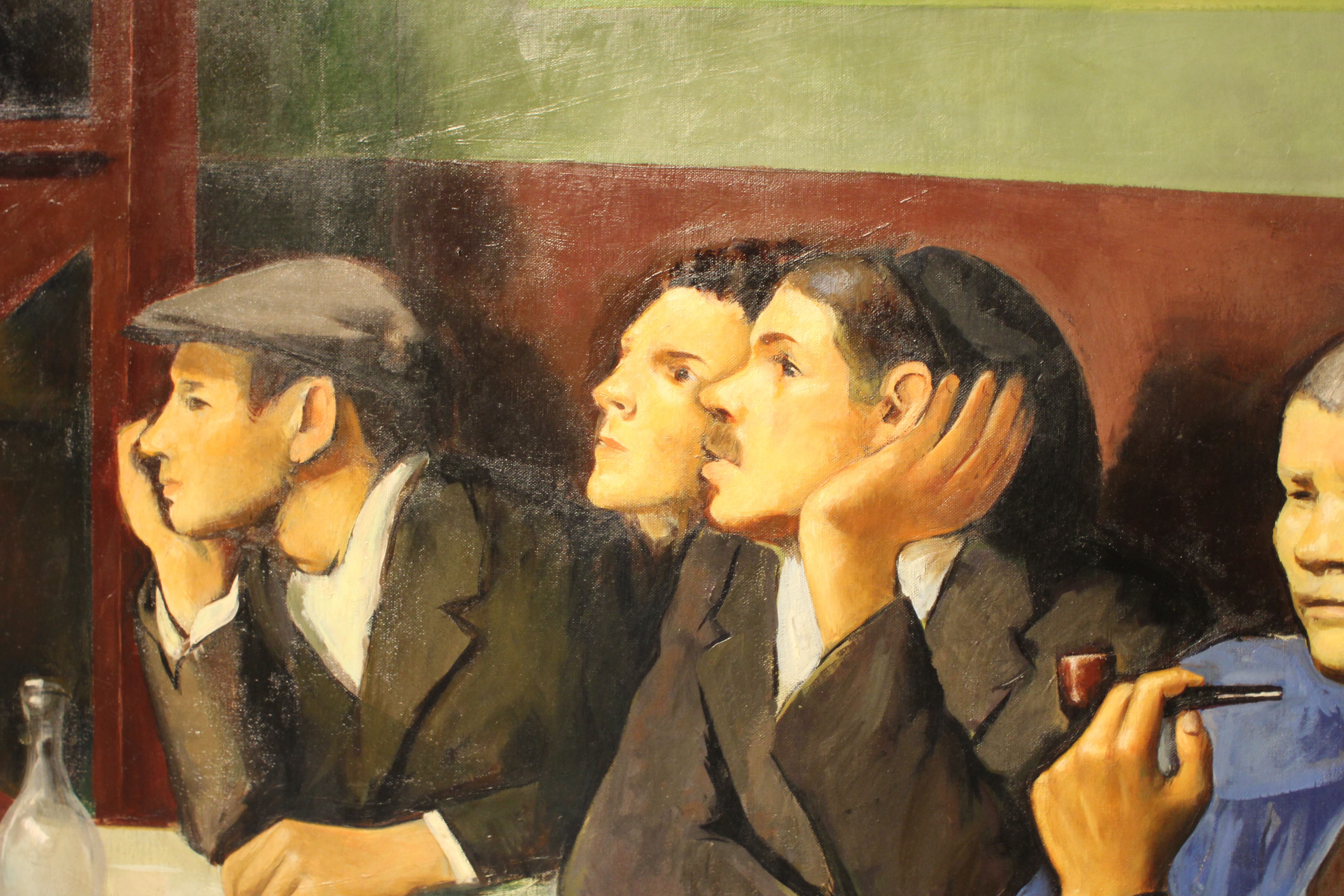
Francesc Domingo (1934) Detail Spectators 
Francesc Domingo (1934) Detail Spectators
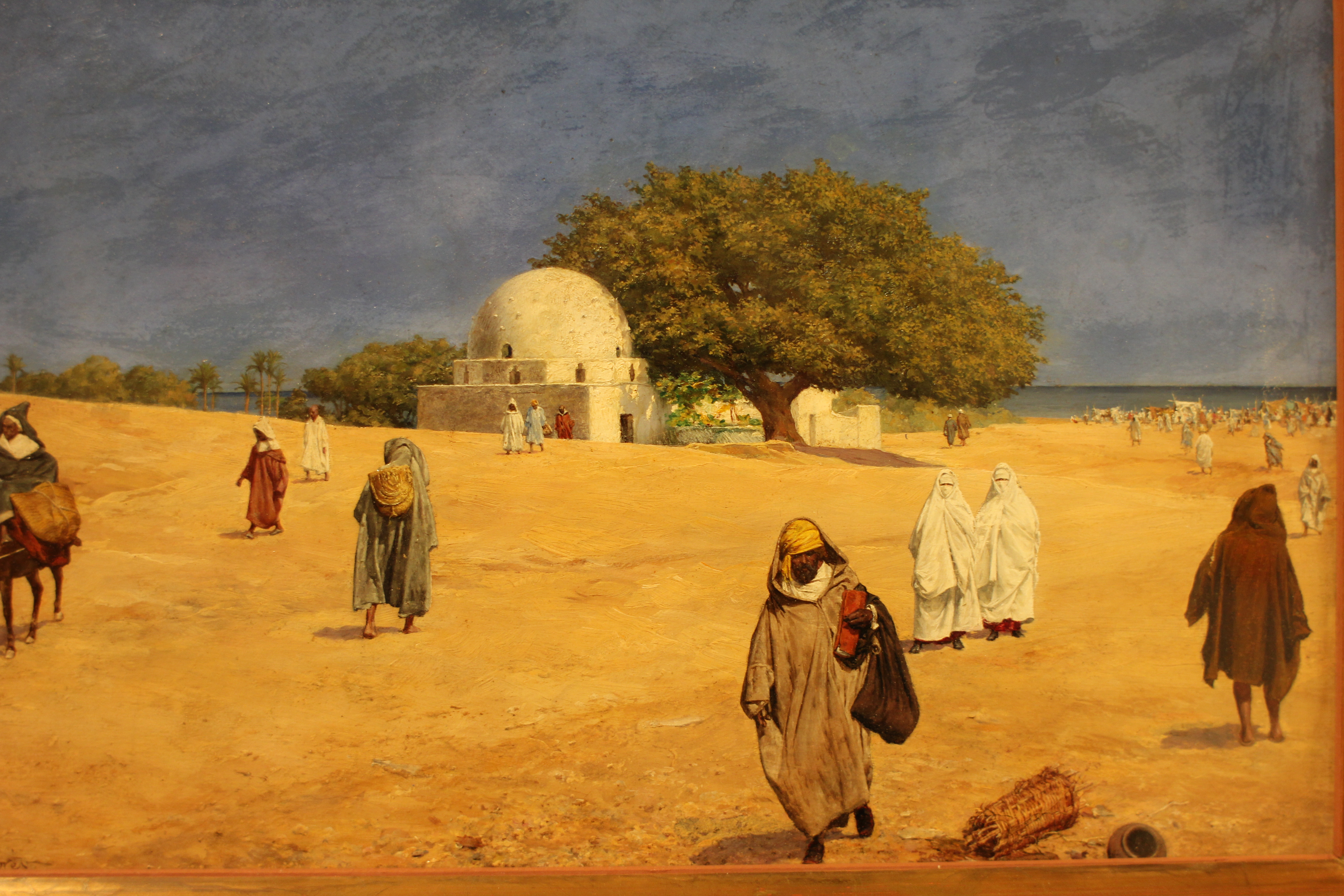
Antoni Fabrés (1920) Moroccan Pilgrimage 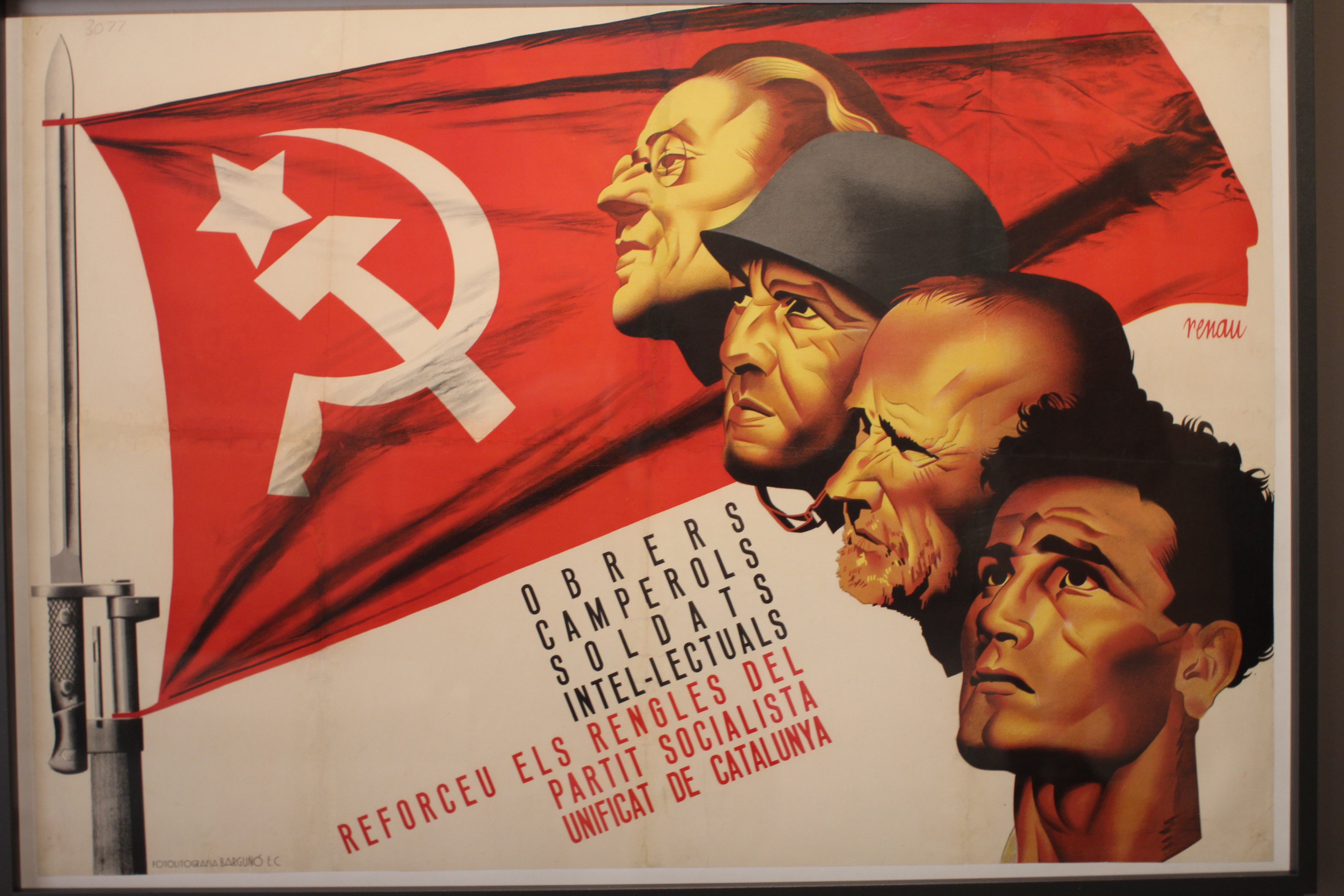
Josep Renau (1936) “Campesino…”
After our all too brief tour we sit on the terrace of the Palau Nacional slowly sipping a glass of beer, watching the light in the sky turn darker as the lights of the city start to twinkle. Below the sound of the fountains is overtaken by the musicians practicing for the New Year’s Eve celebrations.
Dinner dilemma
After a long day we were looking forward to sitting down and relaxing over dinner at Los Torreos. Having weaved our way along Las Ramblas and down Carrer del Pintor Fortuny, we turned into the narrow Carrer d’en Xuclà to discover that Los Torreos was closed for refurbishment.
We were in need of comfort food so we headed back down Carrer d’en Xuclà along to Elisabets. It’s not only cheap and cheerful but a traditional and authentic bar-restaurant, which serves breakfast, but only full meals at lunchtime and tapas in the evening. Apart from a blackboard with the specials or menu del dia, the walls are lined with shelves of old transistor radios and a racing bike hangs in front of the window.
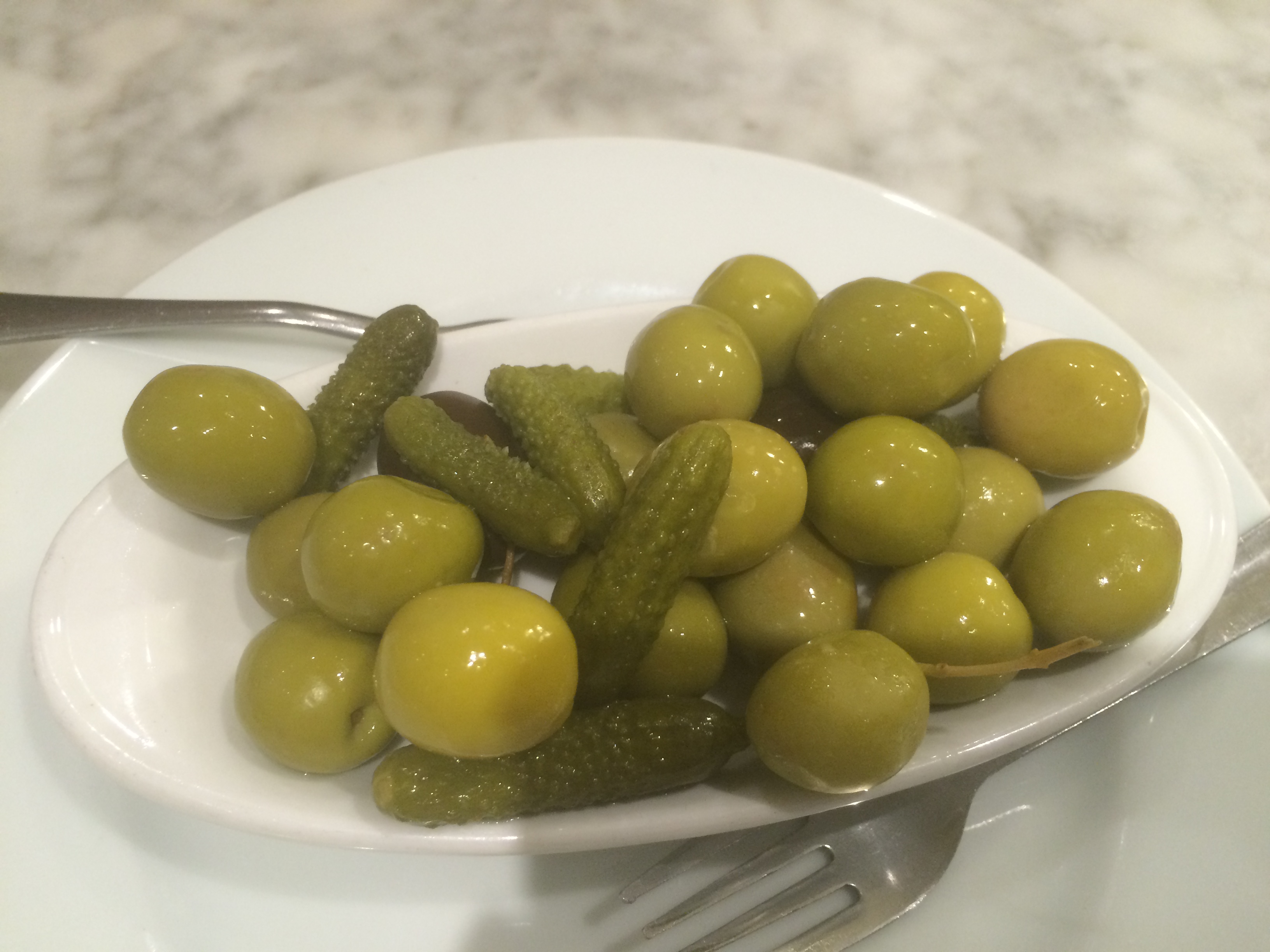
Cornichons & Olives – Elisabets 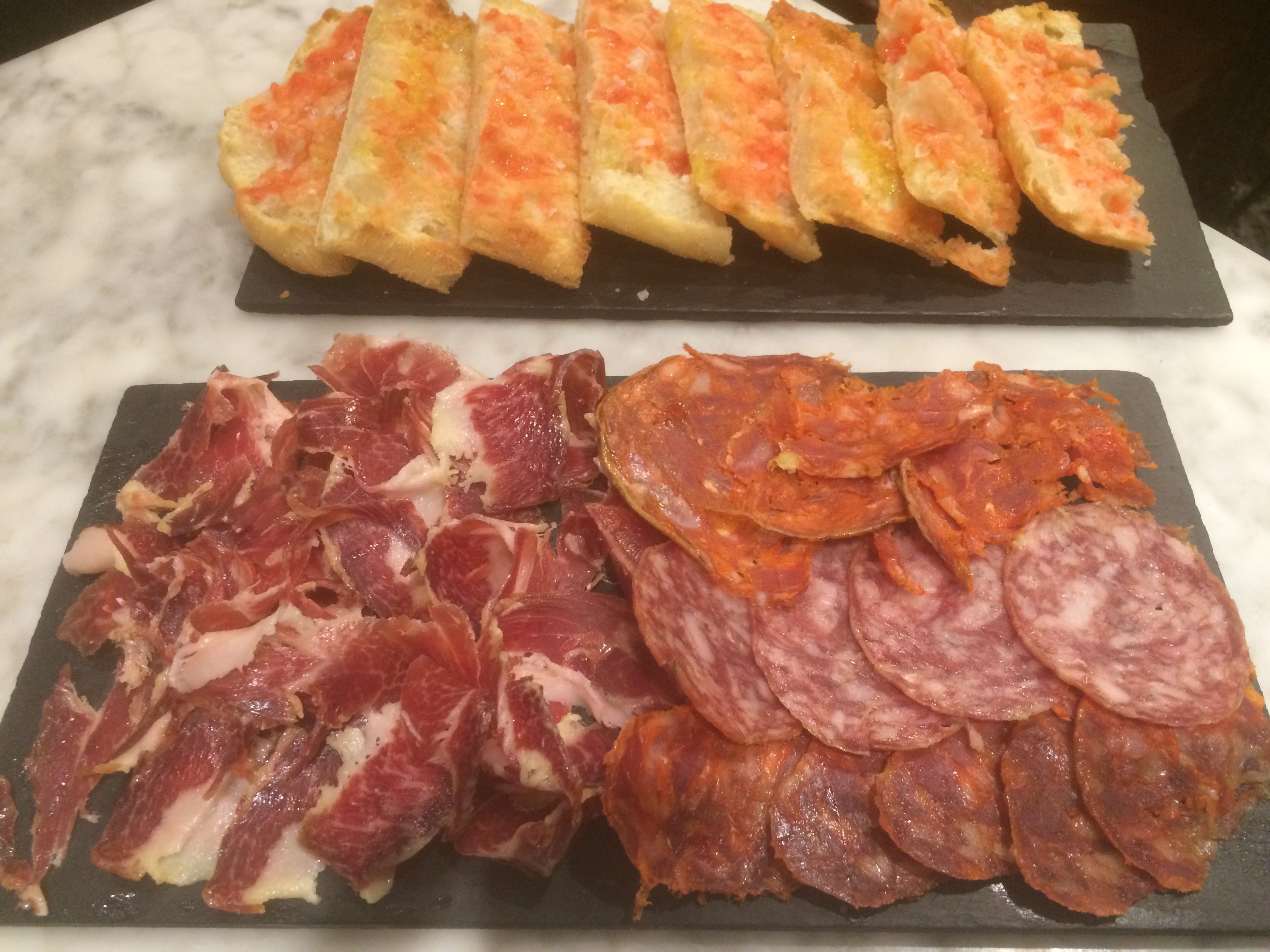
Plato combinado de Ibéricos – Elisabets
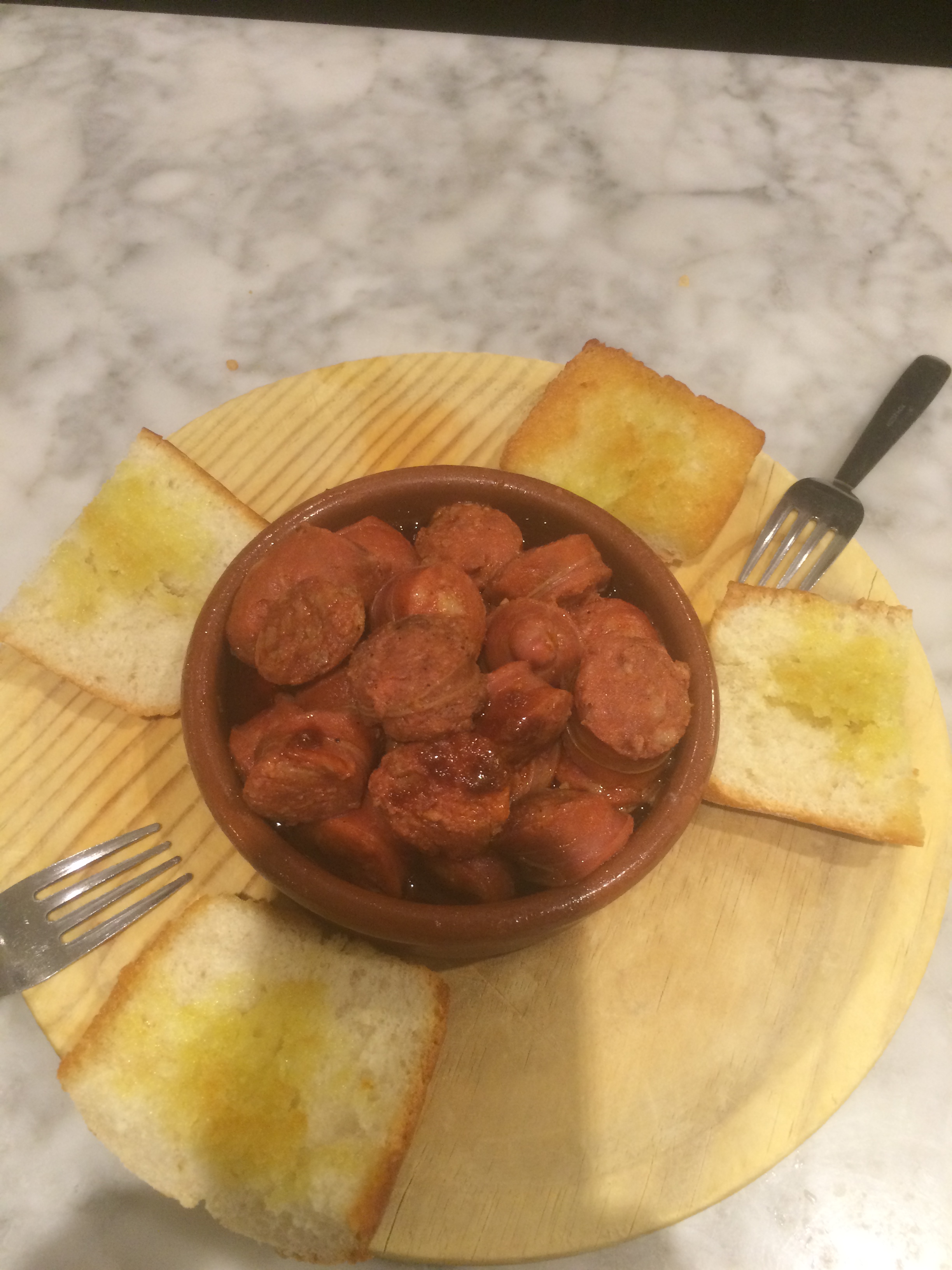
Choricitos a la sidre – Elisabets 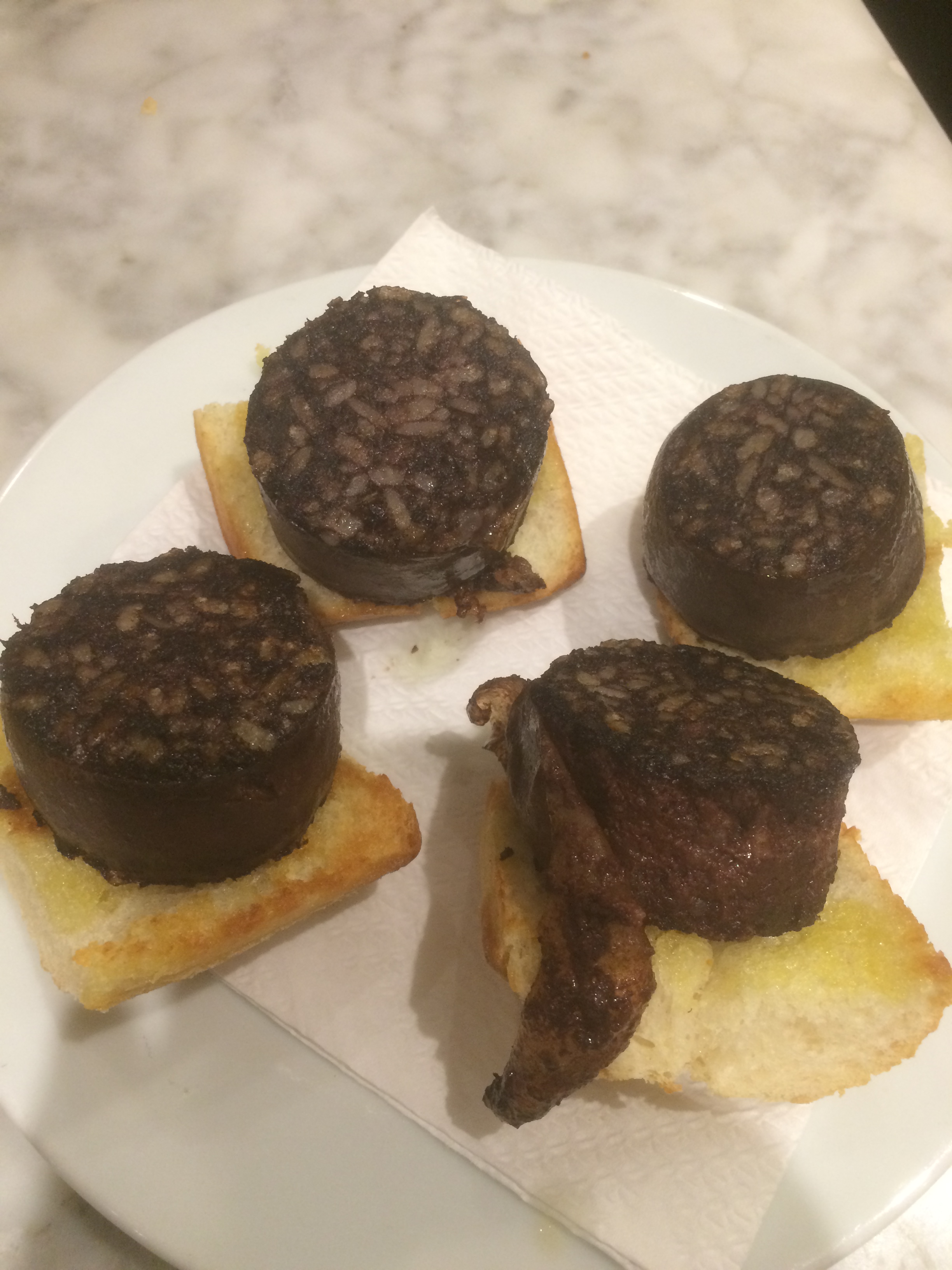
Morcilla de Burgos – Elisabets 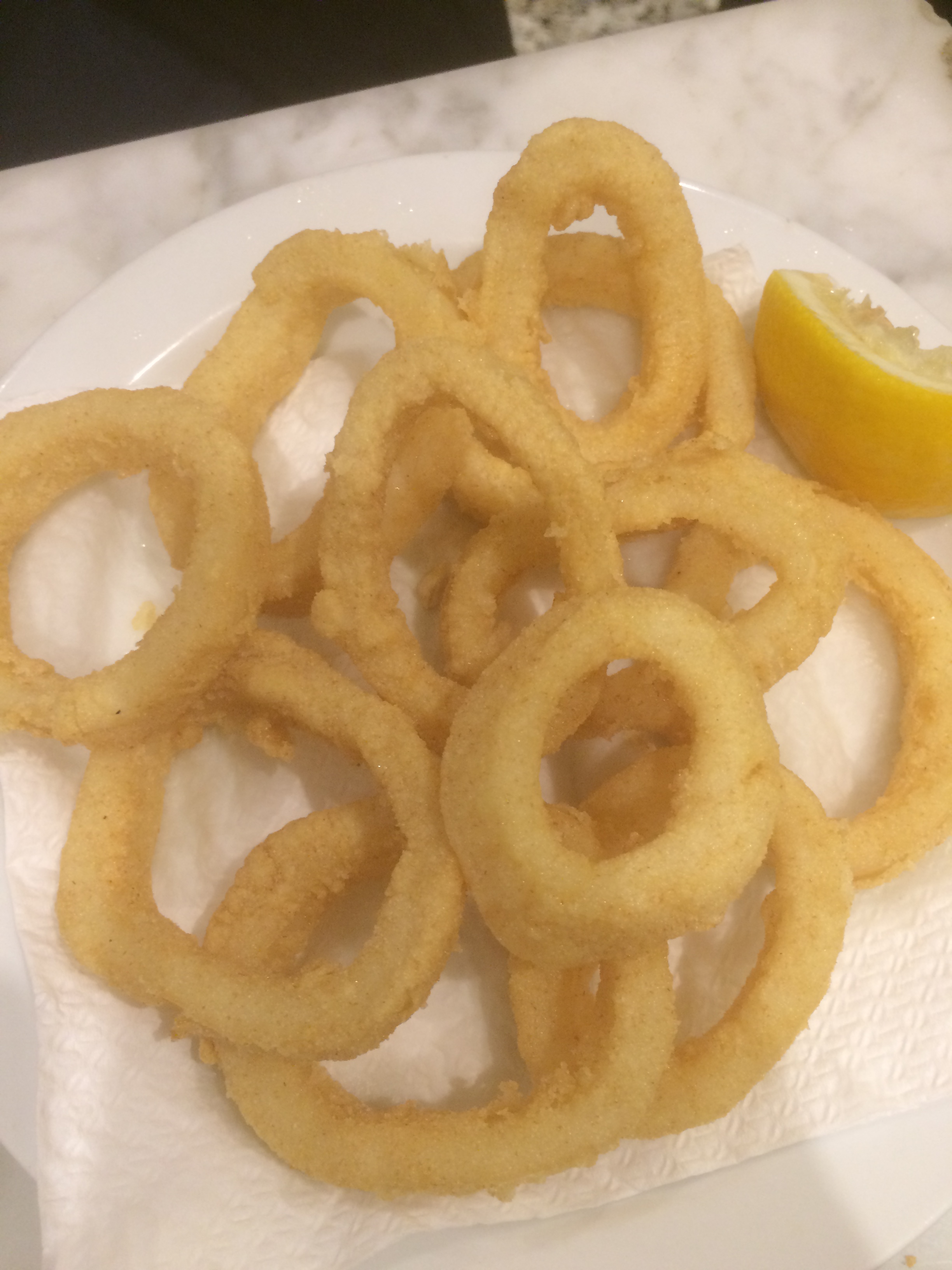
Calamares a la andaluza – Elisabets
We have a beer and some olives whilst deciding what to order from the menu. In the end we go for the plato combinado (a selection of iberico ham, salami, sausage and chorizo) with pá de coca tornado con tomate. We follow this with some Morcilla de Burgos, Calamari a la Andaluza and Choricitos a la sidre. In hindsight we should have substituted one of the meat dishes for a lighter vegetable dish, or just added a vegetable dish and got somebody else to join us!!.
Hoy vamos a Tarragona en tren
Wednesday, 30 December, 2015 – Barcelona, Spain
Desayuno
After breakfast at Farggi we cross the road to Plaça Catalunya from where we take the Metro to Estacio-Sants. It’s a direct journey on Line 3 (Direction Zona Universitària) which takes less than 15 minutes.
Estacio Sants
Estacio Sants is a bright and airy station. After waiting for a few minutes on the concourse our train is shown on the departure board and we make our way downstairs to platforms 9-10 from where our train will depart.
The train is a little delayed and the platform is busy so when it does arrive passengers board quickly in order to secure a seat. We manage to sit together but a number of passengers are left standing. With limited luggage space overhead passengers resort to putting luggage on the seat next to them. Surprisingly none of the standing passengers ask then to move their luggage.
For most of the journey the trains runs along the coast which provides views of the Mediterranean sea.
Tarragona: Veni. Vidi. Bibi.
Wednesday, 30 December, 2015 – Tarragona, Spain
Tarragona – Roman, Medieval and Modern
We pulled into Tarragona train station just 10 minutes later than scheduled, as usual we have a packed itinerary, so every second counts! With only a day in Tarragona we had to make a decision whether to focus on Roman, medieval or modernist sites. Tarragona’s history is like a richly woven tapestry with layers and archaeological strata woven together, with medieval buildings built on Roman remains and modern buildings next to Roman remains. However we had to have a focus and in the end Tárraco – Roman Tarragona – won the day and so our itinerary included mainly Roman sites, although we allowed time for a visit to some other sites, including the medieval cathedral and Balcón del Mediterráneo.
Balcón del Mediterráneo – Balcony of the Mediterranean
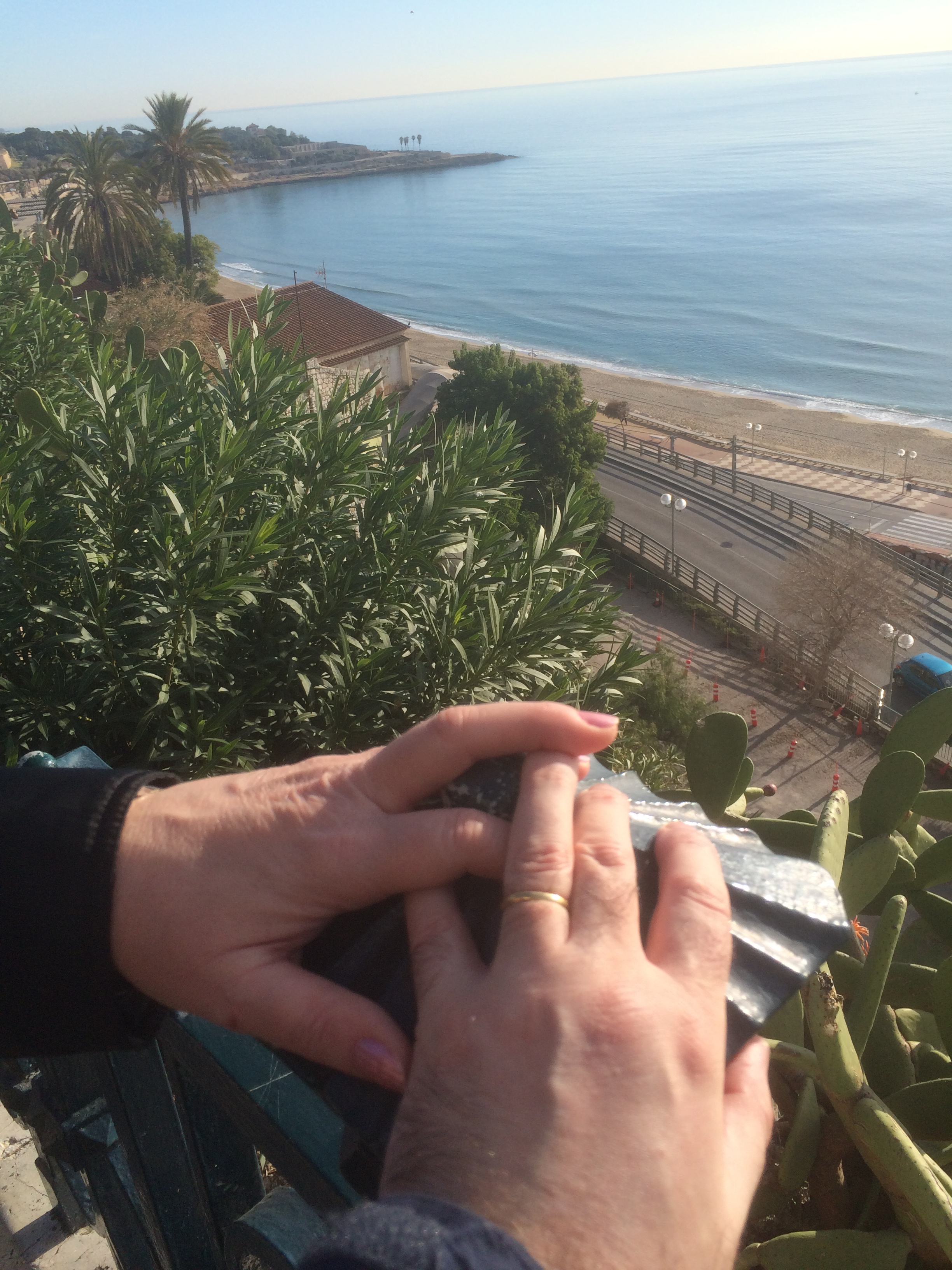
Just five minutes walk from the train station, along Via William J. Bryant, up a few flights of steps to the gently sloping Carrer Baixada de Toro and then more steps! Finally we reached the airy balcony which is at the top of Rambla Nova and provides a panoramic view of the Mediterranean, Tarragona port, Platja del Miracle beach and the ancient Roman amphitheatre.
Christening this viewpoint as the Balcony of the Mediterranean is attributed to Emili Castelar, president of the First Spanish Republic, when he visited Tarragona in 1863. The current iron railings were designed by Ramon Salas i Ricomà in 1889.
There is a local tradition that touching the railings or tocar ferro brings good luck. Apparently falling over the railings brings bad luck. Fortunately we didn’t fall over the railings but instead walked down the hill towards the first site on our tour of Tarraco, the spectacular Roman amphitheatre which overlooks the Mediterranean.
Anfiteatro de Tarragona – Roman Amphitheatre
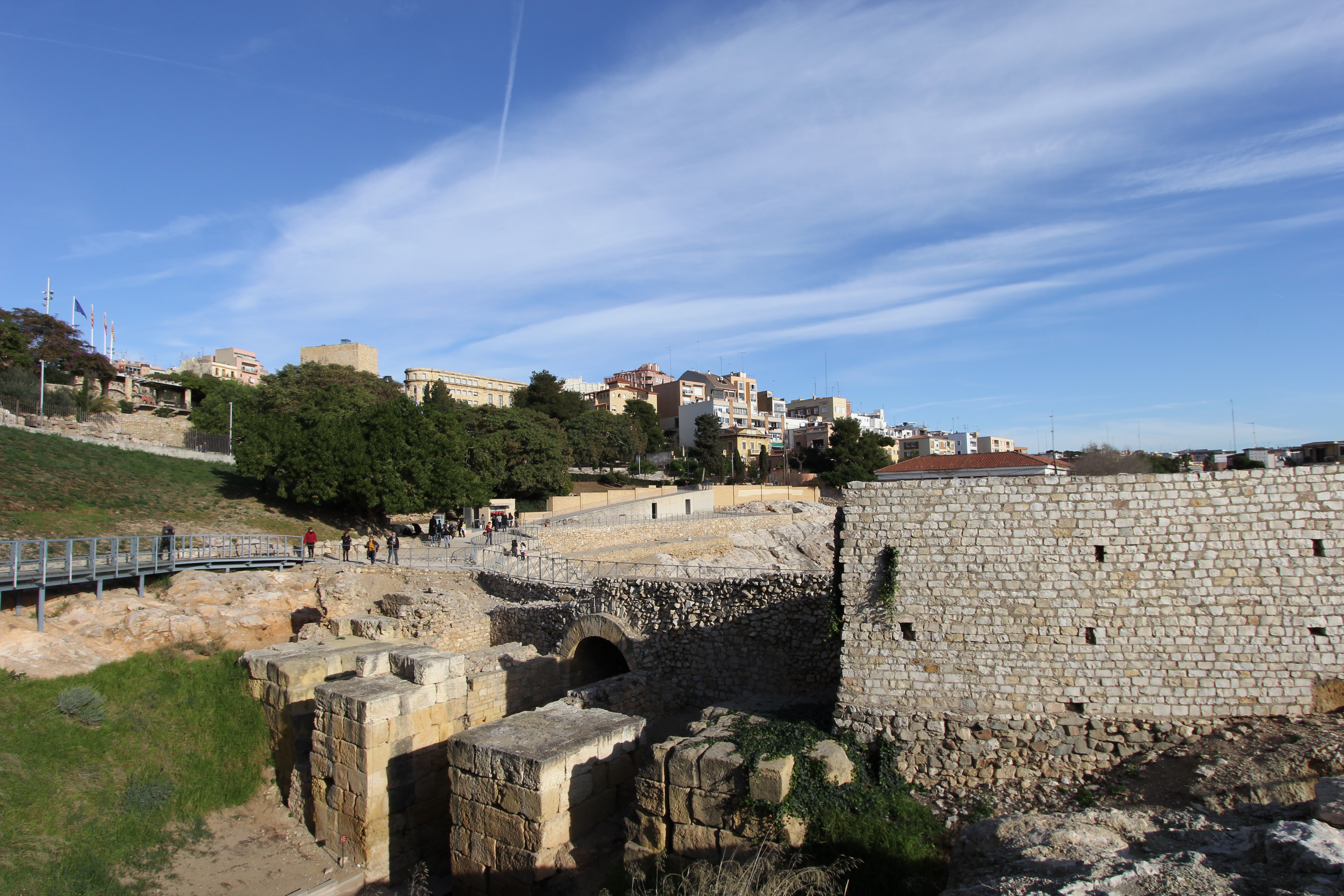
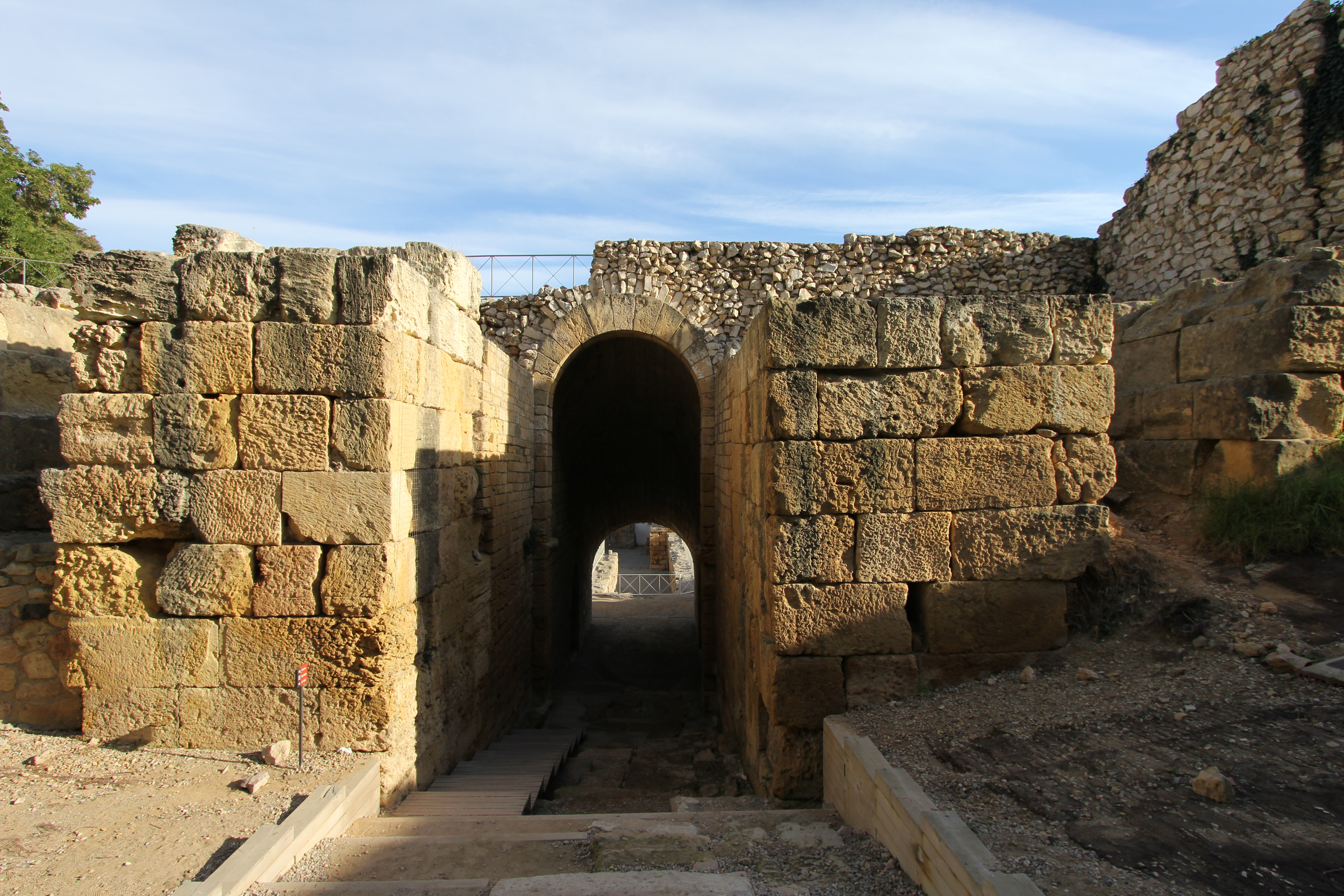
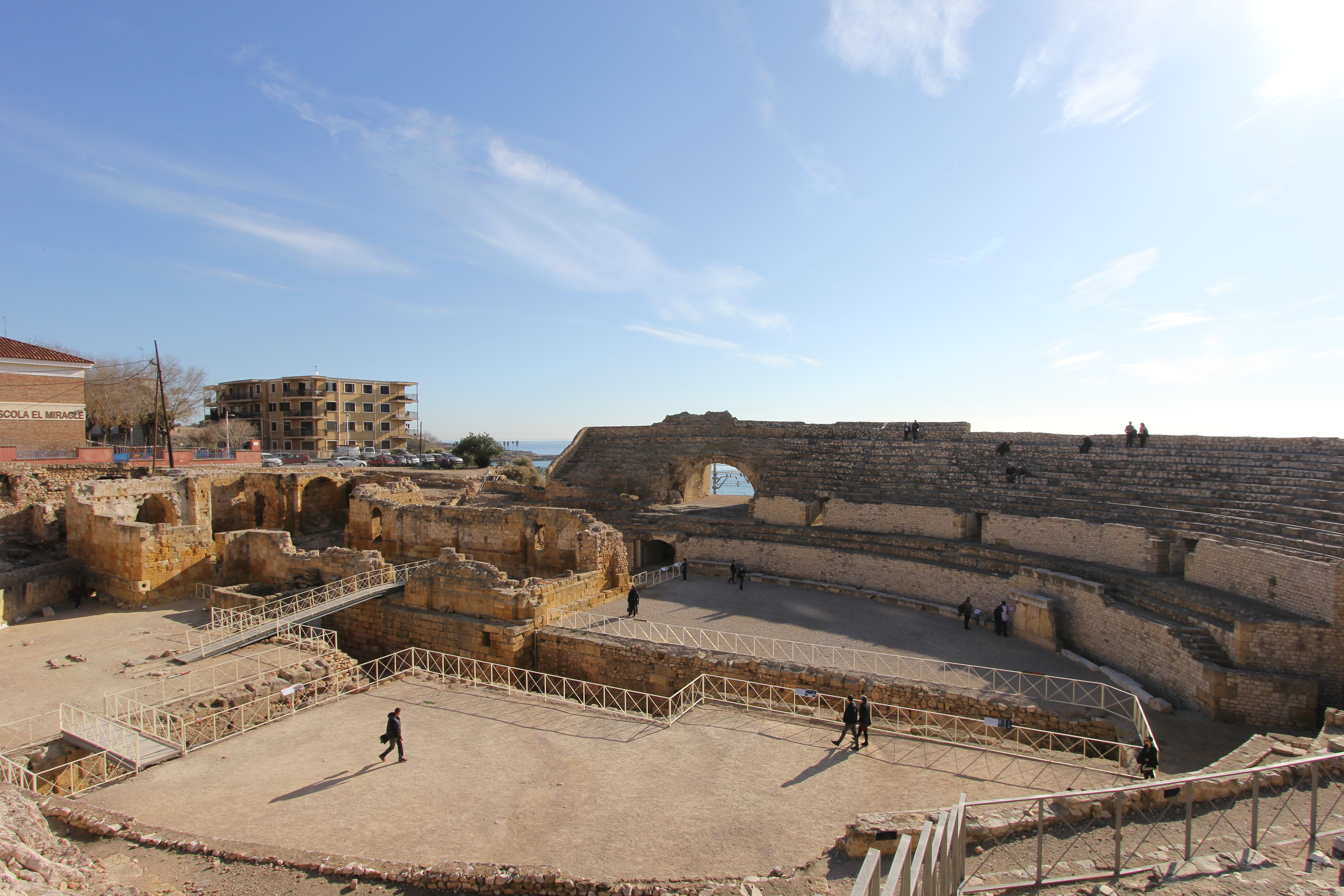
Built in the 2nd century, this well preserved oval structure is in a stunning position overlooking the Mediterranean Sea. On the northern side of the ampitheatre the seats were carved directly out of the underlying sloping bedrock. Some 109 metres long and 86 metres wide it is estimated that the amphitheatrecould accommodate up to 14,000 spectators. In its day, it was the scene of fights between gladiators (munera) and wild animal hunts (venationes), as well as public executions. The amphitheatre is also famous for having had a 140 metre inscription – the longest in the empire – which crowned the podium.
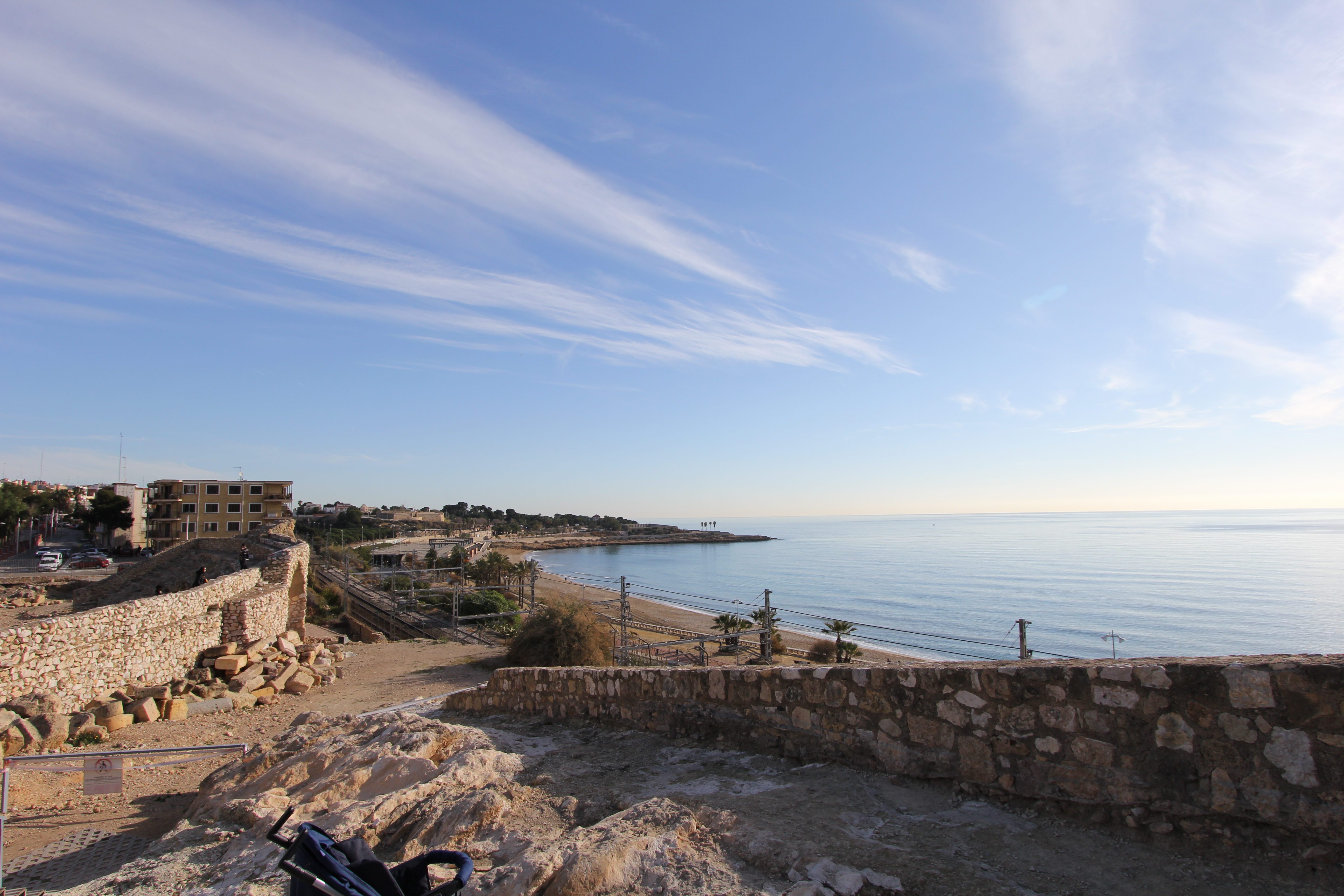
Ampitheatre – Tarragona 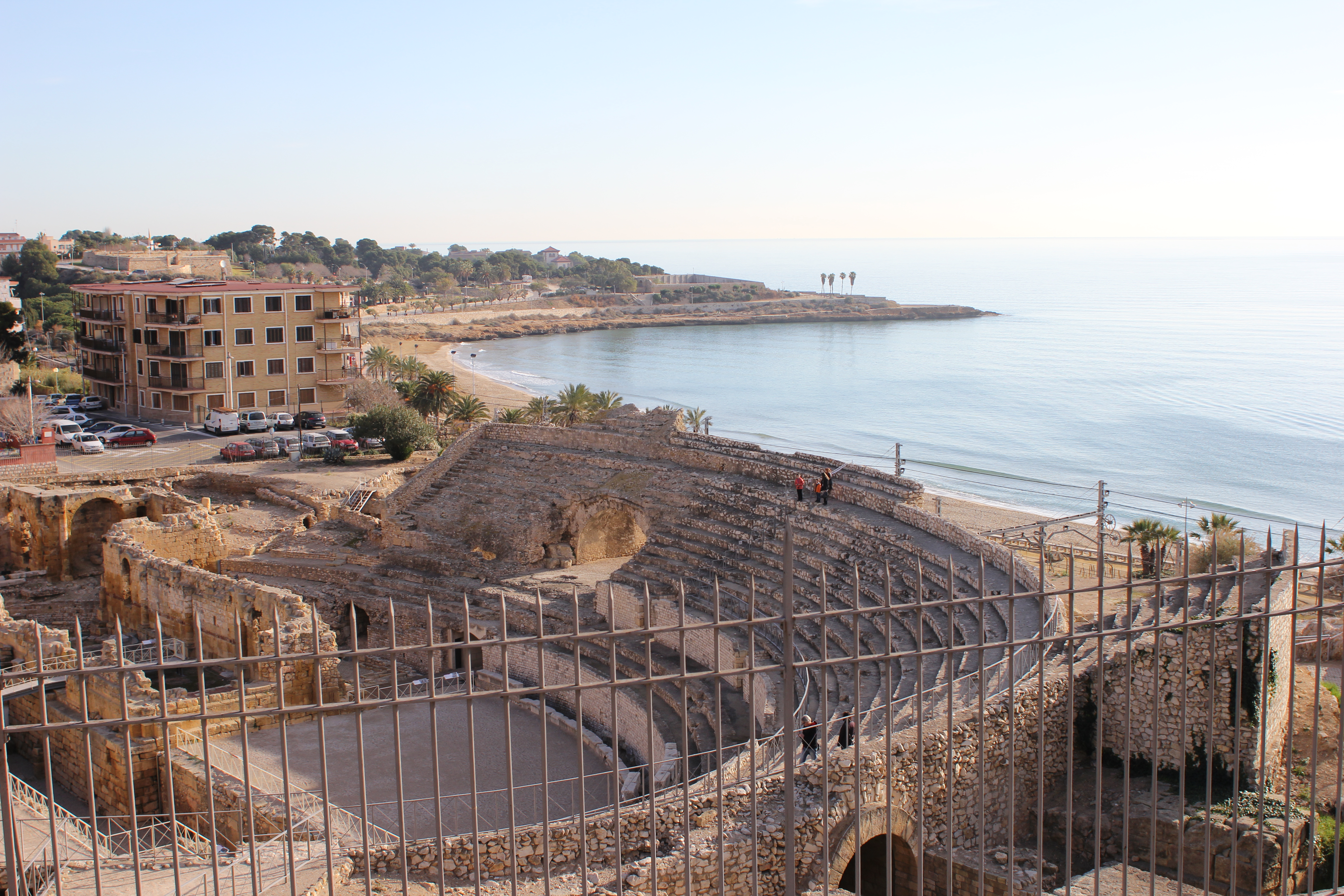
Ampitheatre – Tarragona
The amphitheatre was the site of the martyrdom Bishop Fructuoso who was burned alive with his deacons Augurio and Eulogio in 259 A.D. To commemorate his martyrdom in the early 6th century, a Visigoth basilica was built on the site, which was eventually replaced by the medieval Santa Maria del Miracle (Our Lady of the Miracle) church. The remains of the church which has a Latin-cross floor plan can be seen in the amphitheatre today.
Ampitheatre – Tarragona 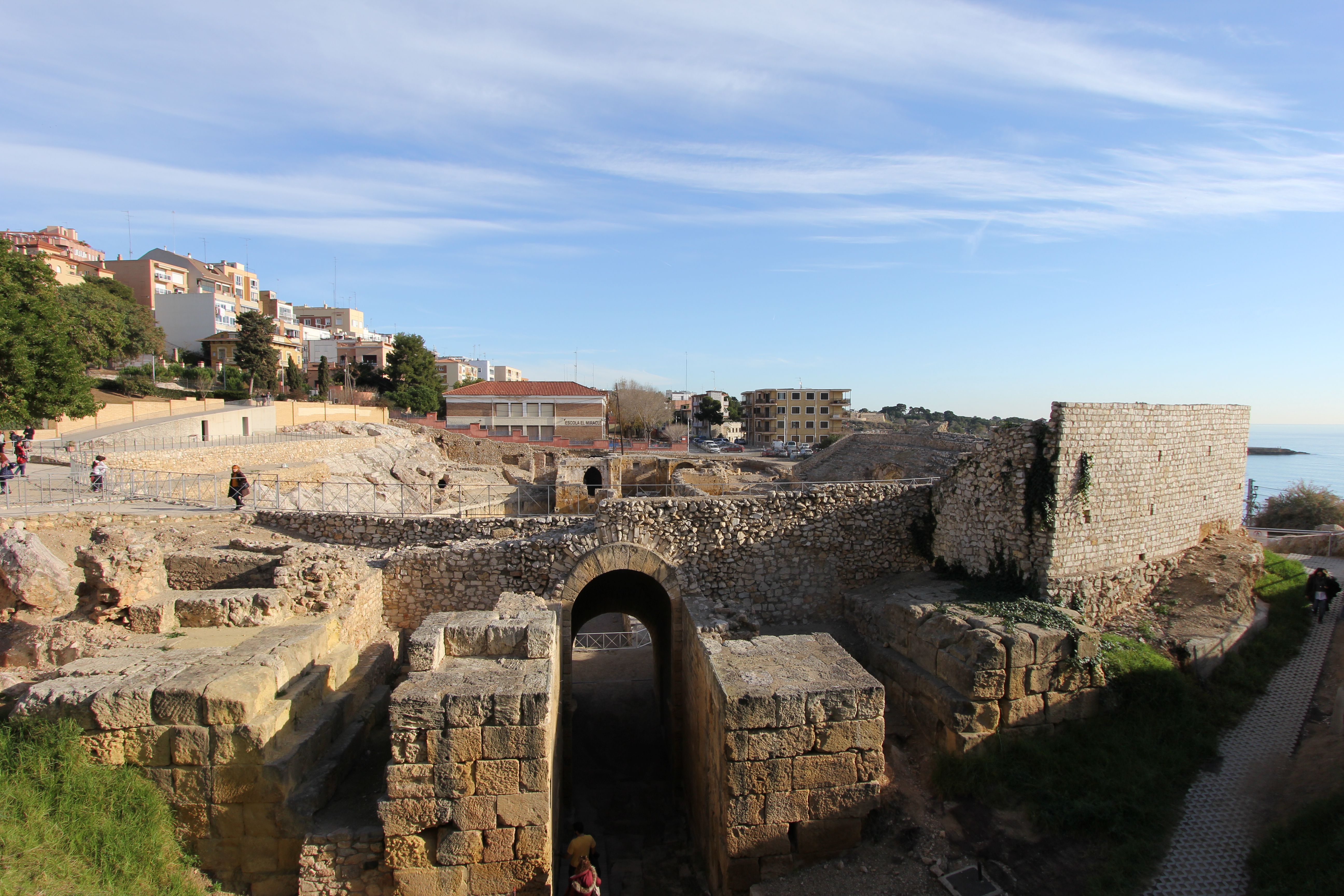
Ampitheatre – Tarragona
Ampitheatre – Tarragona 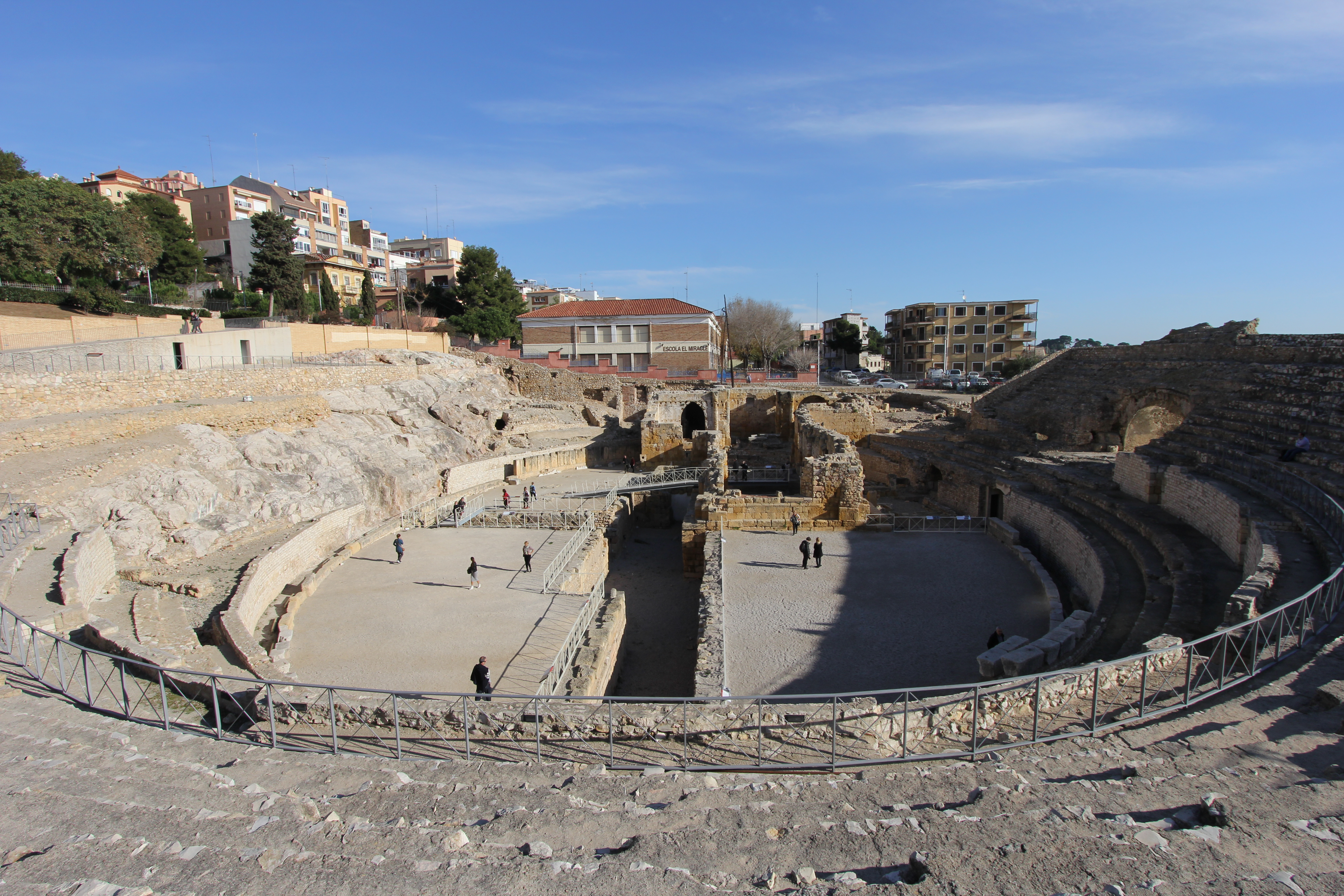
Ampitheatre – Tarragona
Ampitheatre – Tarragona 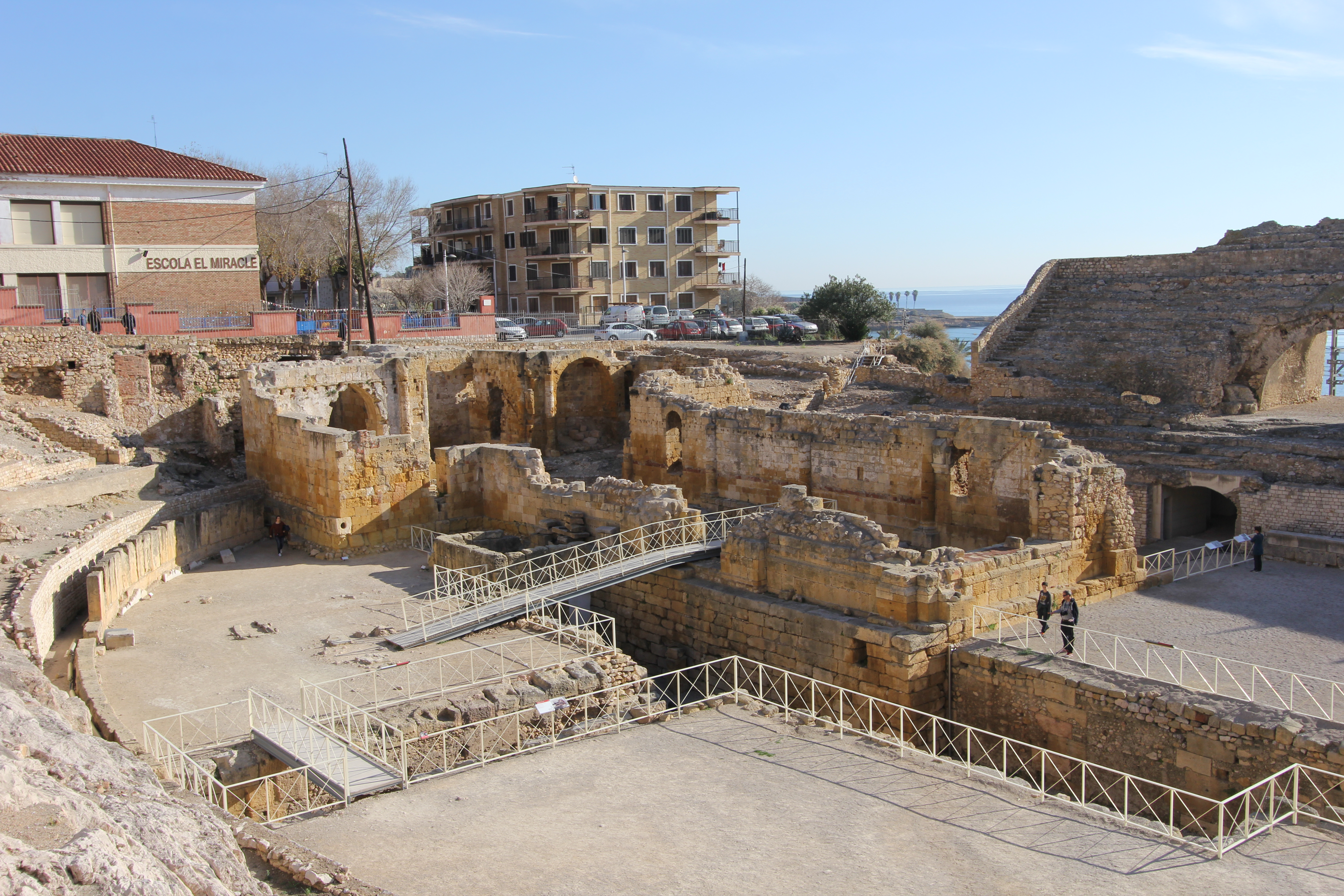
Ampitheatre – Tarragona
As we leave the amphitheatre I take one last look across the site, imagining what it must have looked like at the height of imperial glory, full of colour, noise, life and death with the azure Mediterranean Sea as a backdrop. Ave atque vale.
La Muralla & Torre de las Monjas – The Wall & Monges Tower
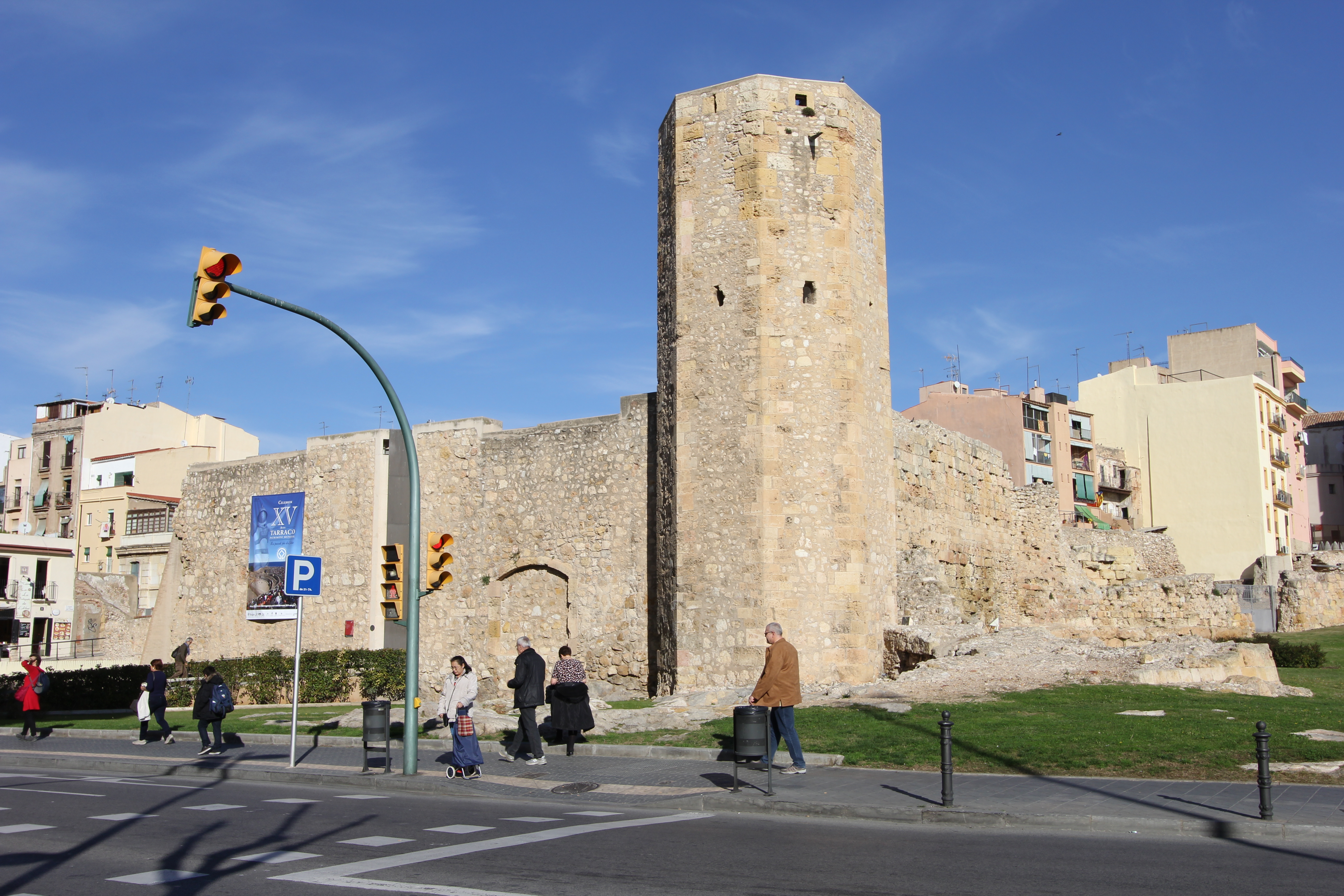
So nothing to do with Pink Floyd, but we are weaving medieval and Roman walls. During the medieval period the Roman wall was maintained and repaired where necessary.
In the 14th century, the walled area was enlarged to include the area of the old Roman Circus through the construction of the Muralleta, or Small Wall, still partially visible adjacent to the Sant Hermenegild vaults. This section of the wall was reinforced with several towers, of which only the Monges and Tintoré towers remain today.
Roman Circus and Praetorium
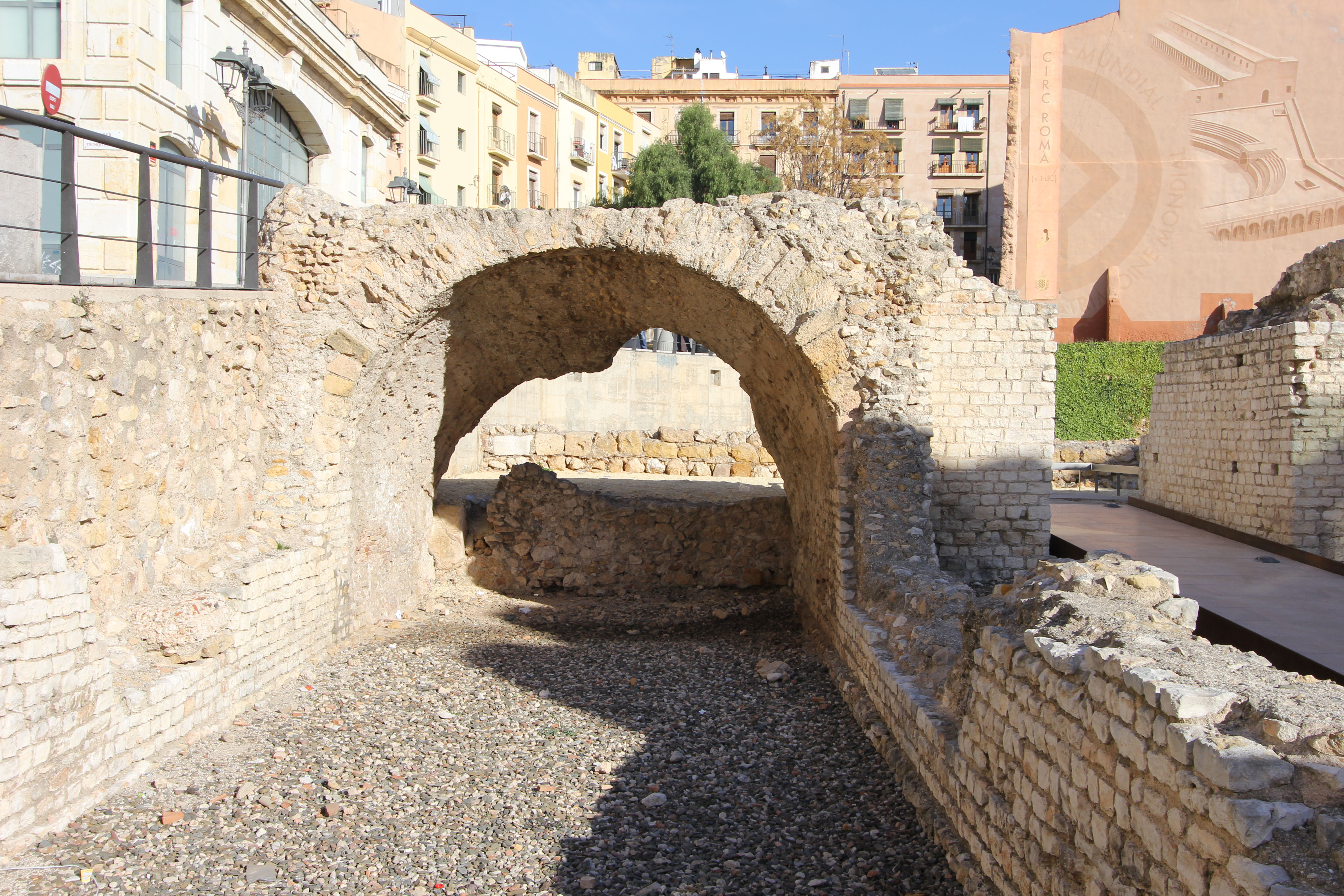
Built in the 1st century Tarragona’s Circus – think Ben Hur rather than Gerry Cottle – was once the venue for spectacular horse and chariot races. You have to use your imagination since only parts of the circus have been revealed and the majority are buried underneath modern 19th century buildings. However, walking around the site, through the tunnels and watching a very good video recreation, enabled us to gain a good understanding of the size of the circus (325m long and some 115m wide) and how it might have looked with the two horse chariots (bigae) or four horse chariots (qaudrigae) racing around the circus and an audience of some 30,000 spectators.
Roman Circus – Tarragona 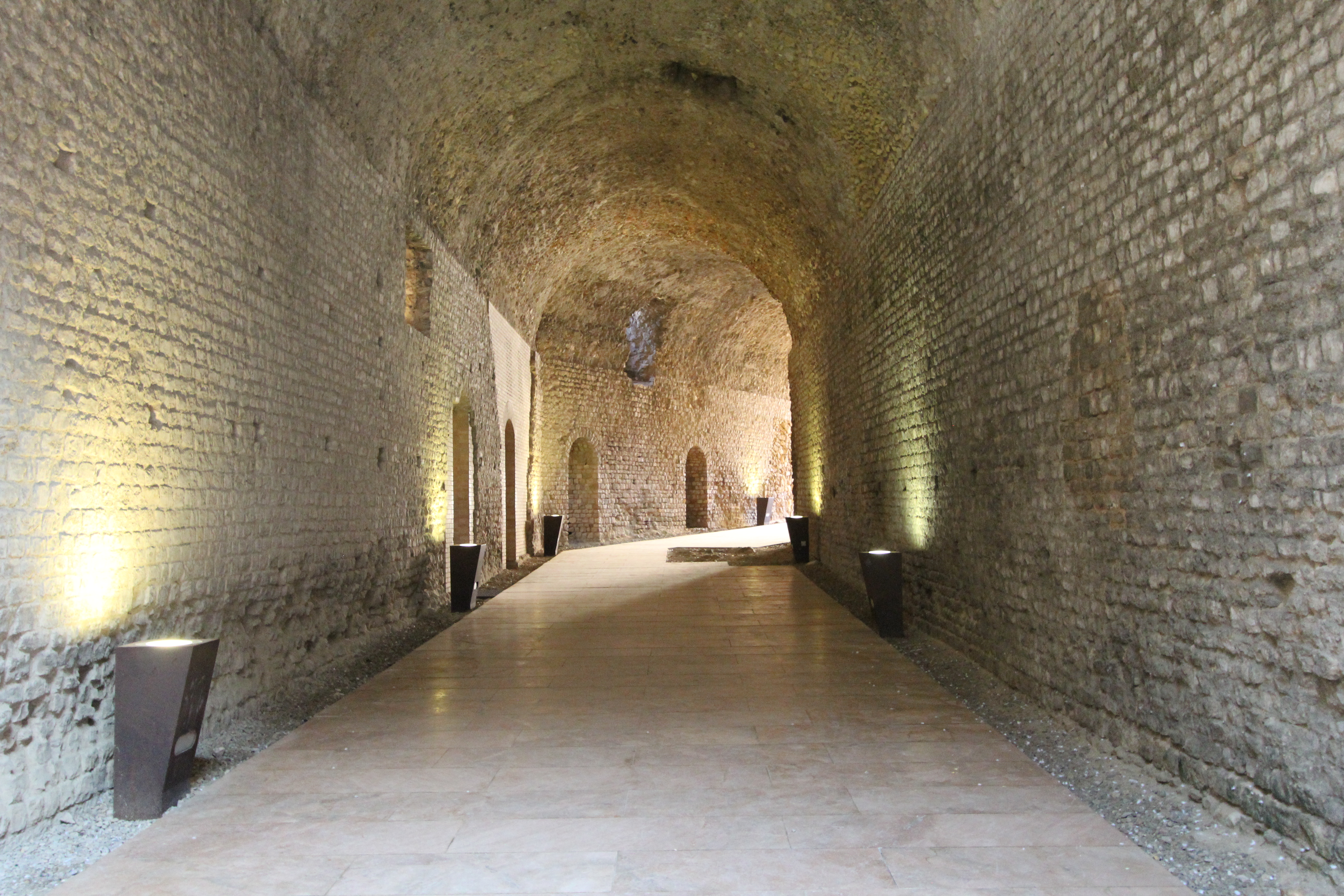
Roman Circus – Tarragona
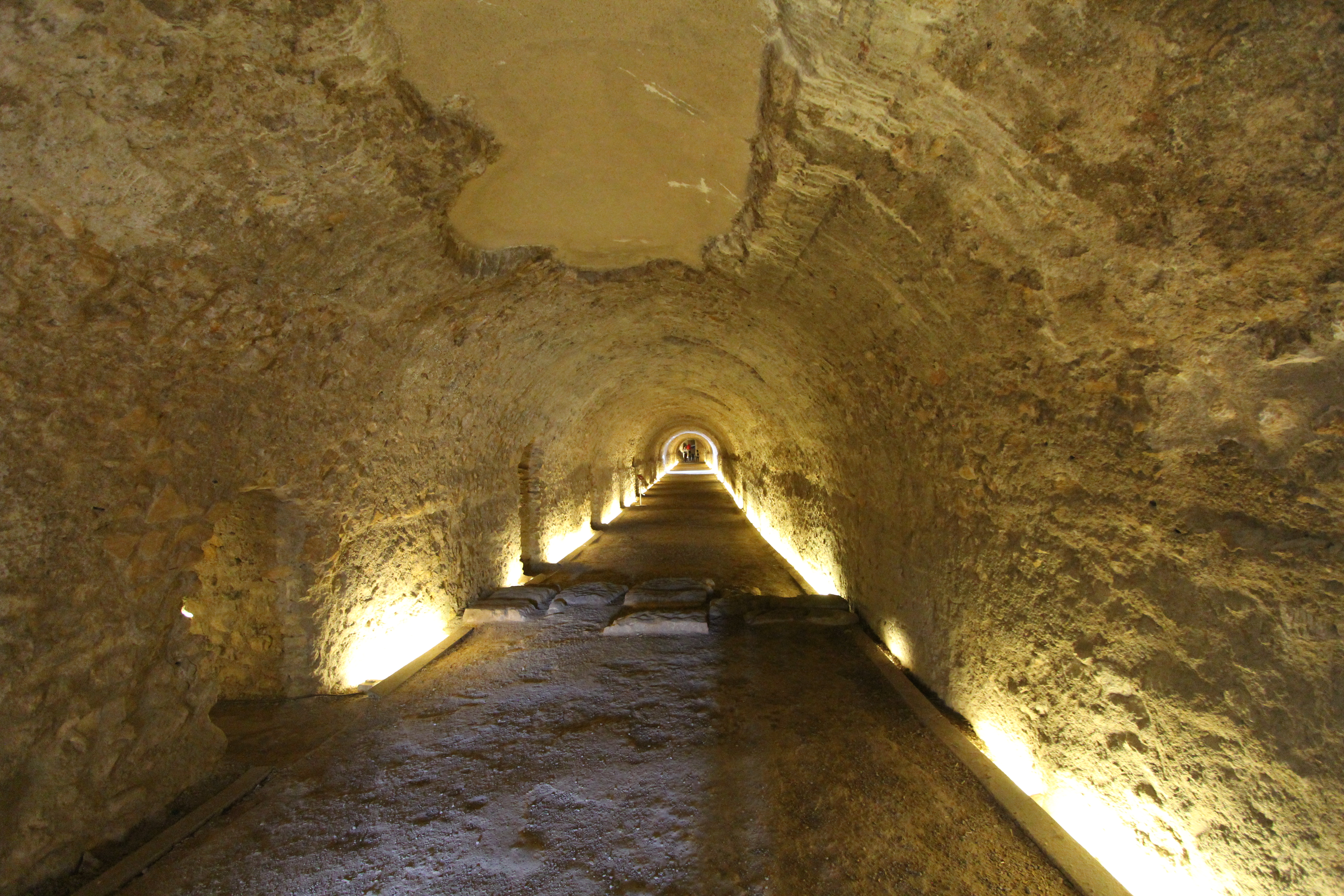
Roman Circus – Tarragona 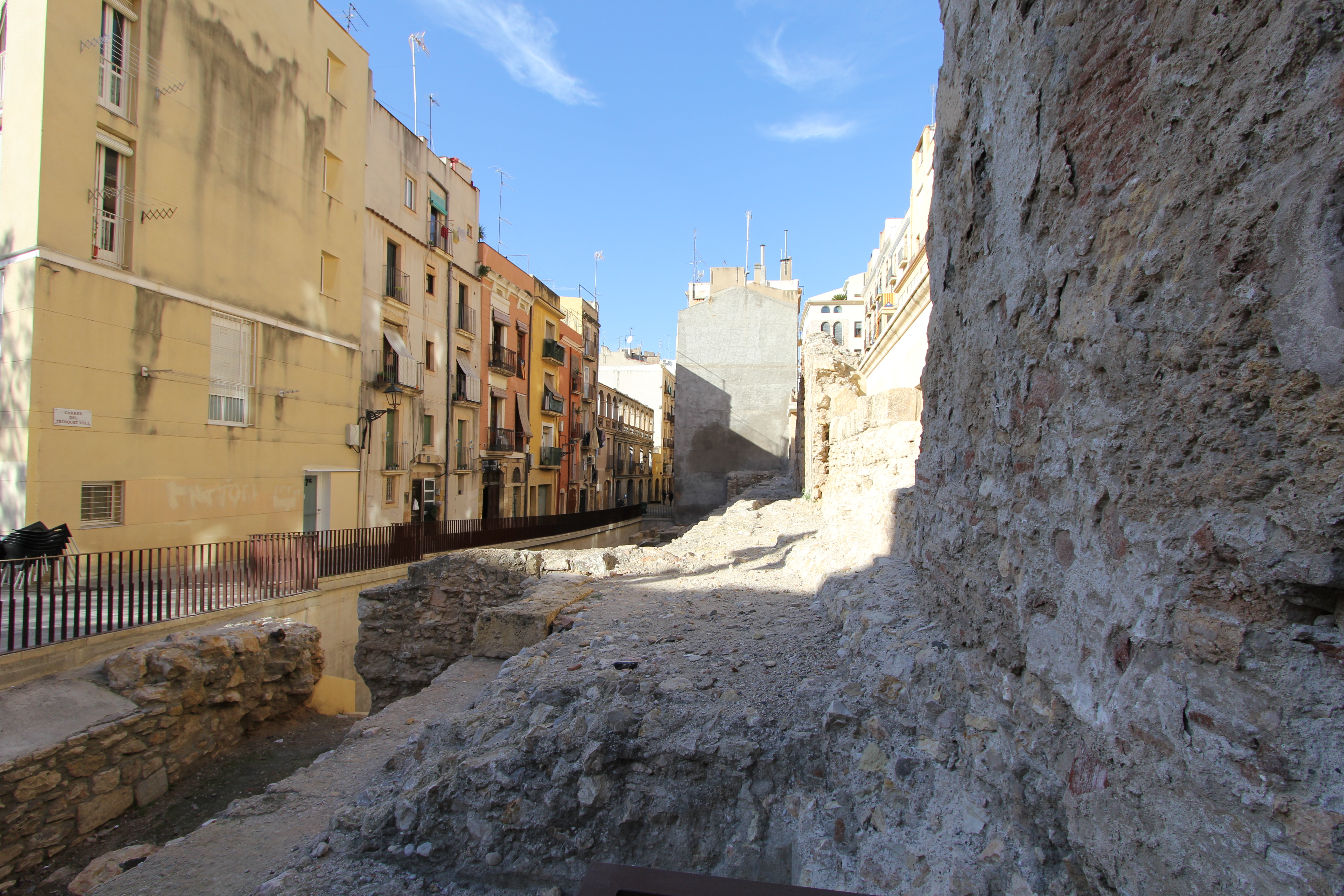
Roman Circus – Tarragona
From the video and various display boards we learn that the circus was constructed on cement vaults which served a dual purpose: firstly, as foundations for the stands, stairways and platforms of the circus; and secondly, as internal passageways for spectators. From the passageways we make our way to the Praetorium, which now houses the history museum.
The Praetorium is a Roman-era tower housing the stairs which connected the lower city to the Provincial Forum via the Circus, to which it is connected by means of underground passageways. From the display boards in the museum we learn that in the 12th century it was transformed into a palace for the monarchs of Aragon and then later was used as a prison.
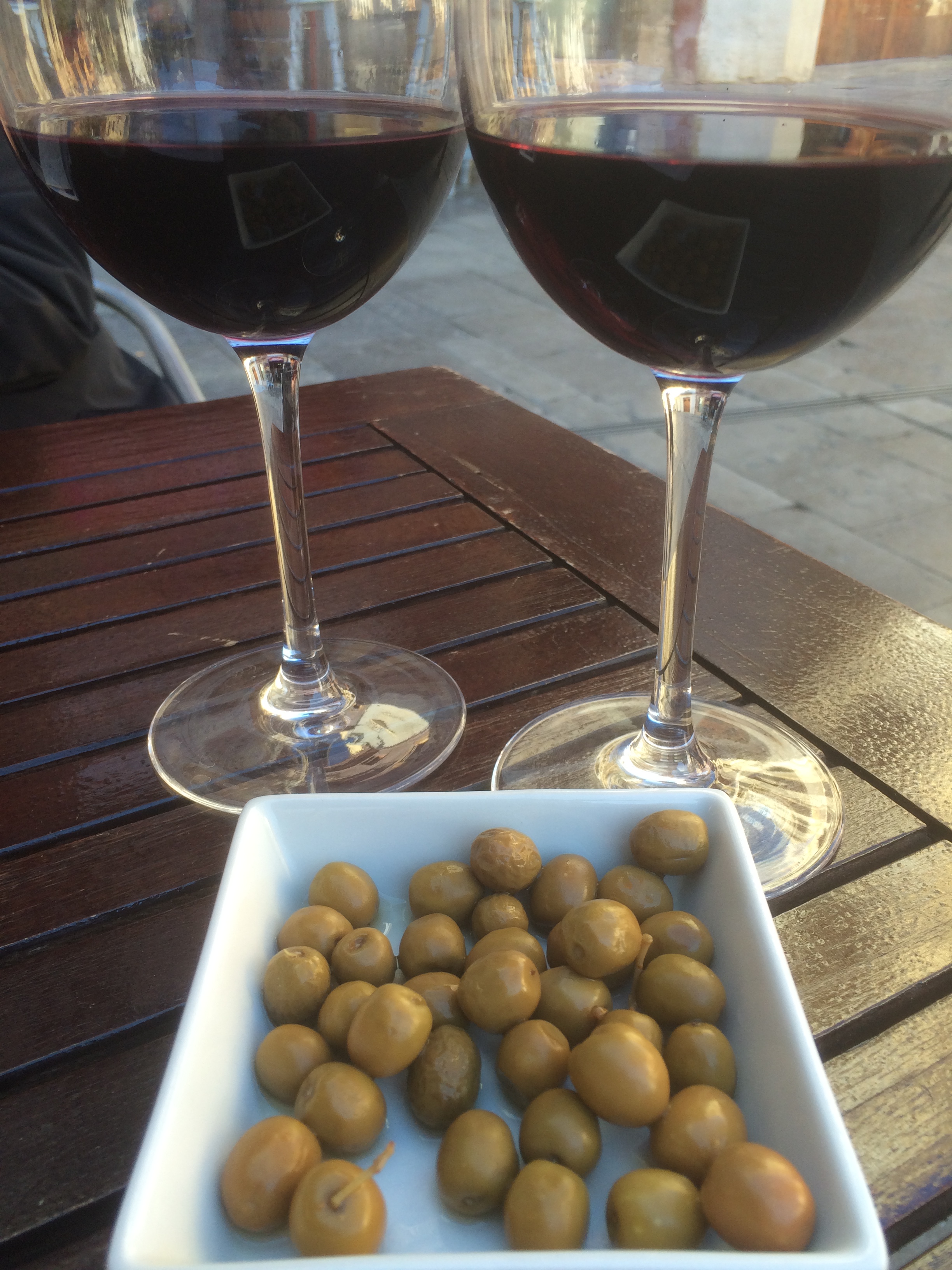
Rioja y aceitunas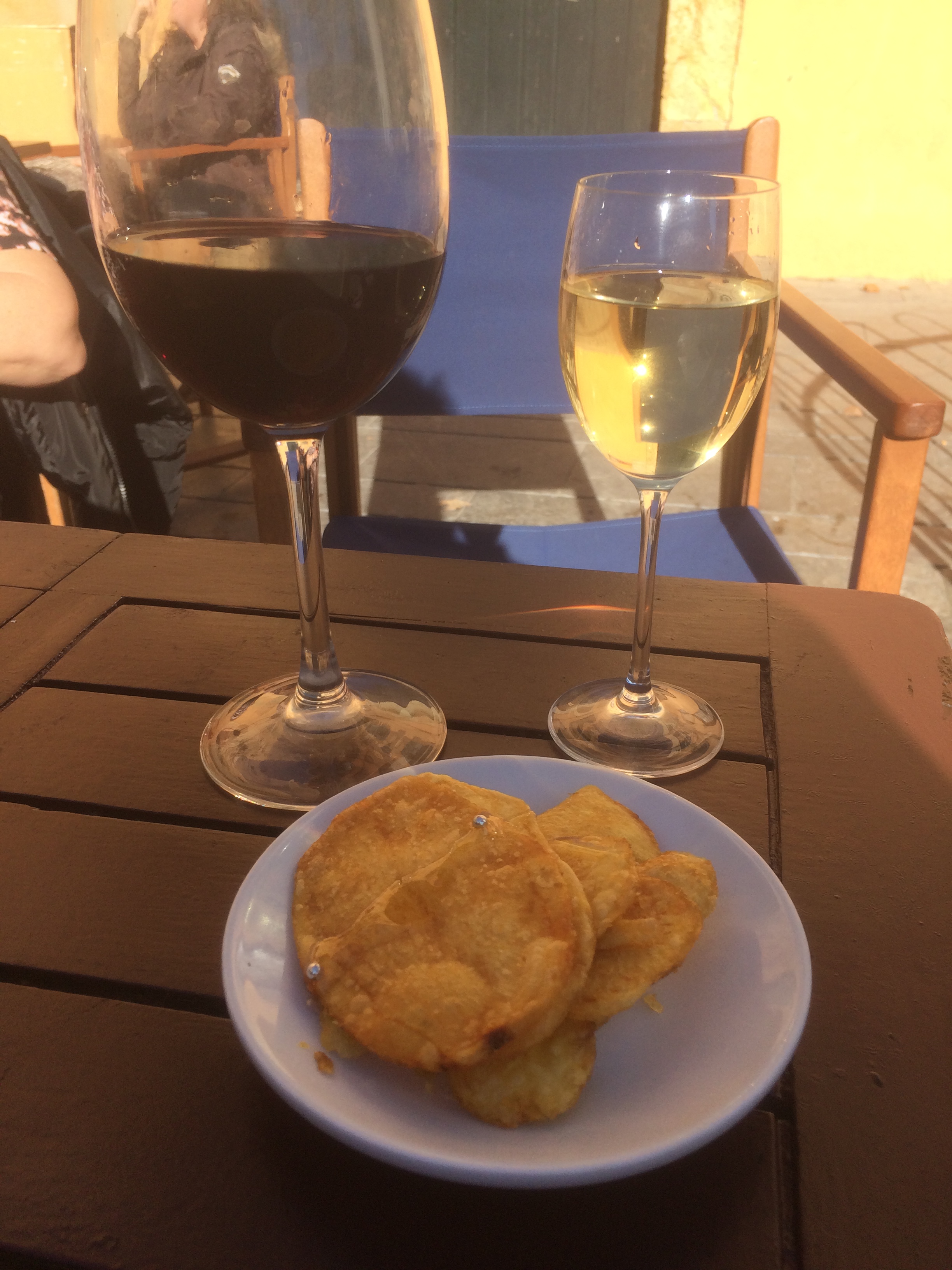
Rioja, jerez y patatas
Plaça del Rei
From our vantage point we enjoyed panoramic views of the Mediterranean and the city, including the Cathedral, which was next on our itinerary.
However, Plaça del Rei below beckoned and we spent a pleasant hour on both sides of the square drinking Rioja in the shade and sherry (La Ina) in the sun whilst nibbling on aceitunas and patatas.
Refreshed we hit the Roman route again, but our next stop is the El call jueu, La judería or the Jewish Quarter.
La judería – The Jewish Quarter
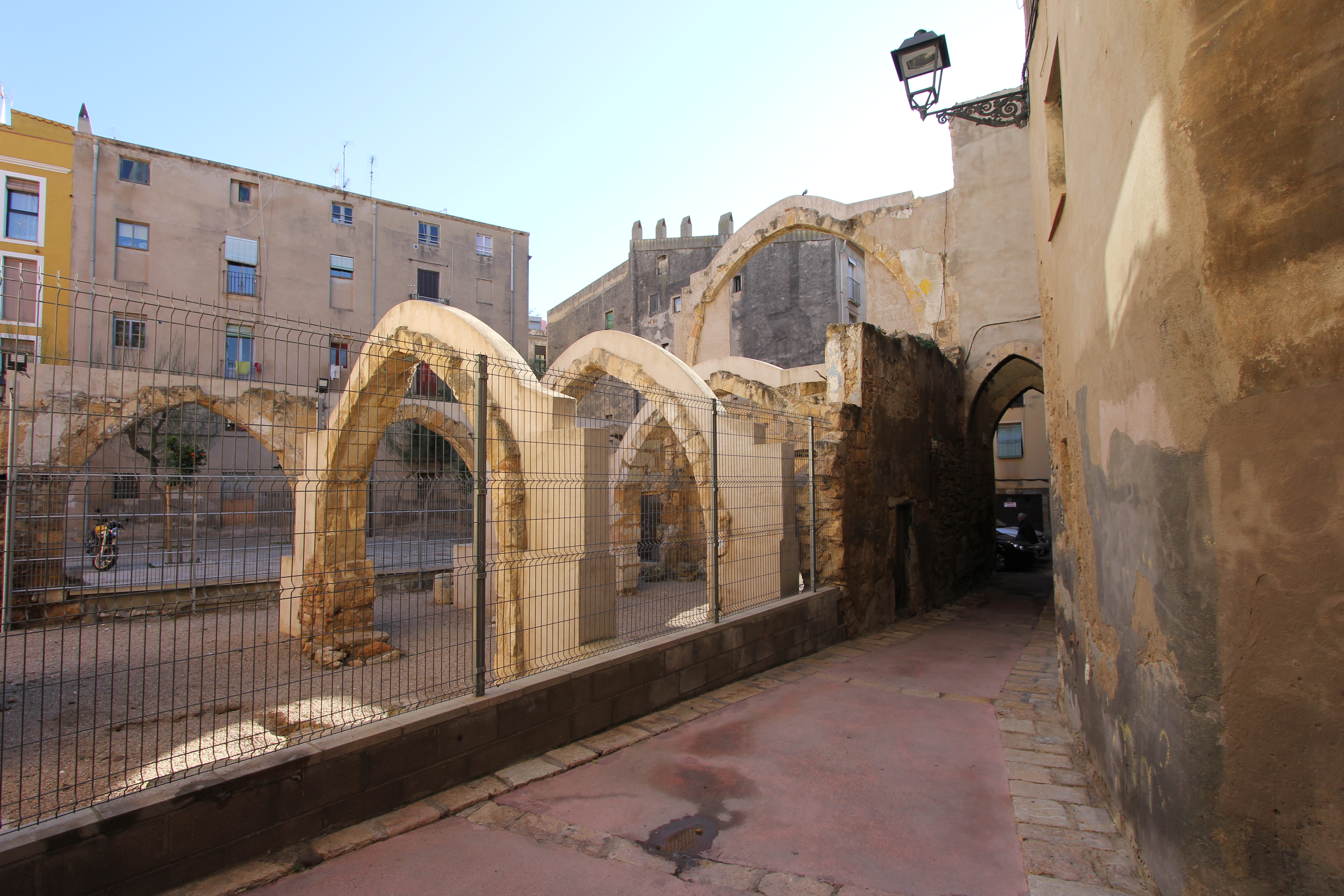
One of the challenges in Catalonia is navigating, literally, between signs written in Catalan and Spanish. Whilst my Spanish is OK my Catalan is limited. In Catalan the Jewish Quarter is known as El call jueu.
The Jews who settled in Tarragona did so under the protection of the King and consequently they settled near the castle. The Jewish Quarter was separate from the rest of the city and could only be entered by one of 4 gates. Many of the inhabitants of the Jewish Quarter were artisans who lived in small dwellings above a ground floor workshop. Very little of the original Jewish Quarter survives today, the Jews were expelled in 1492, and subsequent development saw the demolition of many medieval buildings and structures.
Today, all that remains is a labyrinth of winding narrows streets and several pointed arches along Carrer Talavera and in Plaça dels Àngels.
Catedral de Tarragona – Tarragona Cathedral
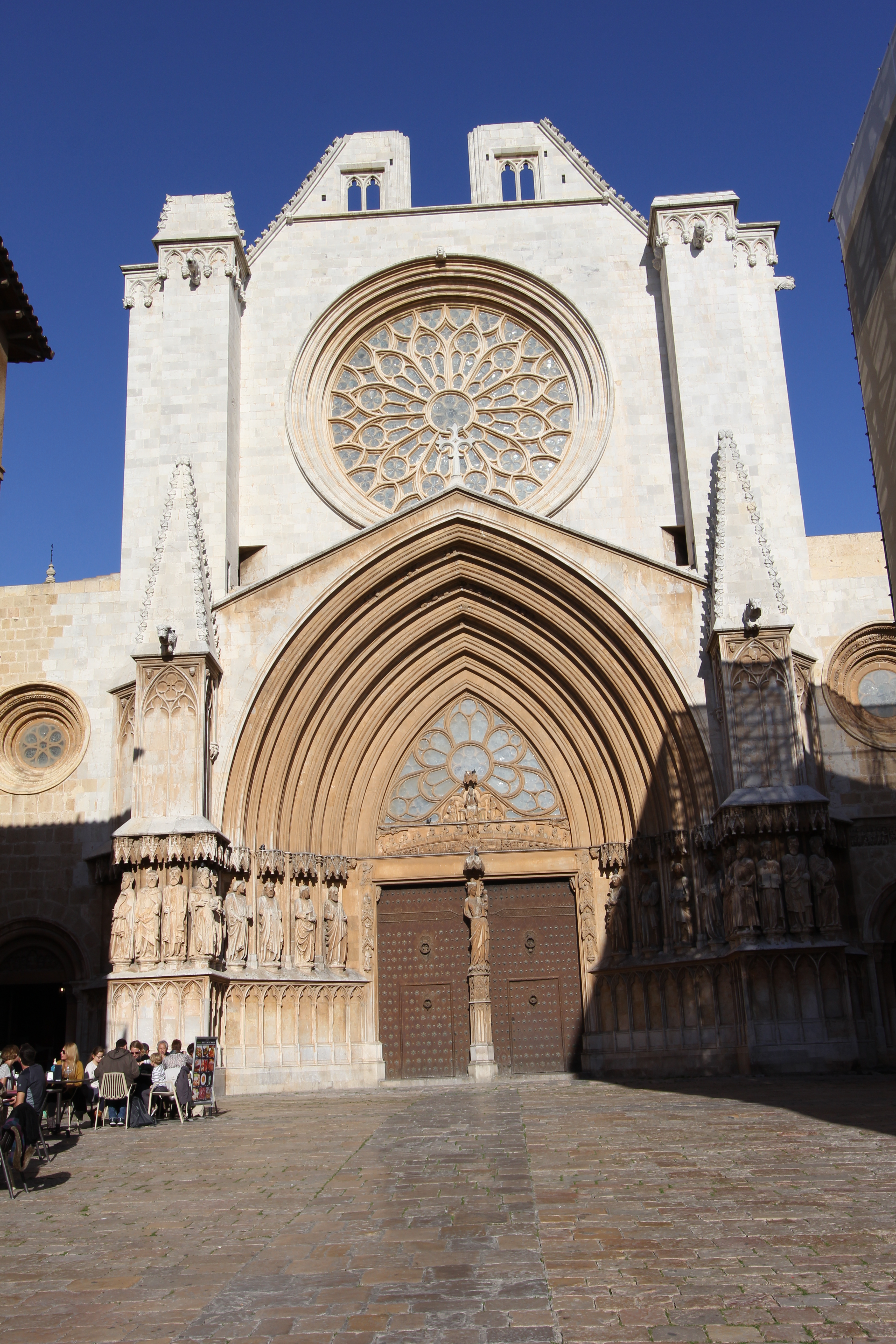
We take a diversion from the Roman road and climb the steps to Plaça de la Seu to visit the cathedral, which was built on the site of a former Roman temple, parts of which can be seen in the cathedral cloister.
Dedicated to Saint Tecla construction of the cathedral began in the 12th century and it was consecrated in 1331. Our first view, as we climb the stone steps, is of the rose window of the cathedral which has become one of Tarragona’s emblematic images. The high altar, dating from 13th century, is magnificent and depicts scenes from the life of Saint Tecla. The Gothic chapels, each offer something interesting, in terms of either architectural and sculptural ornamentation or the statues and altars within.
We walk around the rectangular cloister and the large garden with its orange trees whose boughs hang heavily from ripening fruit. In the afternoon sun, the honey coloured stone of the cathedral glows.
The Diocesan museum, which adjoins the cloister houses a wonderful collection of both medieval and more modern religious art.
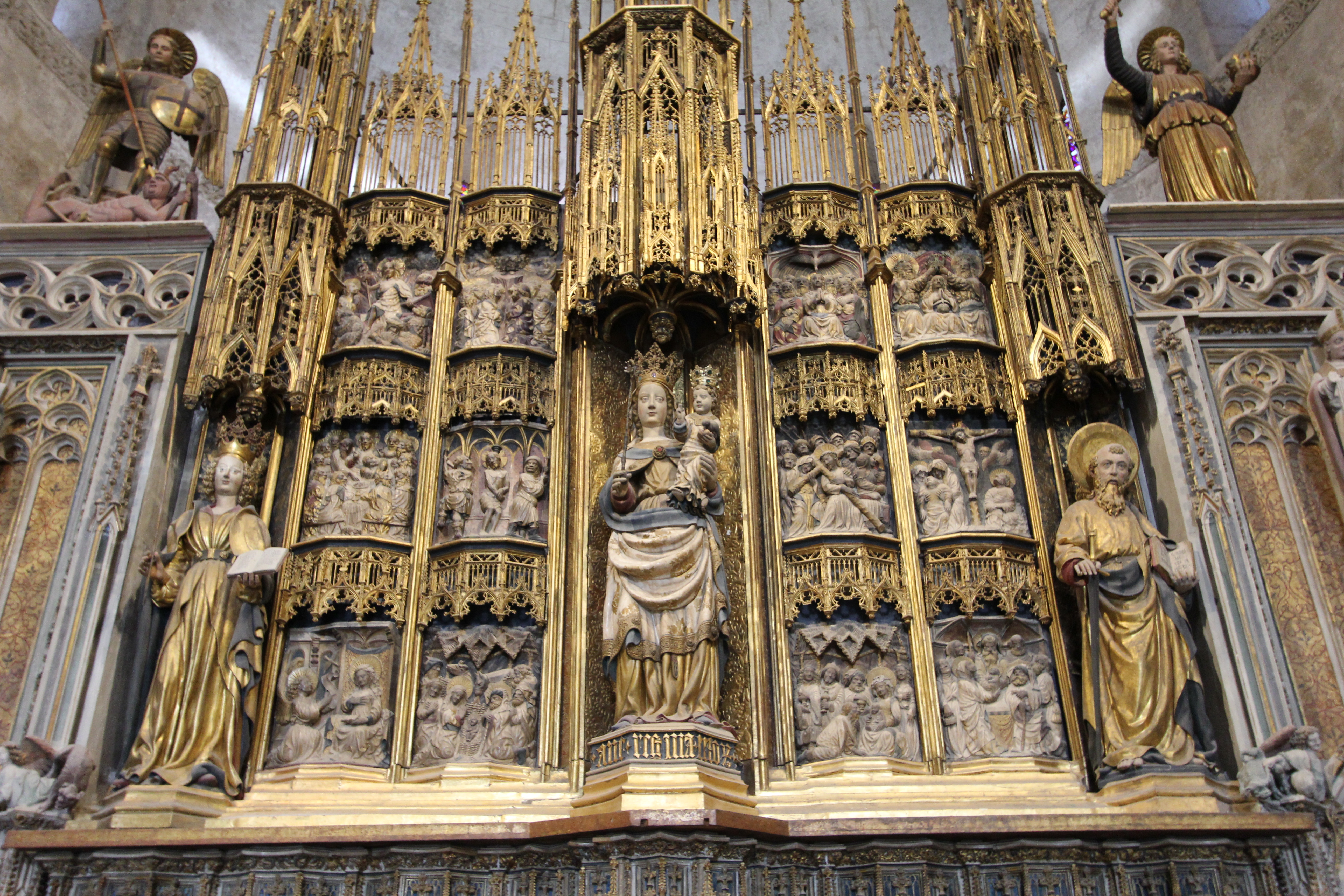
Cathedral – Tarragona 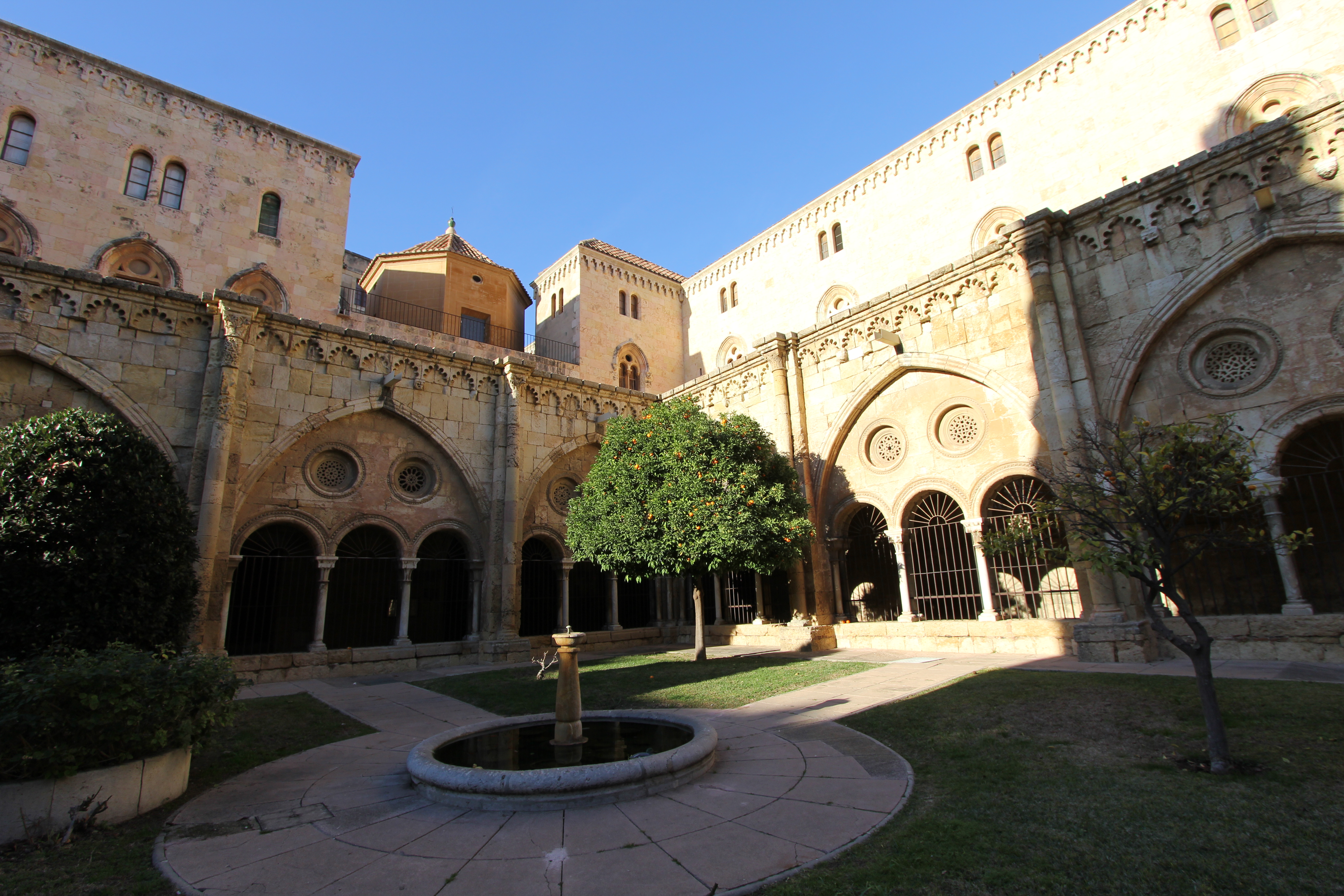
Cloister – Tarragona Cathedral
Las Murallas – Passeig Arqueològic (City Walls – Archaeological Promenade)
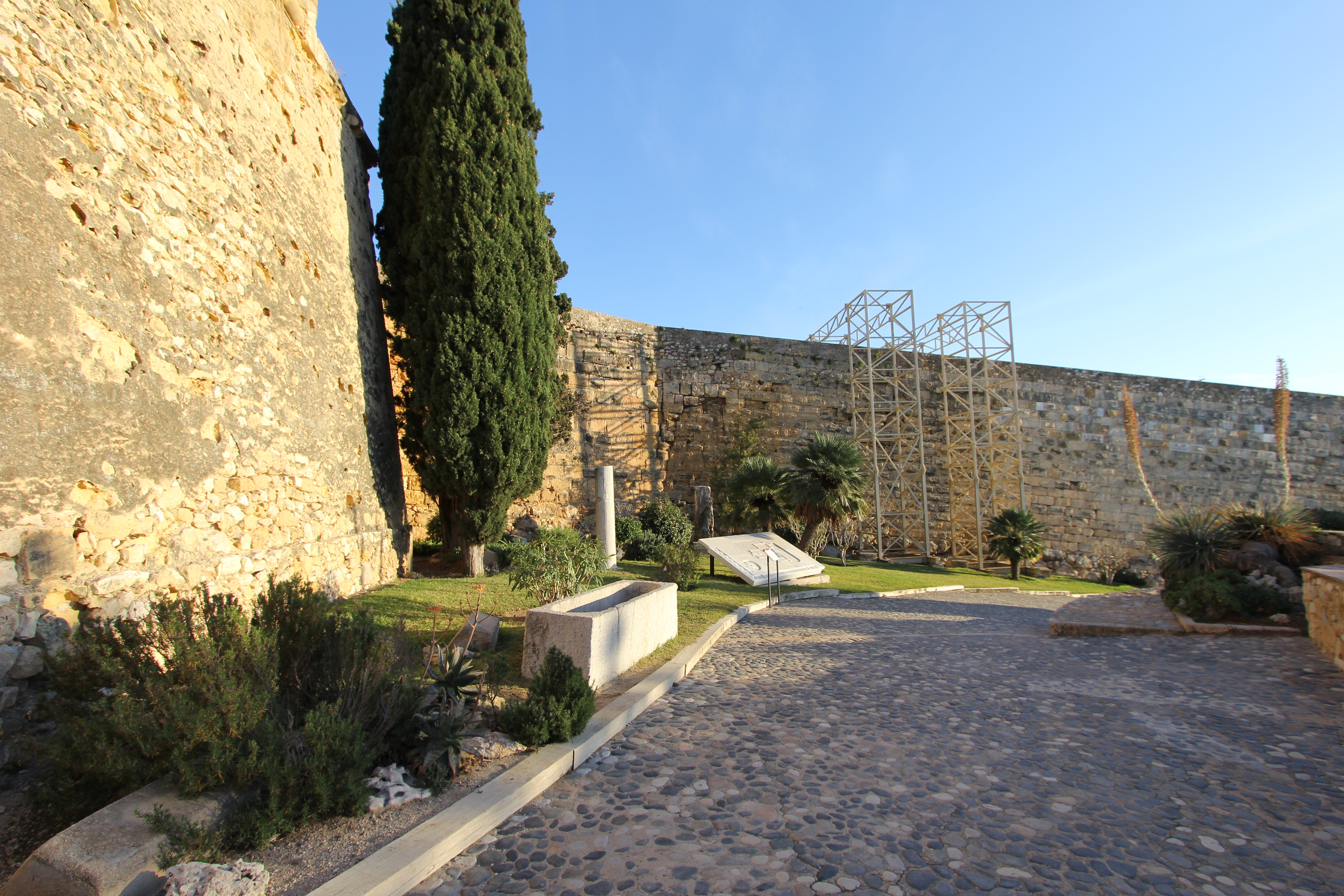
The original city wall, built around Tarraco, in 2BC ran some 3,500 metres of which 1,100 metres remain today and border the old quarter of modern Tarragona!
We walk along the archaeological promenade or Passeig Arqueològic, which has the most interesting and therefore the best preserved sections. The walls are the oldest Roman construction still conserved outside of Italy. Between the 16th and 18th centuries, they were reinforced with bulwarks, a curtain wall and exterior fortifications in order to adapt the Tarragona defences to new forms of heavy artillery.
We’re nearing the end of our Roman route and flagging a little bit.
El Foro Local – The Local or Colonial Forum
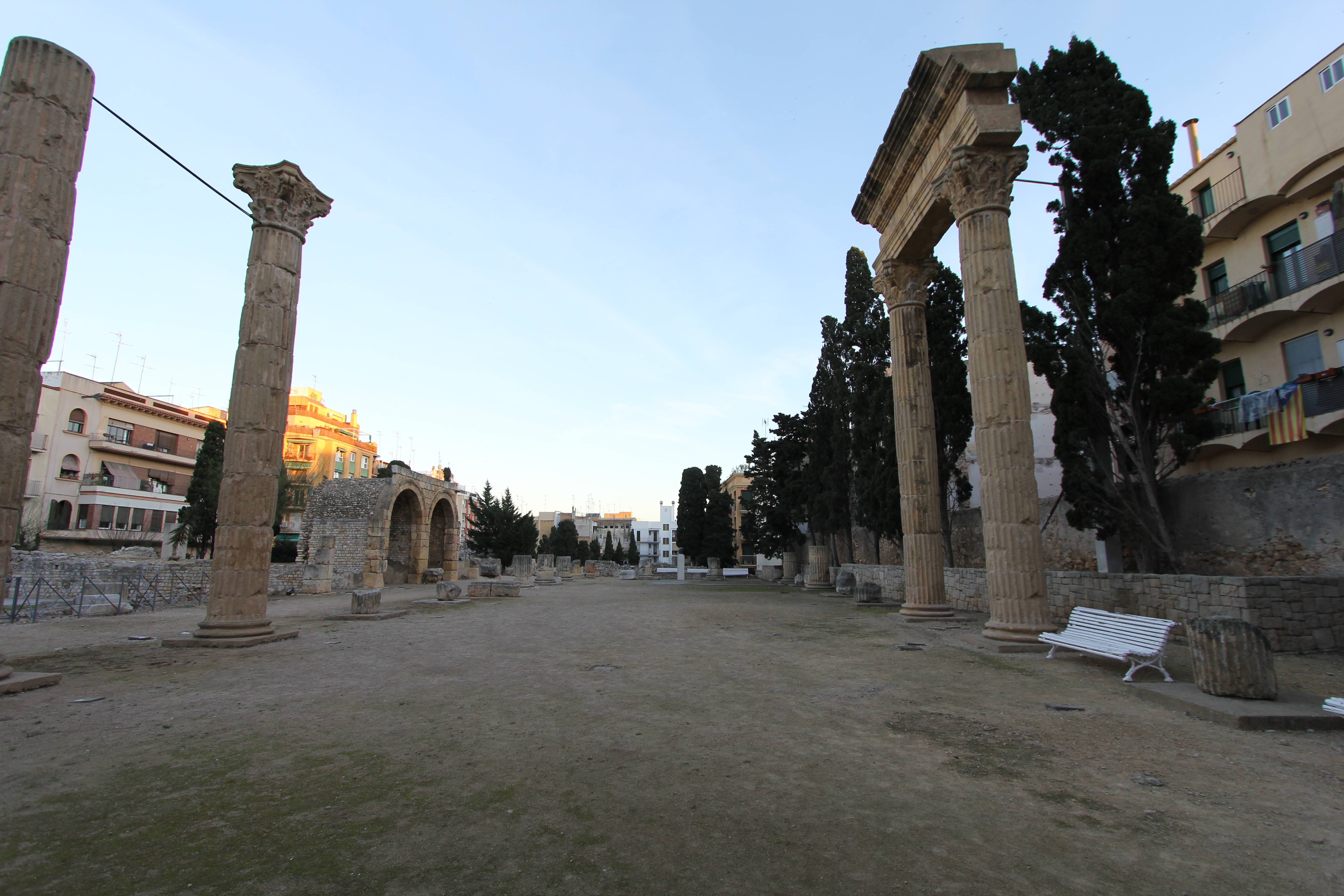
Fortunately nothing funny happened to us on the way to the Forum! And so we ended our tour of Tarragona and our Roman walk at the Local or Colonial Forum.
The forum would have been the hub of daily life in Roman Terraco. The large square would have been surrounded by the most important buildings in the city including: the curia, the basilica, as well as temples and numerous shops. Much of Tarraco’s forum was destroyed as a result of urban expansion in the 19th century.
Today the site is surrounded by relatively modern apartment blocks and shops. It is divided by Carrer de Soler, but the two sites are linked by a pedestrian footbridge. Interestingly the forum was in fact divided into two areas: one religious and the other administrative and commercial. Crossing over the footbridge it is possible to see the remains of several streets and homes, as well as the temple. The temple, part of which remains, is thought to have been dedicated to the Capitoline Triad – Jupiter, Juno and Minerva, or to Dea Roma, or to the deified Emperor during a later period.
The other area, which was administrative and commercial, centred around various buildings including the curia, where the city council (ordo decurionum) would have met, and the basilica. The archways surrounding the area were occupied by shops (tabernae). Whilst only a portion of the basilica – a large building divided into three naves separated by columns – remains, it is possible to get a sense of the scale and grandeur of the forum.
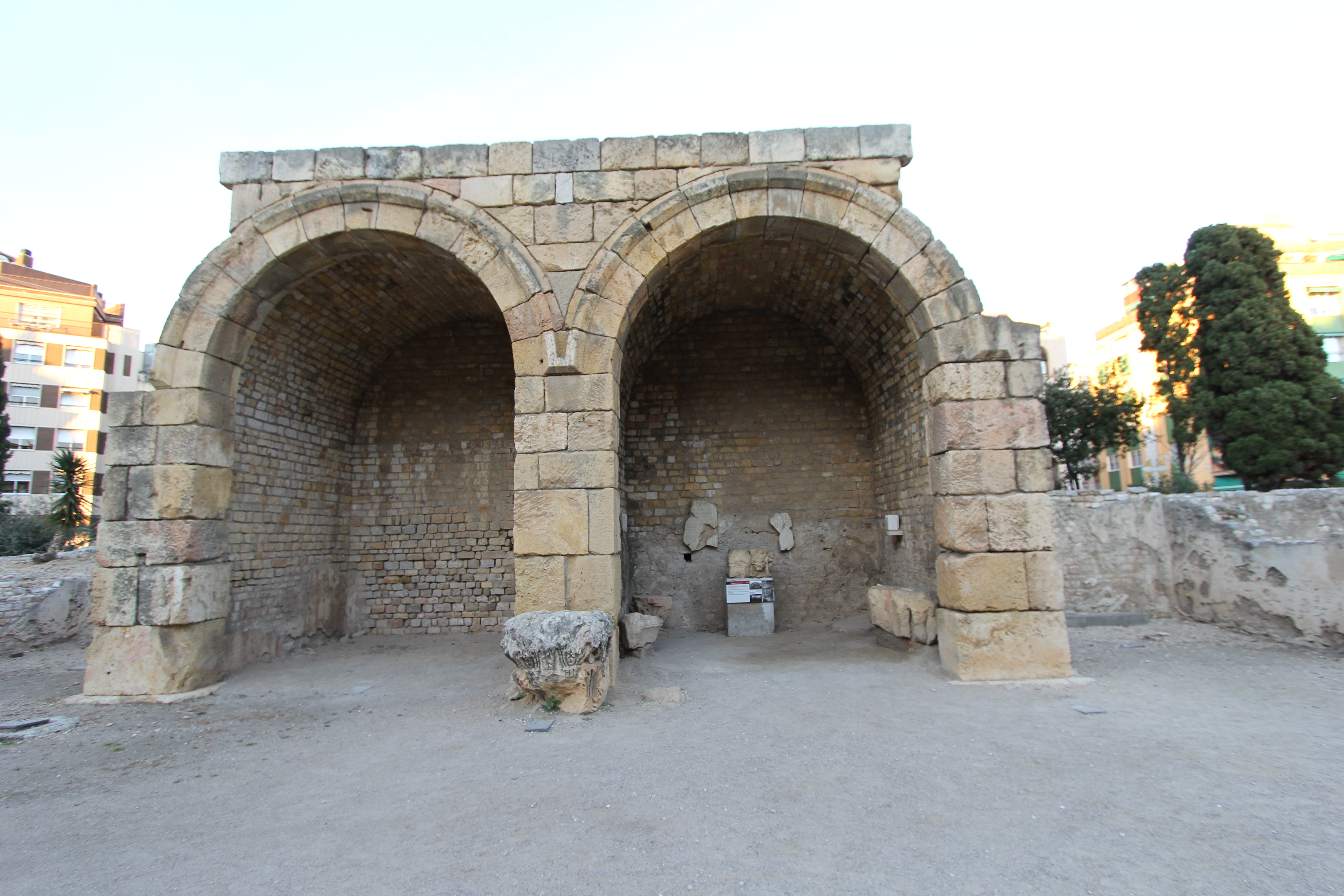
Forum – Tarragona 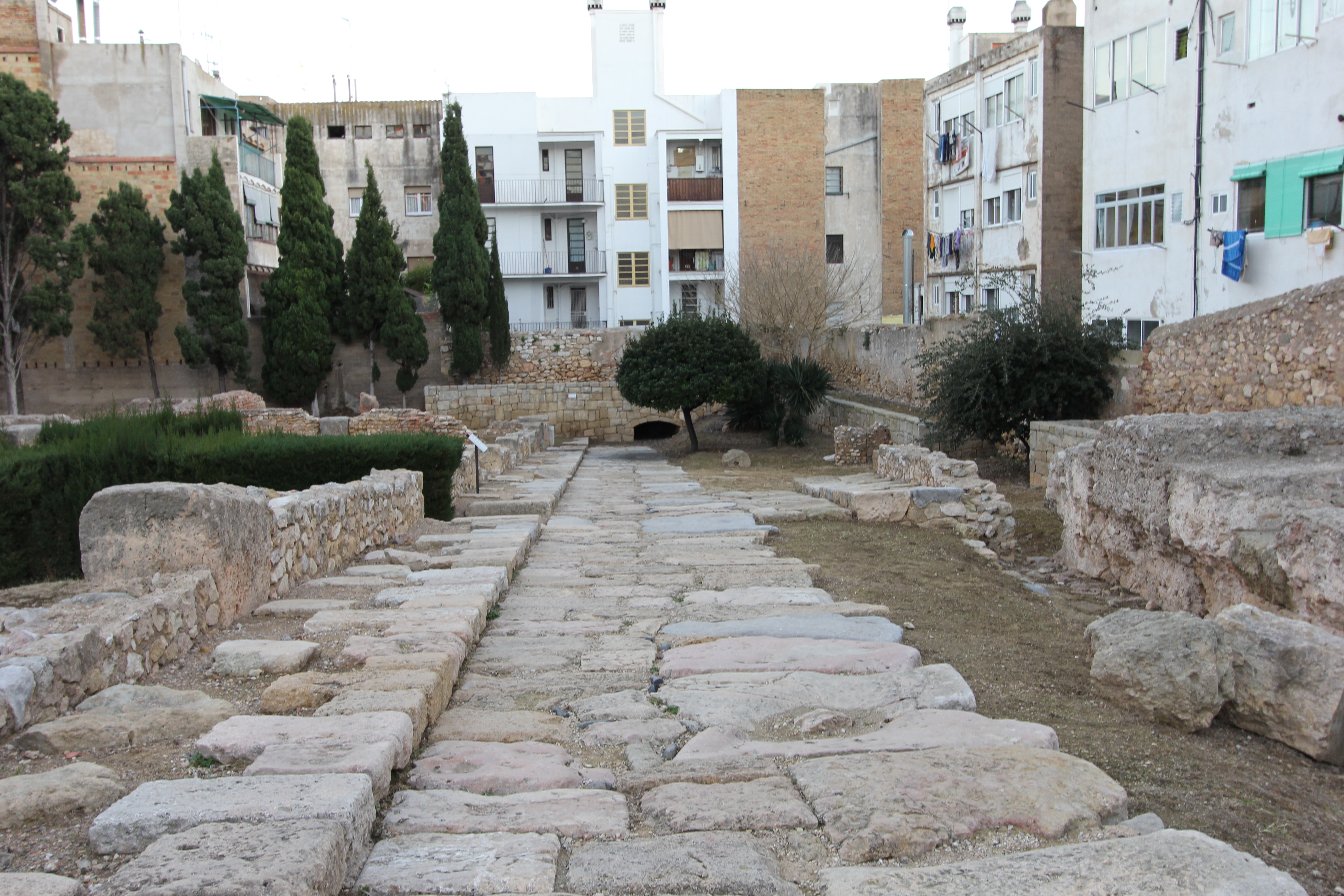
Forum – Tarragona
Back to Barcelona
We end our day in Tarragona with a much needed coffee in the station cafe before boarding the train back to Barcelona.
Anniversary Dinner at Casa Alfredo
Wednesday, 30 December, 2015 – Barcelona, Spain
Back in Barcelona
Our train arrives at Barcelona Estacio Sants on time and we take the Metro Line 4 (Direction Trinitat Nova) from Estacio Sants to Catalunya.
It’s a 15 minute journey on the metro so we just have time to drop our bags, plug the phone in for a quick charge and freshen up at the hotel before heading back out to Casa Alfonso for dinner.
Casa Alfonso – recreating the last supper
Casa Alfonso is rather deceptive, with its narrow frontage, it looks little more than a delicatessen. And then as you walk in the delicatessen gives way to a bar with some tables and then behind that the restaurant.
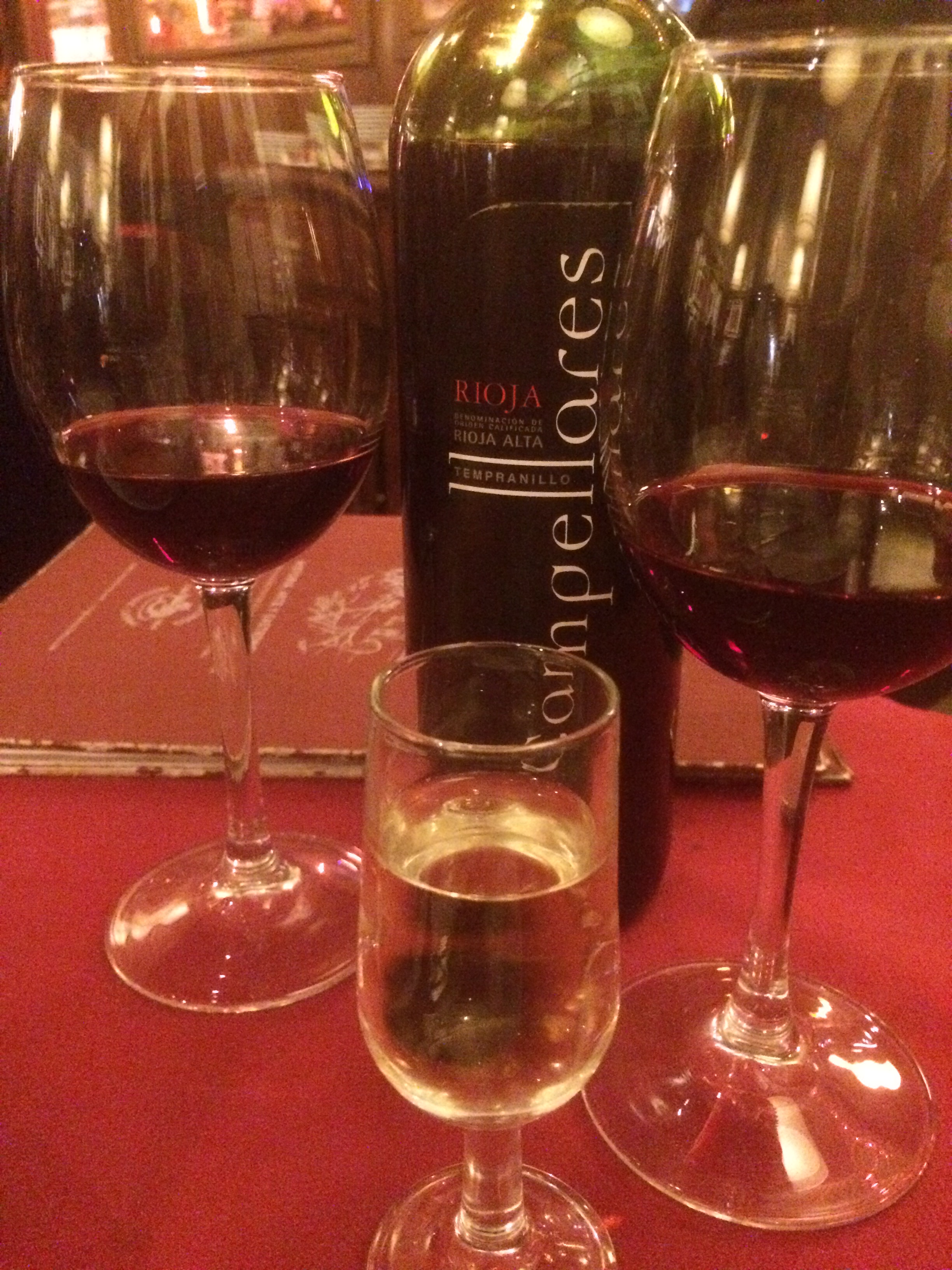
How time flies – it’s exactly a year since we last had dinner at Casa Alfonso. And although it’s not quite the last supper, it is our last dinner in Barcelona this year! After walking for most of the day it was a treat to sit down and chat about what we had seen over sherry and olives, bread and wine.
It’s always the small things that seem to be the most satisfying and a good glass of dry sherry with well marinated olives pleased me. The bread, which had a good crust with a light and airy centre captured the tomatoes it had been rubbed with and the oil drizzled on it, but had been toasted enough to stop it being soggy. The wine, a house Rioja, was equally good. In between talking about the highlights of the day we managed to decide what to order from the extensive menu.

Aceitunas 
Bread
Our selection from the menu included: chips de berenjenas caramelizadas con queso, ganchitos de oreja de cerdo (crispy pigs ears), trinxat de cerdanya con huevo escalfado (cabbage with poached egg), bacalla a la llauna con fesols de sant pau (salt cod with beans) and gambas al ajillo. We went for the house red, which was a rather smooth Rioja. I had to pass on desert, but Sue beat me to the postre post by finding room for a tarte tatin.
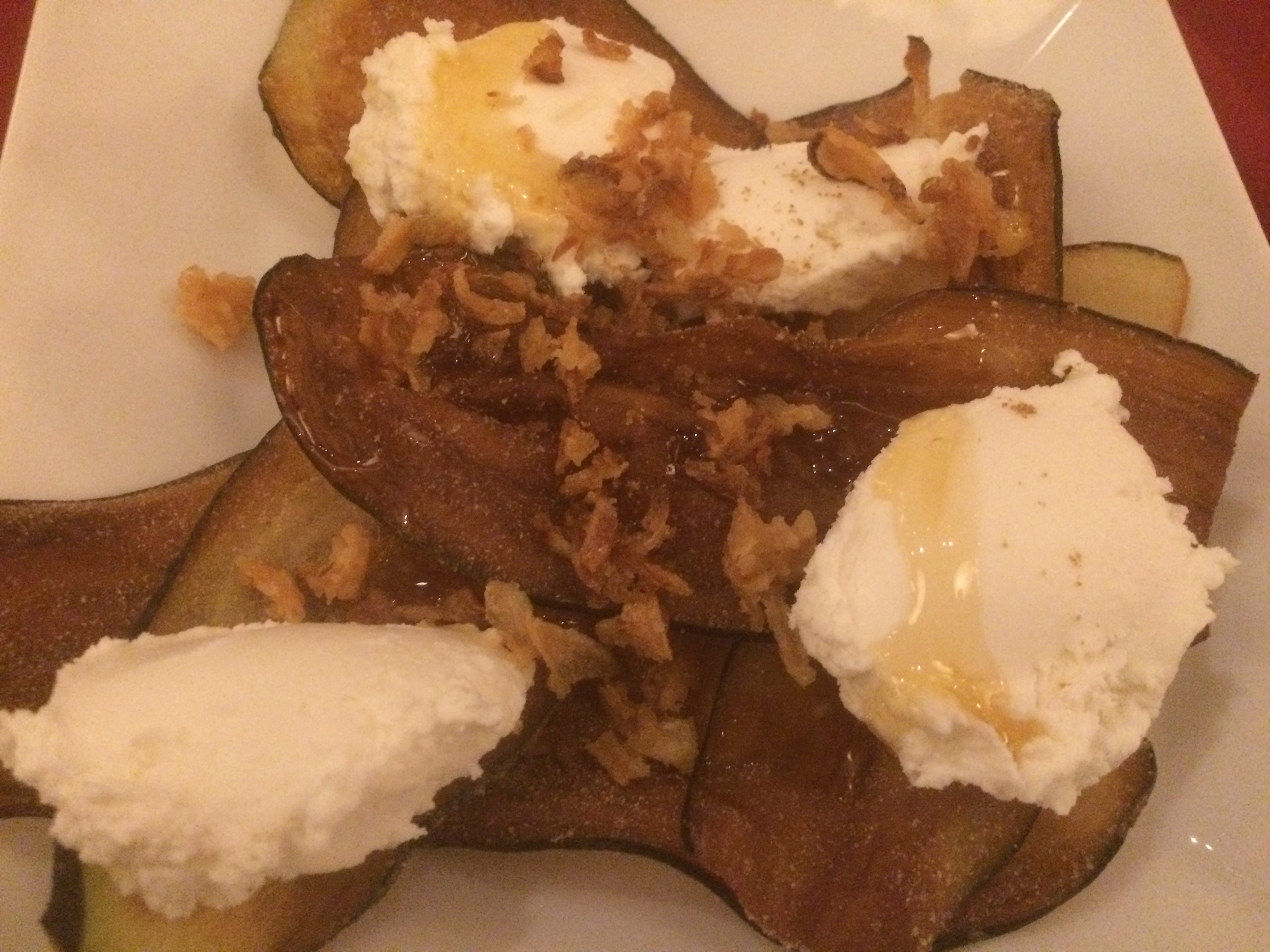
Chips de berenjenas caramelizadas con queso 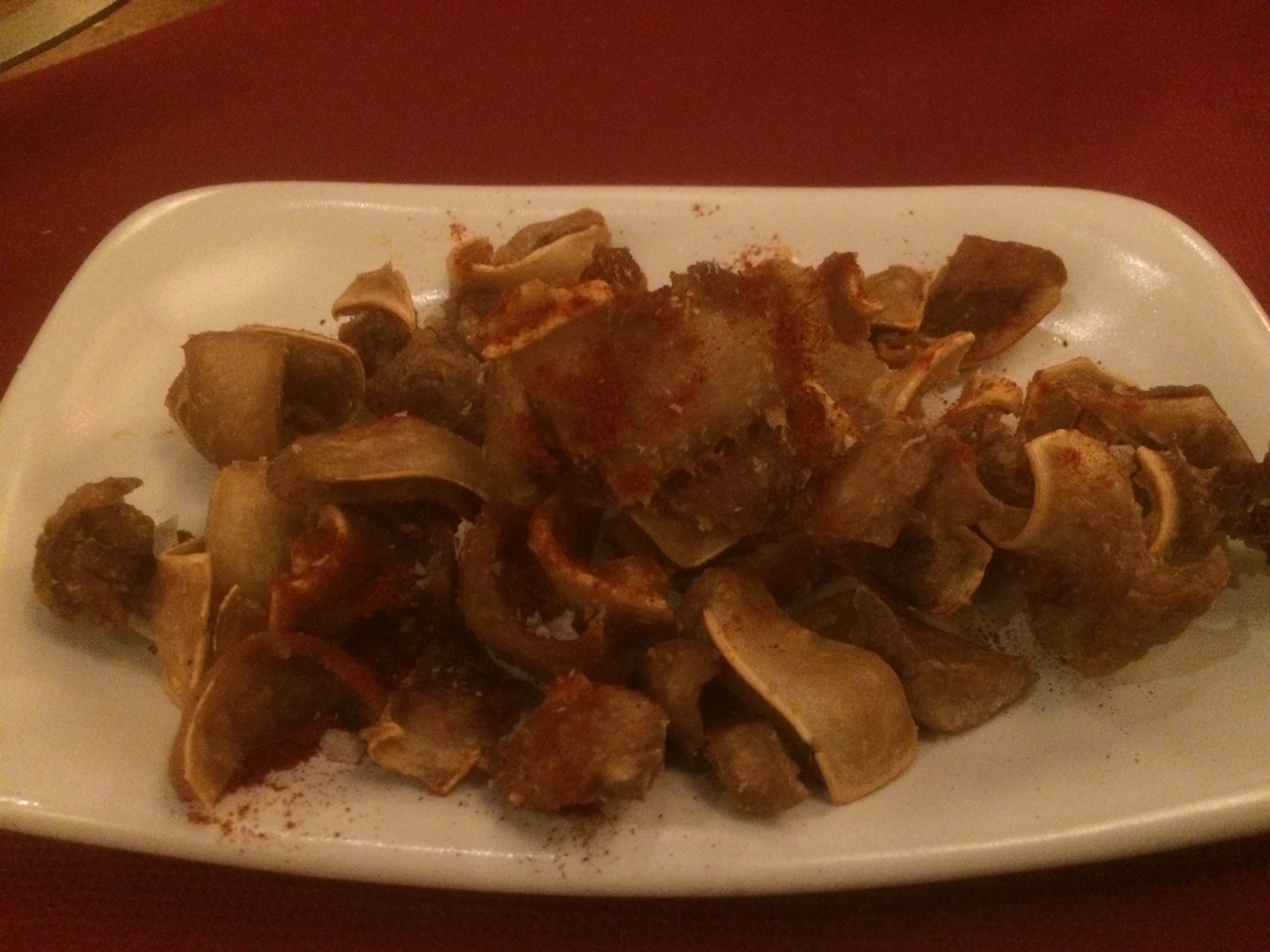
Ganchitos de oreja de cerdo 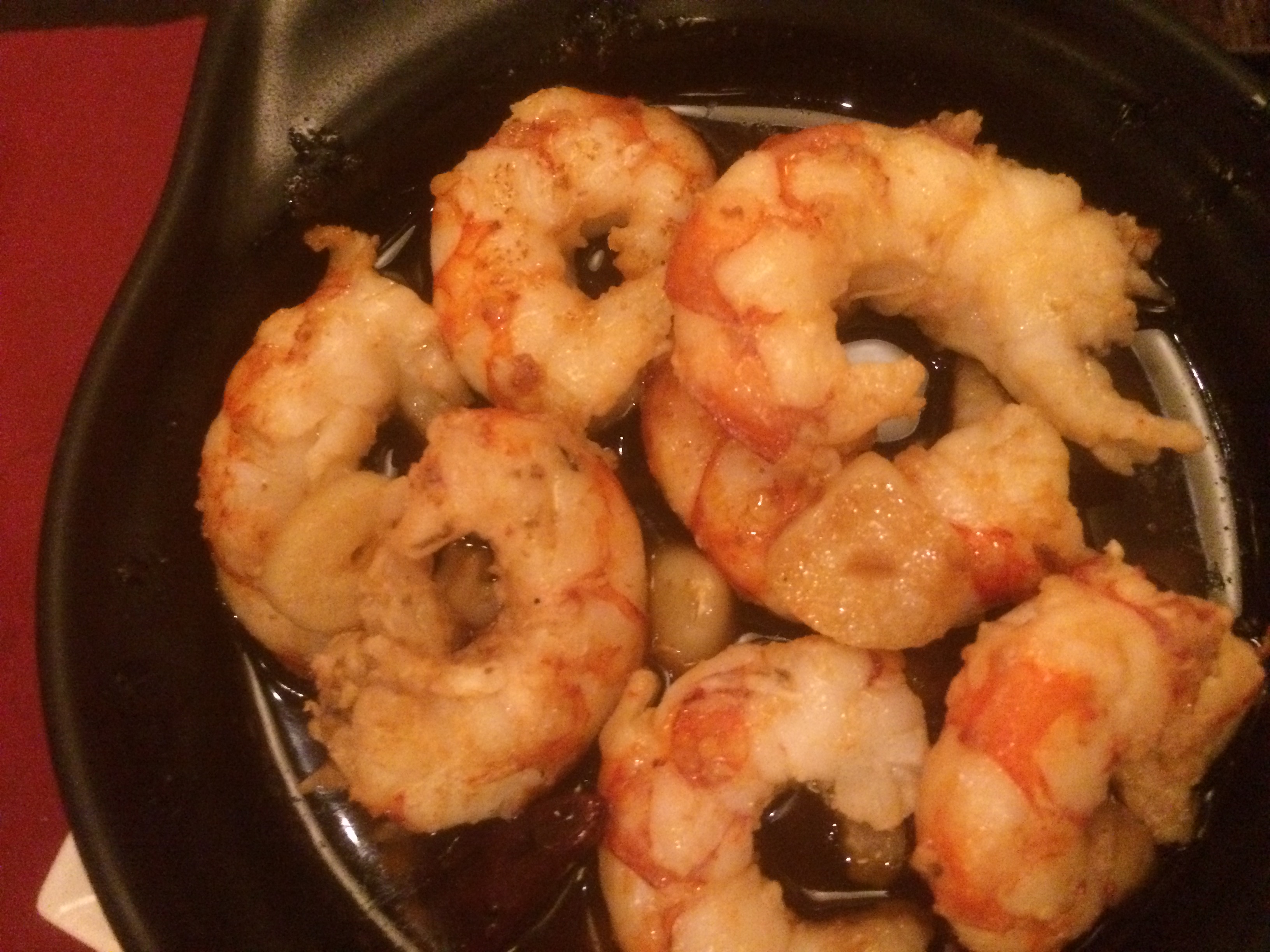
Gambas 
Bacalla a la llauna con fesols de sant pau 
Trinxat de cerdanya con huevo escalfado
Adiós Barcelona
Thursday, 31 December, 2015 – Barcelona, Spain
Breakfast, shopping and wandering
After walking around the Roman sites in Tarragona yesterday we planned a slightly later start to the day and a leisurely breakfast at Farggi.
Supermarket sweep at El Corte Inglés
Before arriving in Barcelona our initial plan was to spend time wandering around the Boqueria market on our final morning and buy some of our favourite Spanish staples. Since we’d had a good wander round the market on our first afternoon, rather than battle with the tourists we decided to shop with the locals and bag a few bargains in El Corte Inglés.
Compared to the Boqueria the supermarket in the basement of El Corte Inglés is cool and calm. Whilst it is reasonably busy, it’s pleasant to browse the aisles without being carried along on a human tide or get in the way of serious shoppers.
Turrón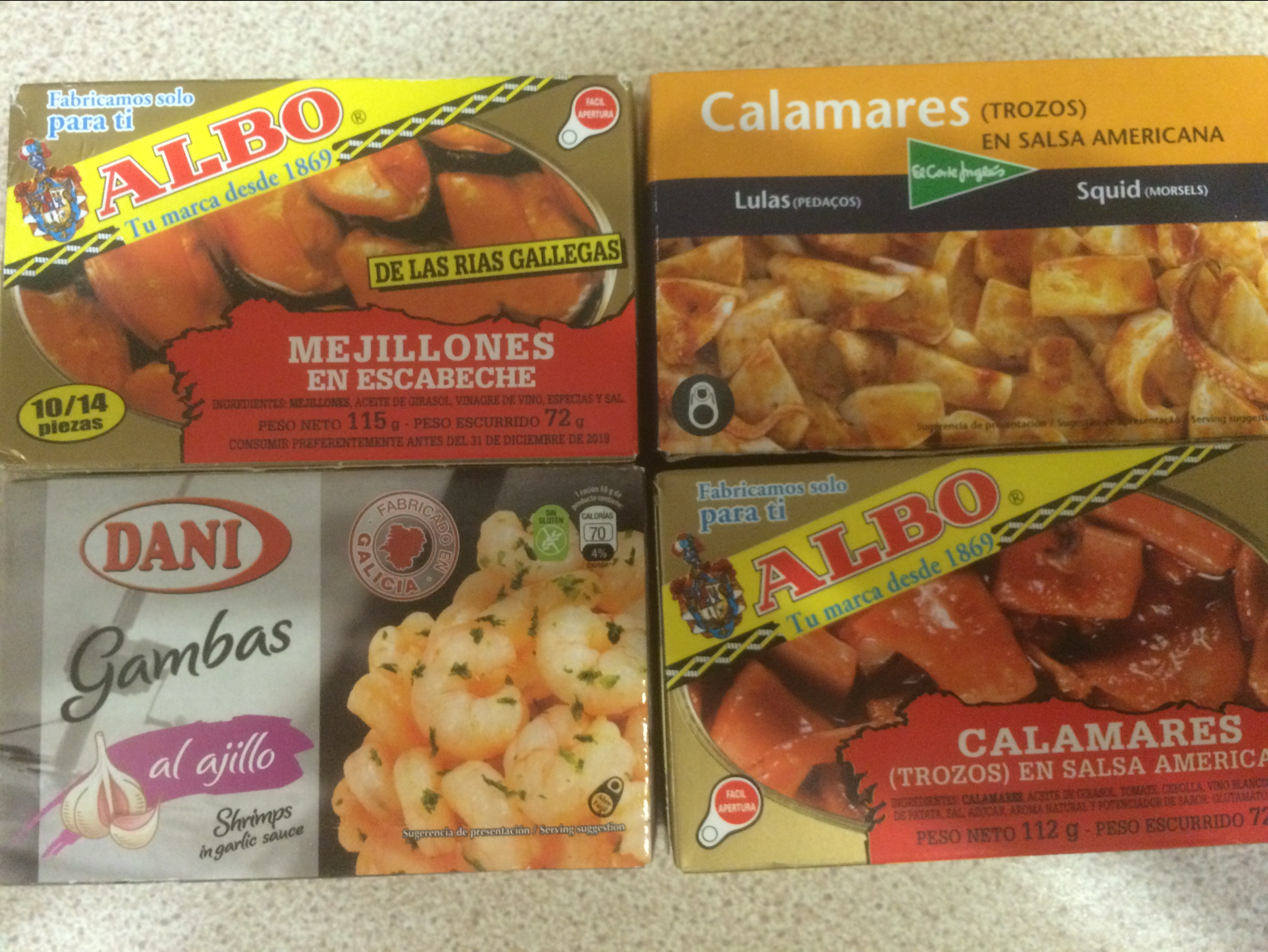
Canned Shellfish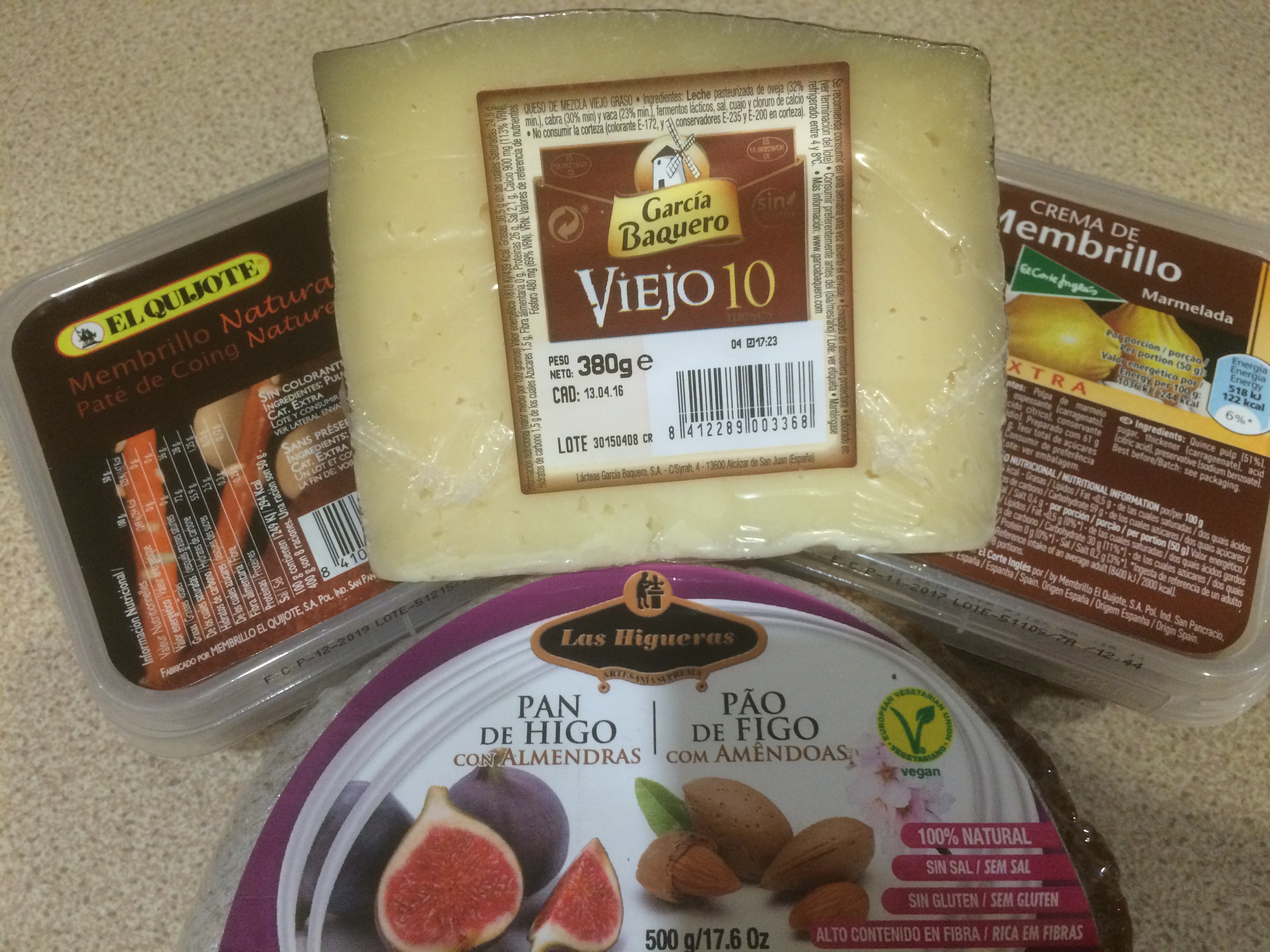
Queso, membrillo and pan de higo
The shelves are well stocked and are constantly being replenished by an army of staff. The supermarket manages to pack in quite a variety of goods – store cupboard staples as well as more specialist produce – in a small space. In addition to the deli counter there is a butchery, fishmonger as well as cured meat and cheese counters. It’s relaxing being able to browse the shelves.
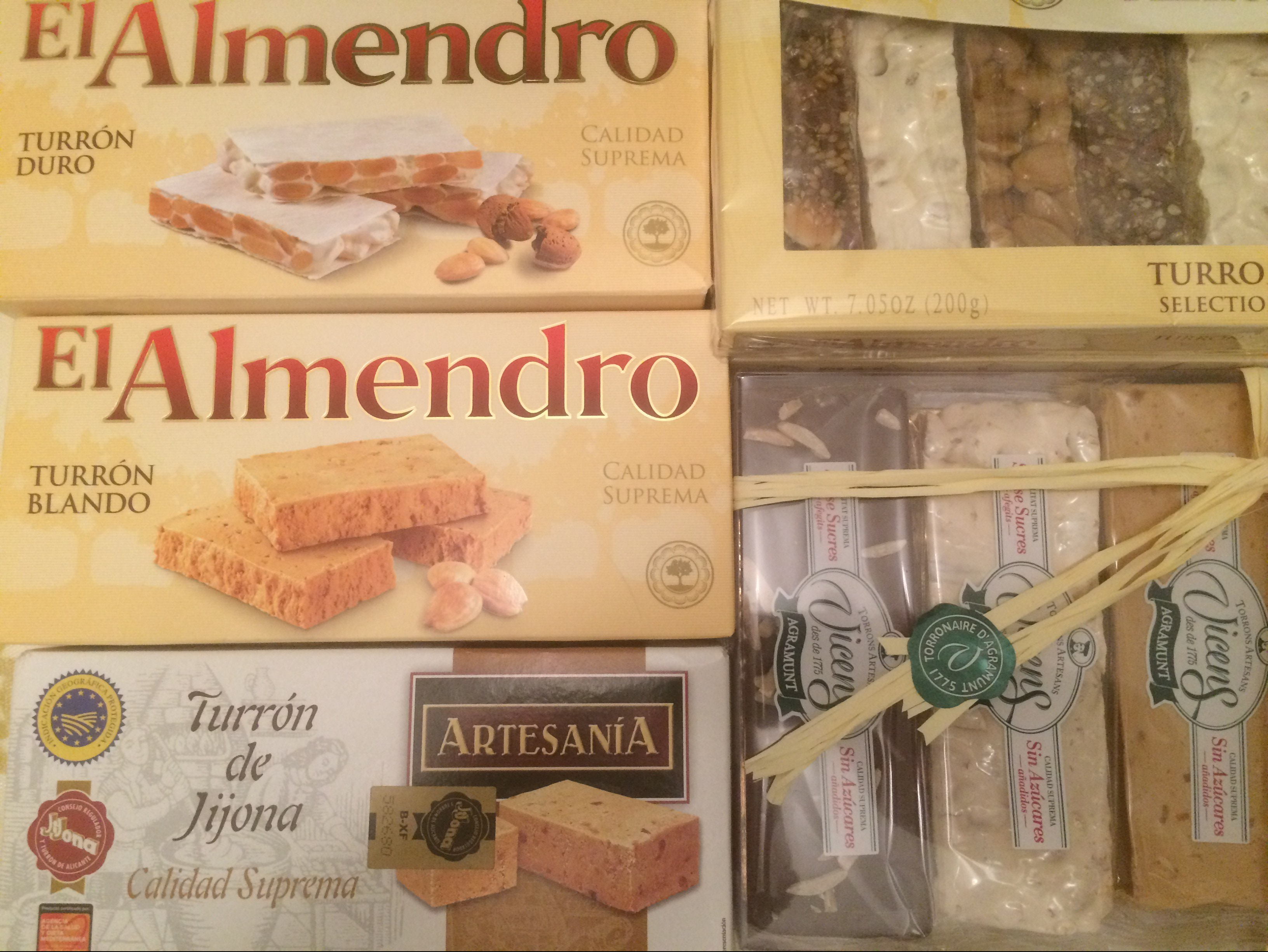
We managed to pick up a few favourite staples including: assorted boxes of turrón, cheese, membrillo (quince paste), and a few cans of shell fish (mussels, prawns, calamari). So next year I will mainly be eating: Turrón, cheese, membrillo, pan de higo and tinned fish. I’m hoping that there will be some olives, sherry and of course the occasional bottle of Rioja.
Desayuno comido. Compras hechas. Tiempo para un paseo y cafe
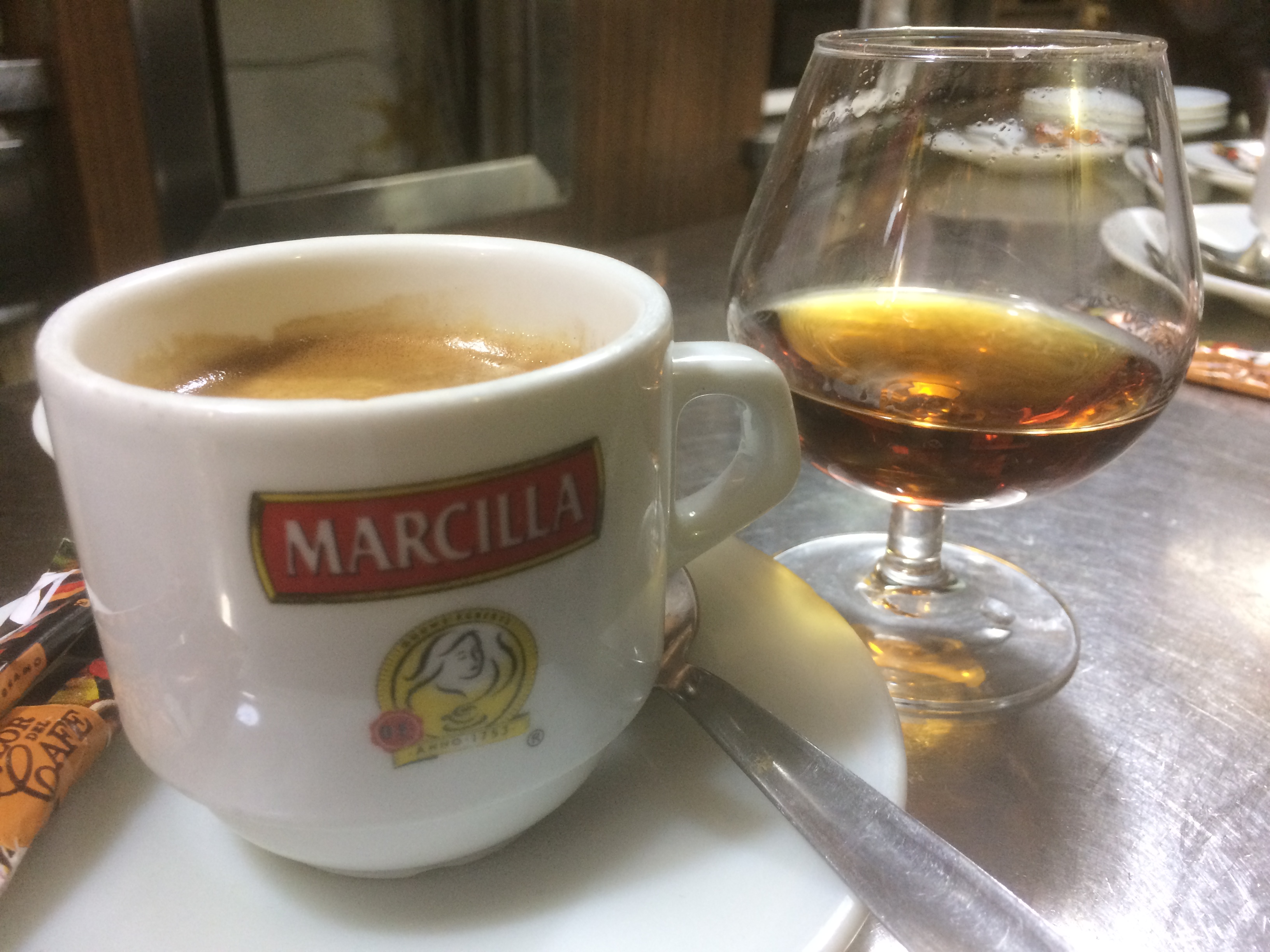
So breakfast eaten, shopping done, we just have time for a walk along Passeig de Gràcia, looking at the upmarket clothes shops and jewellers. The streets aren’t crowded and the shops don’t seem to be that busy. We walked quicker than planned so we had time for a coffee in Luria 2. Unfortunately I don’t know the Spanish for milk, so had to have a brandy instead. ¡Salud!
Adiós Barcelona
All that was left to do was collect our luggage from the hotel and then walk to Plaça Catalunya to catch the A2 Aerobús to the Terminal 2C at El Prat airport.
London – New Year’s Eve
Thursday 31 December, 2015 – London, UK
London
Well, there’s very little to say. The return flight left on time and in the absence of any in-flight entertainment we have to amuse ourselves with the pre-departure safety briefing and then listen to the banter of the off duty cabin crew seated around us who are returning to the UK.
As usual the ever efficient Canon Cars are waiting in the arrivals lounge and in just over 90 minutes of touching down we arrive home in time to say a fond farewell to the old year and welcome in the New Year.
 Hudsons Travel
